A forest can turn fallen leaves into soil, a pond can support fish with tiny aquatic plants, and your lunch can become part of your body and then waste that returns to the environment. That may sound almost magical, but scientists know it is not magic at all. It is a pattern. To understand patterns like these, scientists often use models—tools that help them explain what is happening and predict what may happen next.
A model is a simpler way to show a real object, system, or process. A model can be a drawing, a diagram, a physical object, a chart, or even a set of ideas. Scientists use models because many real things are too big, too small, too fast, too slow, or too complicated to study all at once. In an ecosystem, as [Figure 1] shows, a model can help us focus on the most important parts and connections.
For example, a globe is a model of Earth. A toy car is a model of a real car. A map is a model of a place. In science, a food web drawing is a model of who eats whom. A water cycle diagram is a model of how water moves. A model does not have to be perfect. It only needs to help us understand something important.
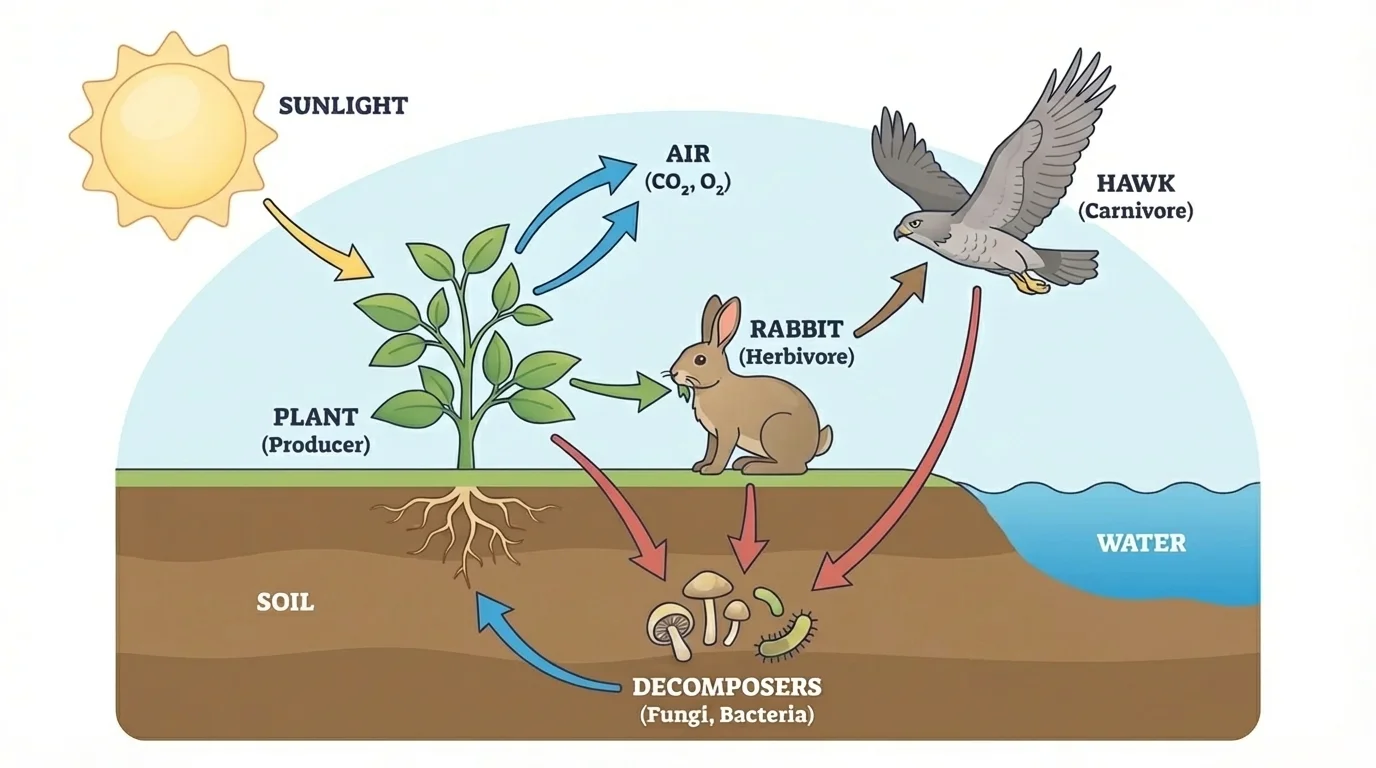
Model is a representation of something real that helps us explain, describe, or predict. Phenomena are events or patterns we can observe, such as leaves decomposing, animals eating plants, or mushrooms growing after rain.
When scientists say they want to describe a phenomenon, they mean they want to explain what is happening. When they want to predict a phenomenon, they mean they want to use evidence and patterns to make a smart guess about what will happen next.
An ecosystem includes living things and nonliving parts of an area that interact. Living things include plants, animals, fungi, and tiny organisms such as bacteria. Nonliving parts include air, water, rocks, and soil. An ecosystem can be as small as a puddle or as large as a rainforest.
Scientists model ecosystems because there are many parts working together at the same time. A model can help us notice patterns that are hard to see in real life. For example, it may be easy to see a rabbit eat grass, but harder to notice where the matter in the rabbit's body came from. A model helps us trace that matter back to the grass, the soil, the water, and the air.
Models also help scientists ask questions such as: What happens if a pond gets less sunlight? What happens if there are fewer worms in the soil? What happens if deer eat too many young plants? A careful model gives clues that help us answer these questions.
Living things need matter to build their bodies. Matter is the "stuff" things are made of. It can change form and move from place to place, but it does not simply vanish.
That idea is important in ecosystems. When a plant grows, it is not creating matter out of nothing. It is taking in matter from the environment, especially water and gases from the air, and using it to build new plant material.
Matter in an ecosystem cycles through the system. It does not just travel one way and disappear. The cycle in [Figure 2] helps us track how matter moves from the environment into living things and then back again. This movement includes plants, animals, decomposers, air, water, and soil.
Plants take in water from the soil through their roots. They also take in carbon dioxide, written as \(\textrm{CO}_2\), from the air. Using energy from sunlight, plants make sugars such as \(\textrm{C}_6\textrm{H}_{12}\textrm{O}_6\). These sugars become part of the plant's body. Leaves, stems, roots, flowers, and fruits are all made from matter the plant took in from the environment.
Animals get matter by eating plants or by eating other animals. If a caterpillar eats a leaf, some of the matter in the leaf becomes part of the caterpillar's body. If a bird eats the caterpillar, some of that matter becomes part of the bird's body. Matter is moving from one organism to another.
Decomposers such as fungi, worms, and bacteria break down dead plants, dead animals, and wastes. This process is called decomposition. It returns matter to the soil and air, where plants can use it again. Without decomposers, dead material would pile up and nutrients would not return to the environment as easily.
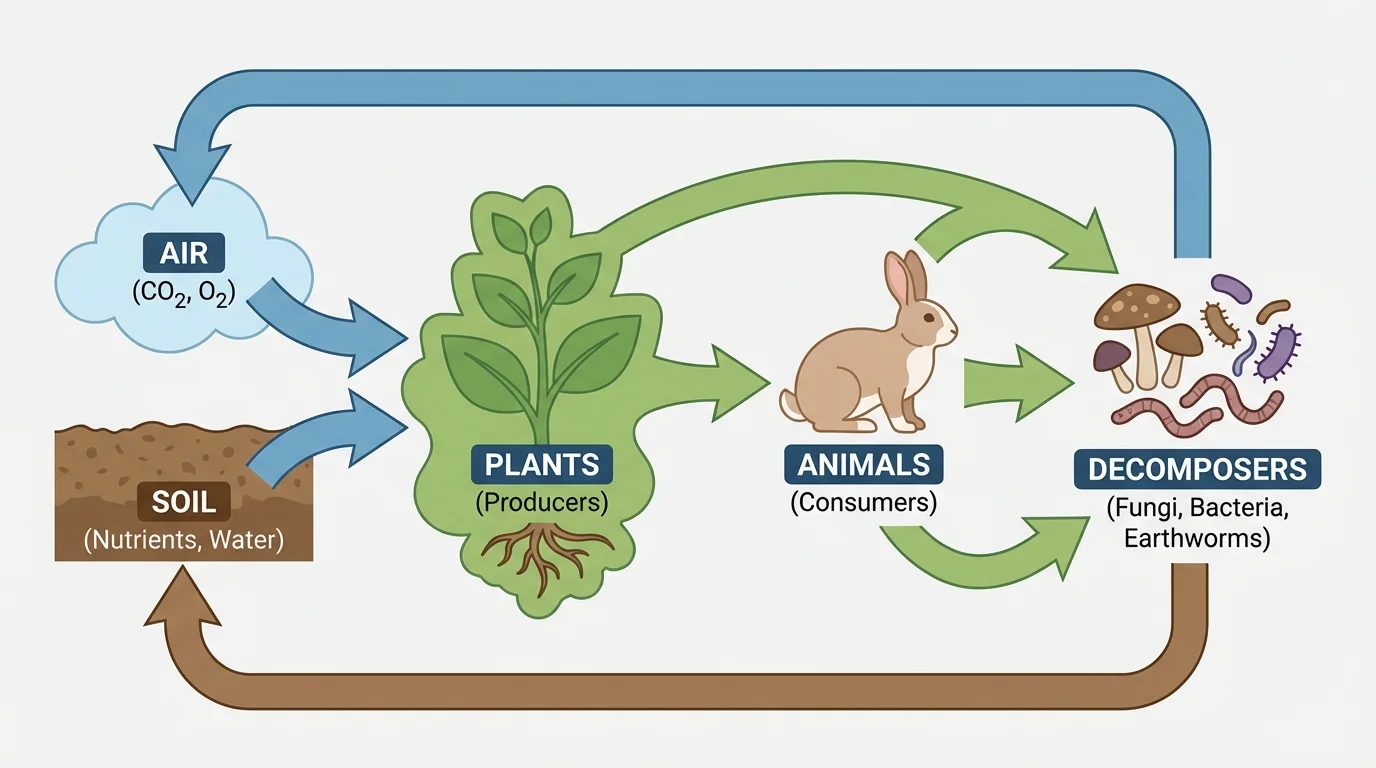
Think about a fallen apple on the ground. At first, it is part of the apple tree. Then it falls. Maybe an insect eats some of it. Later, fungi and bacteria break down the rest. Over time, matter from the apple returns to the soil and air. Then the tree or another plant may use some of that matter again. The matter keeps moving.
Matter cycles, energy flows
In ecosystems, matter is reused again and again, but energy moves differently. Sunlight energy enters the ecosystem, helps plants grow, and then moves through food chains. Matter, however, can return to the soil, water, and air and be used again by living things.
One important reason scientists use models is to separate these two ideas clearly. A model may use arrows for matter movement so students can see that atoms from air, water, food, and waste keep moving through the system.
A good ecosystem model includes the main parts and the connections between them. Often, scientists or students draw boxes or pictures for plants, animals, decomposers, soil, water, and air. Then they use arrows to show where matter moves.
For example, an arrow can go from soil to plant to show that the plant takes in water and minerals from the soil. Another arrow can go from plant to rabbit to show the rabbit eats the plant. Another arrow can go from rabbit to hawk if the hawk eats the rabbit. Then arrows can go from dead plants and animals to decomposers, and from decomposers back to soil and air.
The arrows matter. An arrow is not just decoration. It shows direction. If the arrow points from plant to deer, it means the deer gets matter by eating the plant. If the arrow points from decomposers to soil, it means decomposition returns matter to the soil.
Example: A simple garden model
A student wants to model matter movement in a school garden with bean plants, caterpillars, robins, worms, air, and soil.
Step 1: Identify the parts
The model should include bean plants, caterpillars, robins, worms, air, water, and soil.
Step 2: Add feeding relationships
Draw arrows from bean plants to caterpillars and from caterpillars to robins.
Step 3: Add decomposition
Draw arrows from dead leaves and wastes to worms and other decomposers.
Step 4: Return matter to the environment
Draw arrows from decomposers to soil, and from air and soil back to the bean plants.
This model helps show that matter in the garden keeps moving instead of stopping at one organism.
Sometimes models use words. Sometimes they use pictures. Sometimes they use symbols. The best model is the one that helps explain the important pattern clearly.
A model is not only for describing what is happening now. It can also help us make predictions. In the comparison shown in [Figure 3], we can use the same ecosystem model to think about what changes when one part of the system is missing or reduced.
Suppose a garden has fewer decomposers because the soil becomes too dry. The model helps us predict that dead leaves and wastes may build up. Nutrients may return to the soil more slowly. Plants may then grow less well, and animals that depend on those plants may also be affected.
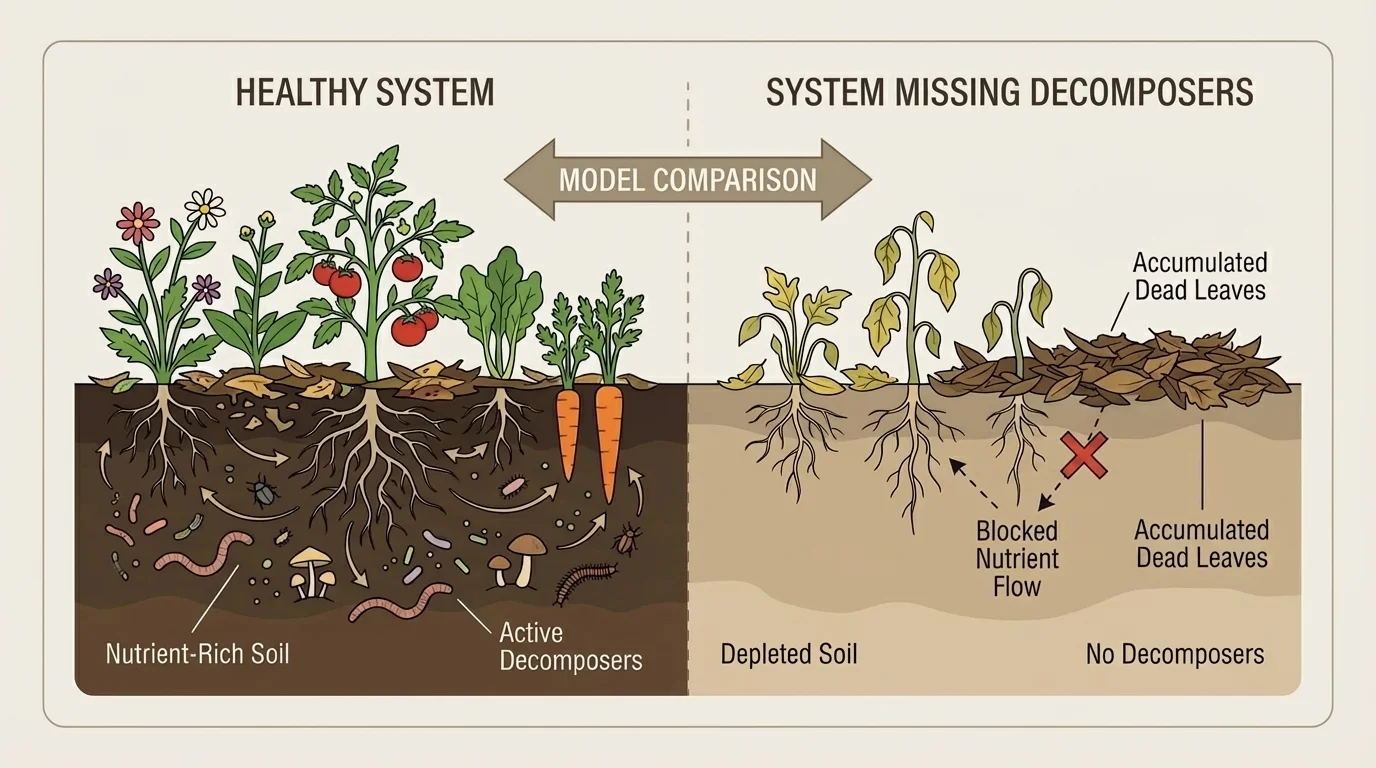
Now suppose there are fewer plants because a disease harms them. The model helps us predict that plant-eating animals may have less food. If those animals decrease, animals that eat them may also have less food. One change can spread through the ecosystem.
Predictions from a model are not wild guesses. They are based on the relationships shown in the model. If the arrows show that many organisms depend on plants, then a drop in plants can affect many other parts of the system.
Some forest soils depend on huge numbers of tiny decomposers that are too small to see without a microscope. Even though they are tiny, they help recycle enormous amounts of matter.
This is why compost piles are so useful in real life. Fruit peels, leaves, and grass clippings may look like garbage at first, but decomposers break them down. Over time, matter from those materials becomes rich soil that helps new plants grow.
Scientists do not all use the same kind of model. As [Figure 4] illustrates, one ecosystem can be shown in several useful ways depending on the question being asked. A drawing may be best for showing who interacts with whom. A physical model may help students see positions and parts. A chart may help compare roles and patterns.
Here are some common kinds of models:
| Type of model | What it looks like | What it helps show |
|---|---|---|
| Diagram | Pictures with arrows and labels | Movement of matter and relationships |
| Physical model | Clay, blocks, or craft materials | Parts of a system and how they connect |
| Chart or table | Organized rows and columns | Comparisons, roles, and patterns |
| Flowchart | Boxes linked by arrows | Steps or cycles in a process |
Table 1. Different types of models and what each one helps scientists and students understand.
A chart can be especially useful for organizing information before building a bigger model.
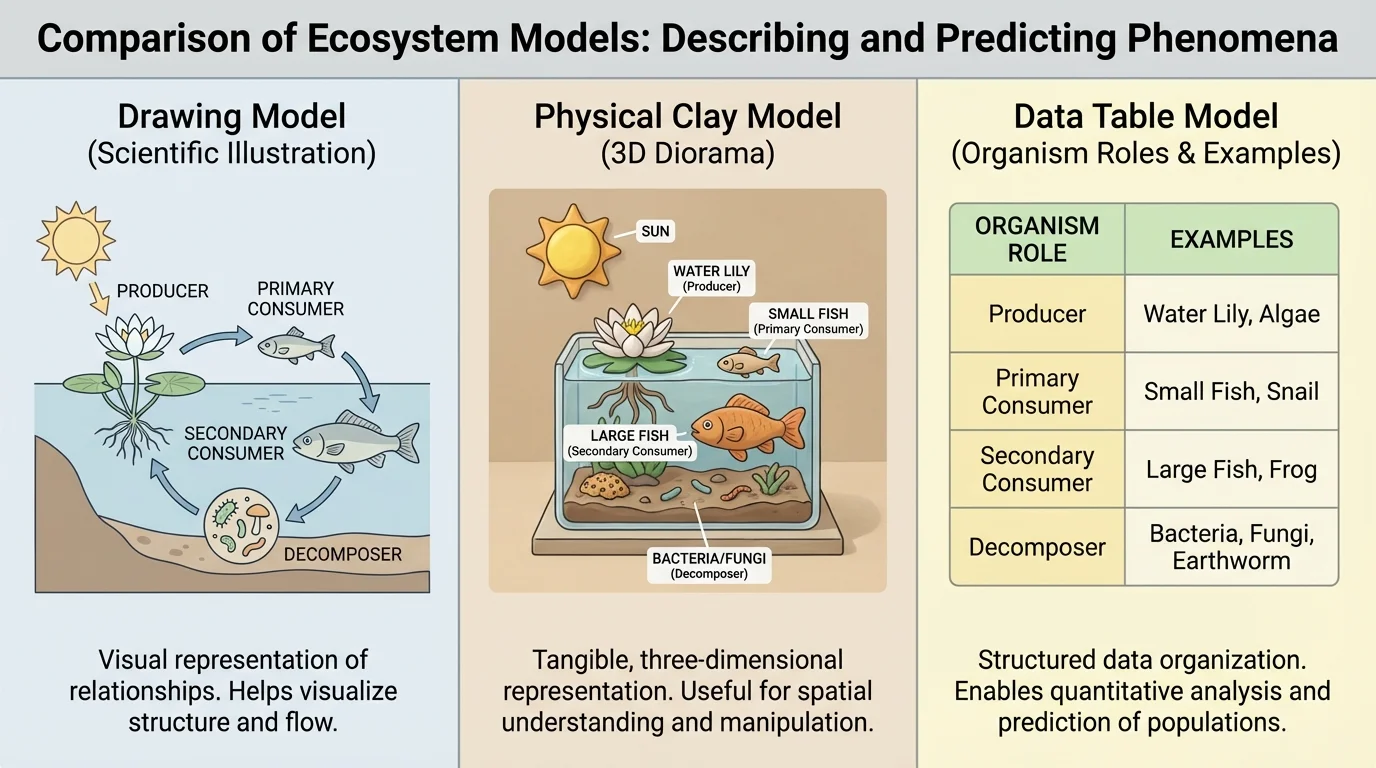
For example, a student might first make a table of organisms in a pond and their roles.
| Organism or part | Role in matter movement |
|---|---|
| Water plant | Takes in matter from water and air, builds plant body |
| Snail | Eats plant material |
| Fish | Eats smaller animals |
| Fungi and bacteria | Break down dead material and waste |
| Water and mud | Store and move matter in the environment |
Table 2. A simple pond ecosystem chart showing how different parts help move matter.
When students compare these model types, they learn that a model is a tool. Different tools help with different jobs.
Farmers, gardeners, forest scientists, and park rangers all use models. A farmer may use a model of soil, plants, insects, and decomposers to understand why crops are healthy or unhealthy. A gardener may use composting knowledge to return plant matter to the soil. A park ranger may use models to predict what happens when one animal population becomes too large or too small.
In a pond, if pollution harms water plants, a model suggests there may be less food and less shelter for small animals. In a forest, if fallen logs are removed too often, there may be fewer places for decomposers to work. In both cases, the model helps explain why a change in one part can affect many others.
Example: Predicting change in a pond
A pond has algae, insect larvae, small fish, larger fish, decomposers, water, and mud.
Step 1: Start with the model
Algae use matter from water and air. Insect larvae eat algae. Small fish eat larvae. Larger fish eat small fish. Decomposers break down wastes and dead organisms.
Step 2: Change one part
Suppose the pond gets muddy and blocks sunlight, so less algae grows.
Step 3: Predict using the model
With less algae, insect larvae may have less food. Then small fish may have less food, and larger fish may also be affected.
The model does not tell the exact number of fish that will remain, but it helps predict the direction of change.
Even at home, you can see these ideas. If you leave fruit scraps in a compost bin, decomposers break them down. If you plant that compost in a garden, plants use matter from the soil, water, and air to grow. The cycle continues.
No model shows everything. A simple ecosystem model may leave out weather, seasons, disease, or tiny organisms. That does not make the model useless. It just means we should remember what the model includes and what it leaves out.
Scientists improve models by adding better observations and evidence. If they learn that a certain fungus is important in helping tree roots, they may add that to the model. If they discover that one animal eats more than one kind of food, they may redraw the arrows.
Looking back at the ecosystem drawing in [Figure 1], we can see how a simple model helps us begin. Looking again at the matter cycle in [Figure 2], we can trace where matter goes. When we compare healthy and changed systems in [Figure 3], we use the model to predict results. And when we compare model types in [Figure 4], we learn that scientists choose models that best fit their questions.
That is one of the most powerful ideas in science: a model is not just a picture. It is a thinking tool. It helps us describe patterns we observe and predict what might happen when conditions change.
