One application can change the price of college by thousands of dollars. For many students, the difference between attending school, delaying enrollment, or taking on heavy debt depends on whether they understand financial aid and apply on time. That means financial aid is more than paperwork. It is part of a bigger life decision about career preparation, continuing education, and future earning power.
Education after high school often leads to more job options and, on average, higher lifetime earnings. That does not mean every student must attend a four-year college. Some students choose community college, trade school, apprenticeships, certificate programs, or military pathways. But nearly all of these options have costs, and many students need help paying them. Learning how to access aid is a practical money skill, just like budgeting or comparing loans.
When people talk about the "cost of college," they often think only about tuition. In reality, education costs can include fees, books, supplies, housing, food, transportation, and personal expenses. If a student can lower those costs with grants or scholarships, they may borrow less. Borrowing less can mean smaller monthly payments later, which leaves more room in an adult budget for rent, transportation, savings, and emergencies.
This connects directly to personal financial literacy. Career preparation and continuing education can raise earning potential, but students also have to think about net cost, the amount left after financial aid is applied. A school with a higher sticker price is not always the most expensive option if it offers strong aid.
Education, cost, and earning potential
Higher education and training can increase access to careers in healthcare, engineering, teaching, skilled trades, information technology, and many other fields. But the financial return depends on both income and cost. A student who receives substantial grant aid may graduate with less debt and greater financial flexibility than a student who pays full price, even if both earn similar salaries.
Because of this, applying for aid is not just something "low-income students" should do. Many colleges use aid applications to determine eligibility for grants, work-study, merit-based institutional aid, and some state programs. Students may miss opportunities if they assume they will not qualify.
Financial aid is financial assistance that helps students pay for education after high school. Some aid is based on financial need, some is based on academic achievement or other factors, and some must be repaid while other types do not.
Grant money usually does not have to be repaid and is often based on financial need.
Scholarship money usually does not have to be repaid and may be awarded for academics, talents, leadership, athletics, identity, community service, or other qualities.
Work-study is a program that allows eligible students to earn money through part-time jobs.
Loan money must be repaid, usually with interest.
A useful way to think about aid is to separate gift aid from borrowed money. Gift aid includes grants and scholarships. Loans can help cover costs, but they create future obligations. If a student borrows $10,000 and later repays more than $10,000 because of interest, that affects future financial choices.
Students should also know that aid can come from different sources: the federal government, state governments, colleges, employers, private organizations, and community groups. Two of the most important applications for Colorado students are the FAFSA and the CASFA.
The Free Application for Federal Student Aid, or FAFSA, is the main application used to determine eligibility for federal financial aid. Many states and colleges also use FAFSA information when awarding their own aid. This means the FAFSA often opens the door to several kinds of support at once.
Students who are eligible for federal student aid generally complete the FAFSA. This can include students planning to attend universities, community colleges, technical schools, and some career training programs. Even students who think their family income is too high should consider applying, because some aid is not limited to the lowest-income households.
Federal aid connected to the FAFSA may include Pell Grants, federal student loans, and federal work-study. Colleges may also use FAFSA information to award campus-based grants or scholarships. In other words, not filing can mean leaving money unclaimed.
Many students are surprised to learn that the word "free" in FAFSA matters. Students should never have to pay a company just to submit the federal application.
The FAFSA also helps schools create a more complete picture of what a student can realistically afford. Schools review the information, combine it with their own policies, and then send an aid offer that may include multiple types of assistance.
The FAFSA follows a clear sequence, as [Figure 1] shows, and understanding that sequence makes the process much less intimidating. Students usually begin by confirming the application opens for the correct academic year and checking the deadlines for their state and colleges.
Before starting, students should gather key documents and information. These may include Social Security numbers, tax records, records of untaxed income, bank balances, and information about assets. In many cases, the student and a parent or spouse may each need their own login credentials, depending on dependency status.
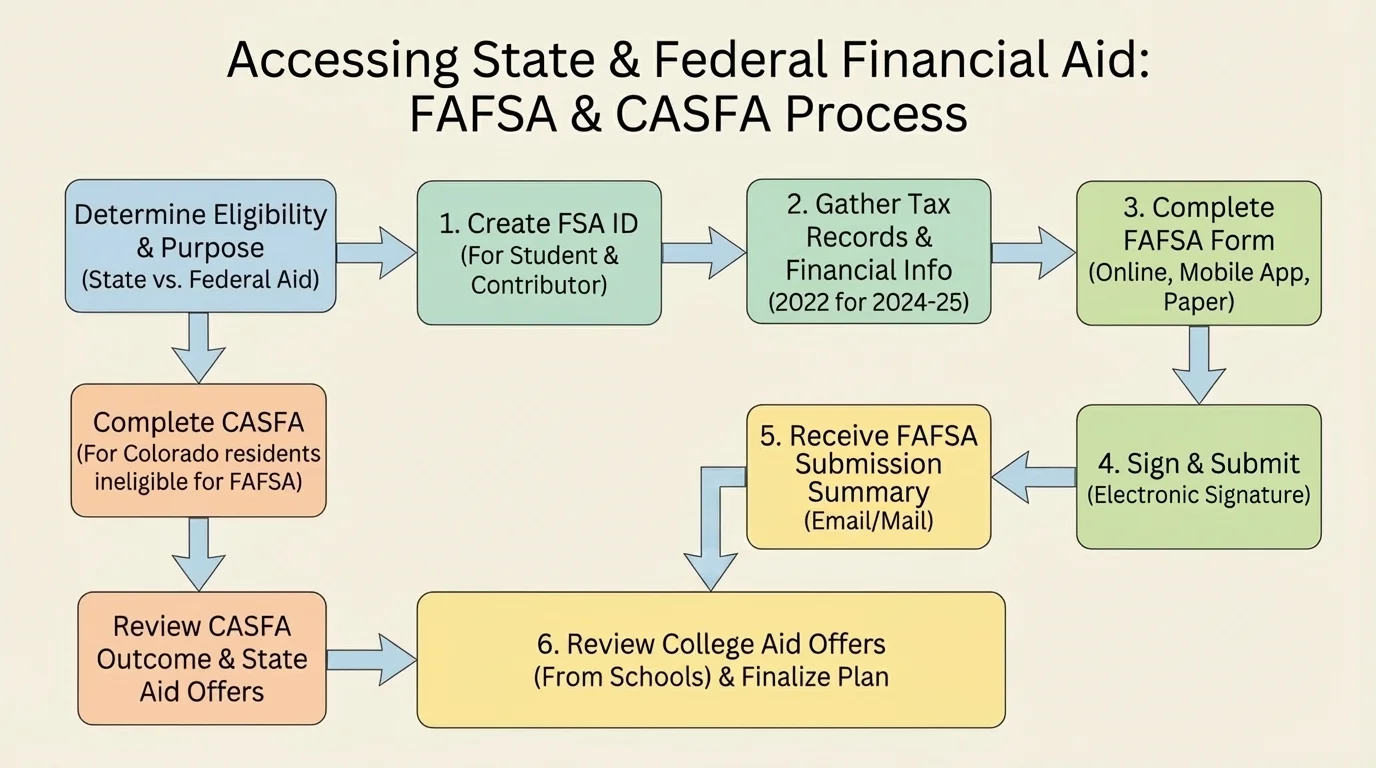
Step 1: Create an FSA ID if required. This is a username and password used to sign and access federal student aid systems. It acts like a secure digital signature.
Step 2: Start the FAFSA for the correct school year. Students must be careful not to choose the wrong year, because aid applications are tied to a specific academic period.
Step 3: Enter personal and family information accurately. This includes demographic information, school selections, and financial details. Accuracy matters because errors can delay processing or change aid eligibility.
Step 4: Sign and submit the application. If parent information is required, that parent must also complete their part. An unsigned FAFSA is not complete.
Step 5: Review the FAFSA Submission Summary. This document confirms what was submitted and may highlight issues that need correction.
Step 6: Watch for follow-up requests from colleges. Some students are selected for verification, a process where the school asks for documents to confirm the information on the application.
FAFSA case study
Elena wants to attend a Colorado community college and later transfer to a four-year university.
Step 1: She creates her FSA ID and reminds her parent to create one too because she is considered a dependent student.
Step 2: She gathers tax information, bank balances, and the list of schools she may attend.
Step 3: She submits the FAFSA before the school priority deadline.
Step 4: She reviews her FAFSA Submission Summary and corrects one small error in her address.
Step 5: Her college later sends an aid offer that includes a grant and work-study, lowering what she would otherwise have to pay out of pocket.
As the process in [Figure 1] makes clear, submitting the FAFSA is not the final step. Reading email, checking student portals, and responding quickly are part of getting aid successfully.
The Colorado Application for State Financial Aid, or CASFA, is designed for students who may not be eligible to complete the FAFSA but may still qualify for certain forms of state or institutional aid in Colorado. This matters because students with different immigration or residency situations still need ways to access support for education.
CASFA is especially important in Colorado because it helps eligible students seek state financial aid and, depending on the institution, other support. It is not a federal aid application, so it does not provide access to federal grants or federal loans. Instead, it connects students to Colorado-specific opportunities and may be used by schools as part of their aid review process.
Eligibility rules can change, and individual circumstances matter. Students should always check current guidance from the Colorado Department of Higher Education and the college they plan to attend.
For some students, the choice between FAFSA and CASFA is straightforward. For others, it depends on aid eligibility rules, citizenship or immigration status, and school requirements. Students should not guess. They should use official guidance to determine which application is correct.
The CASFA process also follows a sequence, and [Figure 2] illustrates how students move from setup to submission to college follow-up. Although it is different from the FAFSA, the same habits help: start early, use accurate information, and meet deadlines.
Students should gather the information required by the CASFA system, which may include personal identification details, family income information, and school choices. The exact documents may differ from the FAFSA requirements, so students should read the application instructions carefully instead of assuming the forms are identical.
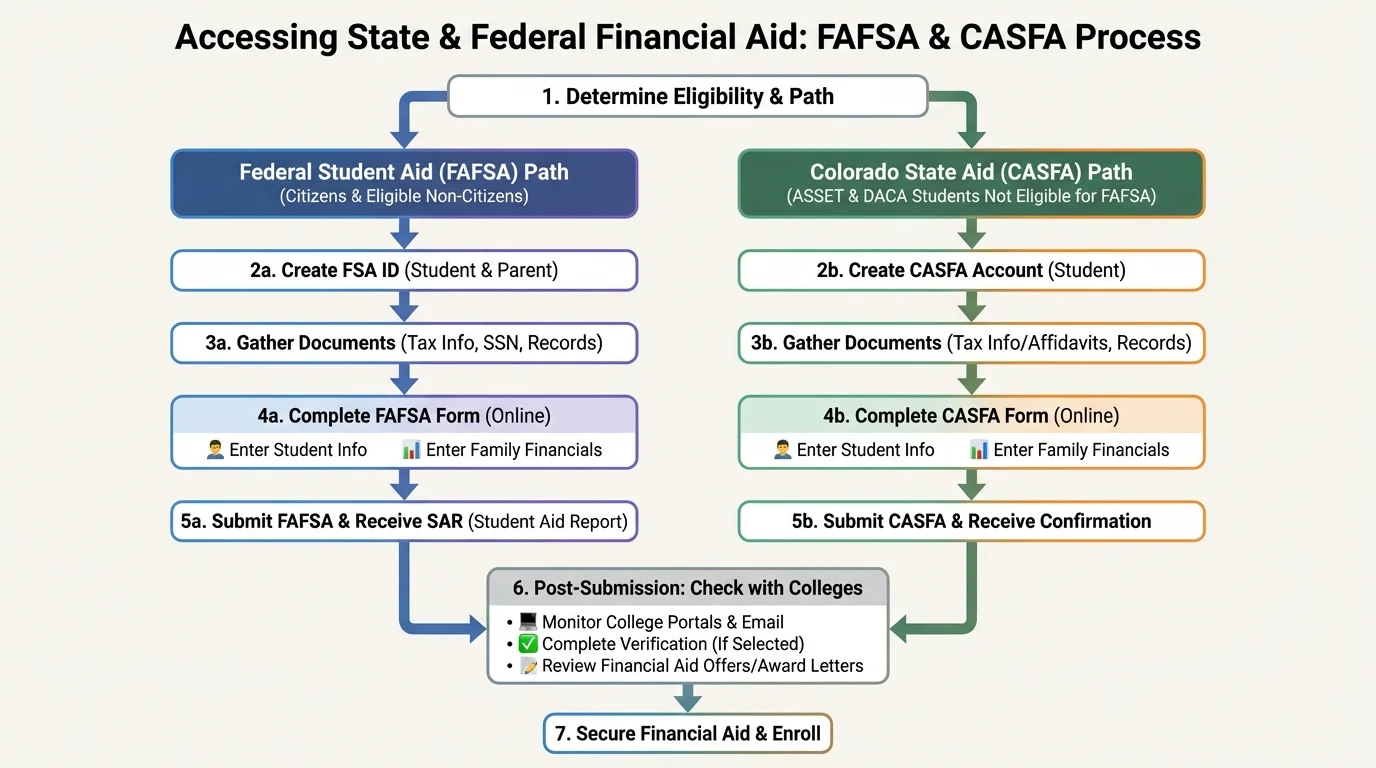
Step 1: Access the CASFA platform for the correct academic year and create any needed login credentials.
Step 2: Enter student and family information carefully. Students should answer honestly and completely.
Step 3: Select the Colorado institutions that should receive the application information.
Step 4: Submit the application before state and college deadlines.
Step 5: Check email and college portals for next steps, document requests, or aid offers.
Just as with the FAFSA, timing matters. A student who is eligible for state support but submits late may lose access to limited funds. Some aid is awarded on a first-come, first-served basis until available money runs out.
CASFA case study
Mateo plans to attend a public university in Colorado and is not eligible for federal aid, so he completes the CASFA.
Step 1: He confirms that CASFA is the correct application for his situation.
Step 2: He gathers family income information and completes the form carefully.
Step 3: He submits early to improve his chances of receiving limited state aid.
Step 4: He watches for messages from the university and provides any extra documents requested.
Step 5: His school uses the information to review him for Colorado aid programs and institutional assistance.
The sequence shown in [Figure 2] highlights an important idea: aid applications are not only about filling in blanks. They are also about follow-through.
Both applications help students seek money for education, but they are not interchangeable. The biggest difference is that FAFSA is the route to federal aid, while CASFA is a Colorado-specific route for students who may not be able to use FAFSA.
| Application | Main Purpose | Who Commonly Uses It | Possible Aid Access |
|---|---|---|---|
| FAFSA | Apply for federal student aid and often state or institutional aid | Students eligible for federal student aid | Federal grants, federal loans, work-study, and often college/state aid |
| CASFA | Apply for Colorado state financial aid and some institutional review | Students in Colorado who are not eligible for FAFSA but may qualify for state aid | Colorado state aid and possibly institutional aid, depending on the school |
Table 1. Comparison of the FAFSA and CASFA by purpose, typical users, and aid access.
Students should never submit both just because they are unsure. The correct choice depends on eligibility rules. Using the wrong application can waste time or create confusion. When in doubt, students should ask a school counselor, college financial aid office, or official state resource.
[Figure 3] Financial aid offices do not just ask, "How much money does this family make?" They look at education costs and financial information together. The overall price a school estimates for one year is often called the cost of attendance.
Cost of attendance can include direct costs paid to the school, such as tuition and fees, and indirect costs such as books, transportation, housing, and food. Even students living at home may have commuting and supply costs.
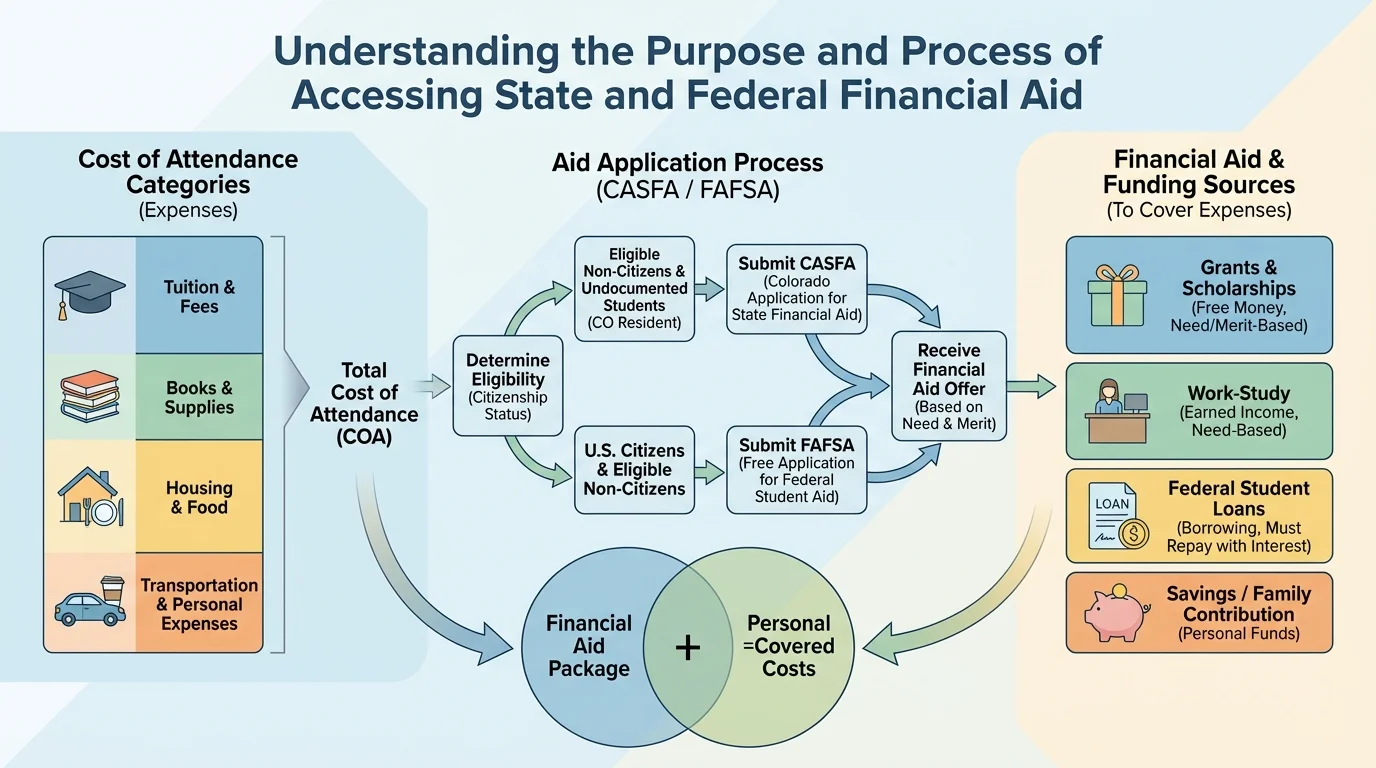
Schools use application data to estimate what level of support a student may need. One federal measure used in the aid process is the Student Aid Index, often shortened to SAI. It helps colleges determine eligibility for certain types of aid, although it is not the same thing as a final bill.
A student should also compare the net cost at different schools. In simple terms, students often think of net cost as:
\[\textrm{Net Cost} = \textrm{Cost of Attendance} - (\textrm{Grants} + \textrm{Scholarships})\]
If one school costs $28,000 and offers $18,000 in grants and scholarships, the approximate net cost is \(28{,}000 - 18{,}000 = 10{,}000\). If another school costs $18,000 and offers $5,000 in grants and scholarships, the approximate net cost is \(18{,}000 - 5{,}000 = 13{,}000\). The lower sticker price school is not automatically the cheaper one after aid.
Comparing two college offers
Nia receives two aid offers and wants to decide which option is more affordable.
Step 1: School A has a cost of attendance of $30,000 and gift aid of $20,000.
The estimated net cost is \(30{,}000 - 20{,}000 = 10{,}000\).
Step 2: School B has a cost of attendance of $22,000 and gift aid of $9,000.
The estimated net cost is \(22{,}000 - 9{,}000 = 13{,}000\).
Step 3: She compares the remaining amounts, loan options, and whether work-study is included.
Even though School A costs more at first glance, School A leaves Nia with a lower estimated net cost.
The cost categories in [Figure 3] also remind students that they need a full budget, not just a tuition plan. A student who ignores transportation or book costs may underestimate what they truly need.
One common mistake is missing deadlines. Some aid deadlines are fixed, and others are "priority" dates. Meeting the priority date is often important because some money is limited. Applying early gives students access to the widest range of options.
Another mistake is guessing. If an application asks for financial information, students and families should use real records, not rough estimates unless the instructions specifically allow them. Incorrect information can cause delays, corrections, or verification requests.
Students should also watch out for scams. Official FAFSA submission is free, and students should be cautious about companies that promise guaranteed aid for a fee. Paying for help is not automatically a scam, but official school and government guidance should always come first.
Verification is normal, not punishment
If a school selects a student for verification, it usually means the school needs documents to confirm parts of the application. This does not automatically mean the student did anything wrong. It does mean the student should respond quickly so aid is not delayed.
Another important strategy is reapplying every year. Financial aid is not a one-time action at the start of high school senior year. Students typically need to complete the FAFSA or CASFA again for each academic year they want aid.
Finally, students should save copies of usernames, confirmation pages, submitted information, and requested documents. Staying organized makes it easier to fix errors, answer questions, and compare offers later.
Financial aid affects choices far beyond freshman year. A student who receives more grant aid may be able to work fewer hours during the semester and spend more time on classes, internships, labs, or clinical training. Those experiences can strengthen future job opportunities.
Another student may compare a public university, a community college transfer path, and a technical program. The best choice depends on career goals, time to completion, total cost, and expected earnings. Financial aid applications help make those comparisons real instead of based on guesses.
For example, a student entering a welding program, a nursing pathway, or a computer science degree may all need different amounts of time and money to finish training. But in each case, understanding FAFSA or CASFA can reduce financial barriers and support a stronger long-term plan. The process maps in [Figure 1] and [Figure 2] show that the path to aid is systematic: prepare, submit, review, and respond.
Accessing aid is really about increasing opportunity. It helps students connect today's paperwork to tomorrow's career options, income, and financial independence. Knowing how to complete the right application, meet deadlines, and compare offers is a life skill that can shape major decisions for years.
