A lake can look calm on the surface while intense ecological interactions are happening underneath. Fish compete for oxygen, algae respond to nutrient levels, bacteria break down dead matter, and tiny changes in temperature or rainfall can shift the entire balance. Scientists often say ecosystems are stable, but they do not mean ecosystems are frozen. They mean that under stable conditions, complex interactions tend to keep the numbers and kinds of organisms within a certain range. To decide whether that explanation is convincing, you need more than facts. You need to evaluate the claim, the evidence behind it, and the reasoning that connects the two.
Science is not a collection of unchangeable statements. An accepted explanation is accepted because it has survived repeated testing, careful observation, and comparison with alternatives. In ecology, that matters because ecosystems are complicated. Many variables operate at once: rainfall, soil nutrients, temperature, predators, disease, migration, and human activity. A strong scientific argument must show not only what happened, but also why the proposed explanation is better than competing explanations.
When biologists say an ecosystem tends to maintain relatively consistent numbers and types of organisms, they are describing a pattern observed in many places over time. Forests, coral reefs, prairies, and wetlands often fluctuate from season to season, yet still retain a recognizable structure. Trees may vary in number, prey populations may rise and fall, and some species may migrate, but the ecosystem does not instantly become something entirely different. Evaluating this explanation means asking whether the available data truly show long-term consistency, what mechanisms produce that consistency, and under what conditions the pattern breaks down.
This kind of evaluation is especially important in public debates. One group might claim that a fishery is healthy because fish were abundant for the last two years. Another group might argue that the fishery is collapsing because average fish size has decreased over the last decade. Both are making arguments. The stronger argument is not the one stated more confidently; it is the one supported by broader, more reliable evidence and clearer reasoning.
Ecosystems include biotic factors, such as organisms and their interactions, and abiotic factors, such as water, temperature, sunlight, and minerals. Changes in either type can affect population size and community structure.
To evaluate ecosystem arguments well, it helps to organize thinking with a simple framework: claim, evidence, and reasoning.
A claim is the statement being argued. In ecology, a claim might be: "Predator-prey interactions help keep populations relatively stable in this forest." Or: "A prolonged drought caused this grassland to shift into a shrub-dominated ecosystem." A claim should be specific enough to test.
Evidence is the information used to support the claim. This may include population counts, satellite images, field observations, water chemistry data, climate records, experiments, or long-term surveys. For example, if researchers count wolves, elk, and willow trees over many years, those data can serve as evidence for a claim about how predators influence ecosystem structure.
Reasoning explains why the evidence supports the claim. This is where scientific principles matter. A student might say: wolf populations increased, elk browsing decreased, and willow recovered; therefore predation changed herbivore behavior and abundance, allowing plant recovery. That is reasoning because it links evidence to ecological mechanisms.
Claim is a statement or conclusion that answers a question. Evidence is the scientific data or observations used to support that statement. Reasoning is the explanation of why the evidence supports the claim, based on scientific ideas.
A weak argument can fail in different ways. The claim may be too broad. The evidence may be limited or unreliable. The reasoning may skip steps, confuse correlation with causation, or ignore other possible explanations. Strong evaluation means checking all three parts.
In a stable ecosystem, populations usually do not stay at one exact number. Instead, they fluctuate around ranges because birth rates, death rates, food supply, and species interactions change over time. These feedbacks often prevent unlimited growth, and the pattern of interacting populations, as shown in [Figure 1], helps explain why ecosystems can remain recognizable even while numbers rise and fall.
Consider a grassland. If rabbit numbers increase sharply, foxes may have more food and their population may rise after a delay. More foxes then increase predation on rabbits, causing rabbit numbers to fall. As rabbit numbers drop, fox numbers may also decline because food becomes less available. The result is not perfect balance but a dynamic pattern of change around a range. Ecologists often relate this to carrying capacity, the largest population size that an environment can support over time.
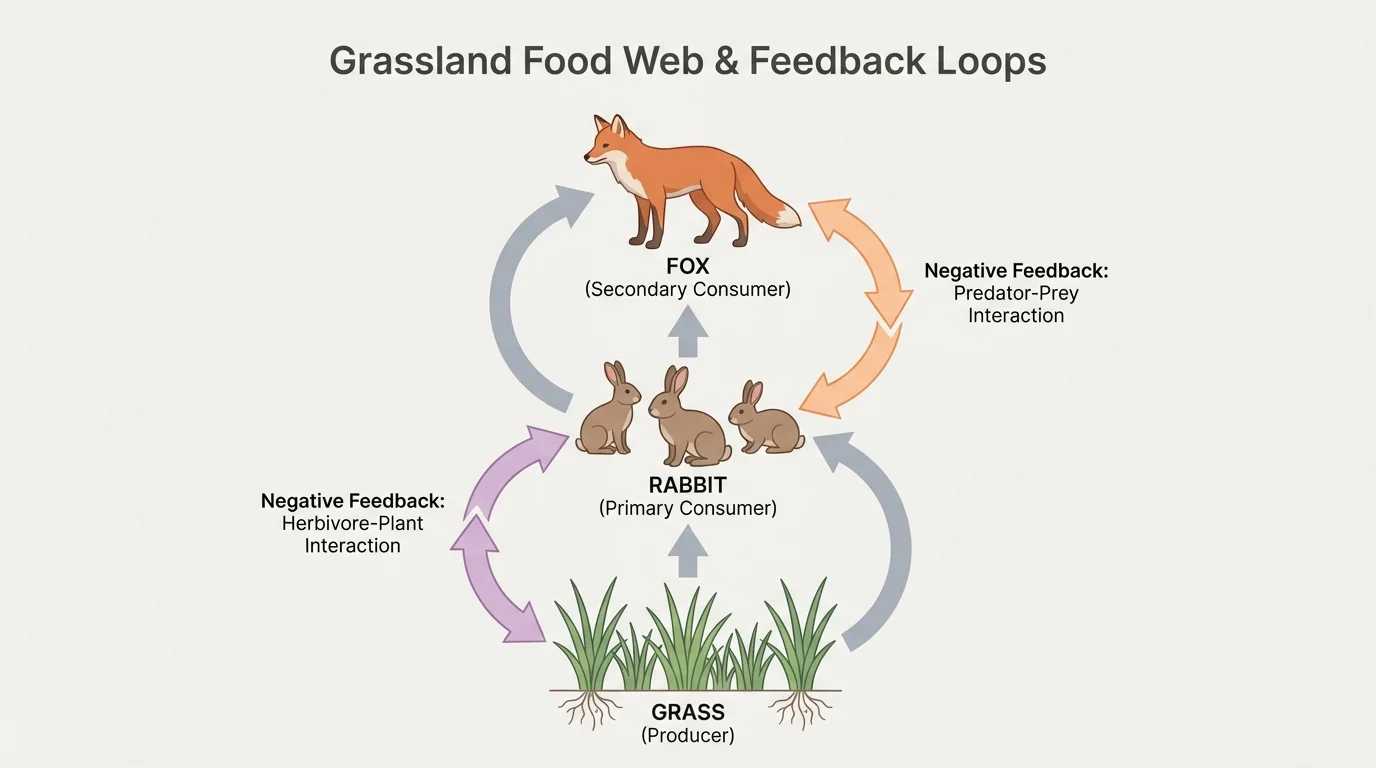
Resources also matter. If rainfall is average, plants may regrow fast enough to support herbivores year after year. If nutrients in the soil remain available and disease stays at typical levels, plant and animal populations can persist with familiar patterns. Stability depends on interactions among many factors, not on the absence of change.
Scientists sometimes model population growth with a logistic pattern. When resources are abundant, a population may grow rapidly. As resources become limited, growth slows. A simple model is
\[\frac{dN}{dt} = rN\left(1 - \frac{N}{K}\right)\]
where \(N\) is population size, \(r\) is growth rate, and \(K\) is carrying capacity. For a numeric example, if \(N = 200\), \(r = 0.4\), and \(K = 500\), then
\[\frac{dN}{dt} = 0.4(200)\left(1 - \frac{200}{500}\right) = 80(0.6) = 48\]
This suggests the population is still increasing, but not as fast as it would if resources were unlimited. The model is simplified, yet it captures an important idea: limits in the environment help prevent endless growth.
The numbers and types of organisms in ecosystems are influenced by many kinds of interactions. Predation can prevent prey populations from growing without limit. Competition can reduce the success of organisms using the same resource. Disease can spread more effectively in dense populations, lowering their size. Mutualistic relationships, such as pollinators and flowering plants, can support reproduction and long-term persistence of multiple species.
These interactions create feedback loops. A feedback loop is a process in which a change produces effects that influence the original change. Negative feedback tends to reduce extremes. For instance, when deer populations become too high, food shortages may increase starvation or lower reproduction. That pushes the population downward. Positive feedback can amplify change. If warming melts ice, darker surfaces absorb more sunlight, causing more warming and more melting. In ecosystems, positive feedback can sometimes contribute to major shifts.
Stability does not mean no change. Ecological stability usually means that an ecosystem resists drastic transformation or returns toward a familiar pattern after moderate disturbance. Daily, seasonal, and yearly variation still occur. What matters is whether the system remains within a range that preserves its basic structure and function.
Keystone species can be especially important. A keystone species has an effect on ecosystem structure that is much larger than expected from its abundance. Sea otters are a classic example. By feeding on sea urchins, otters protect kelp forests. Without otters, urchin populations can explode and consume large areas of kelp. This does not prove that every predator stabilizes every ecosystem, but it shows why accepted explanations often focus on specific interactions rather than one universal rule.
[Figure 2] As seen earlier in [Figure 1], food webs help explain why a change in one population can influence others indirectly. A student evaluating an argument should ask whether the proposed interaction actually fits the ecosystem being studied. An explanation that works in one food web may not work the same way in another.
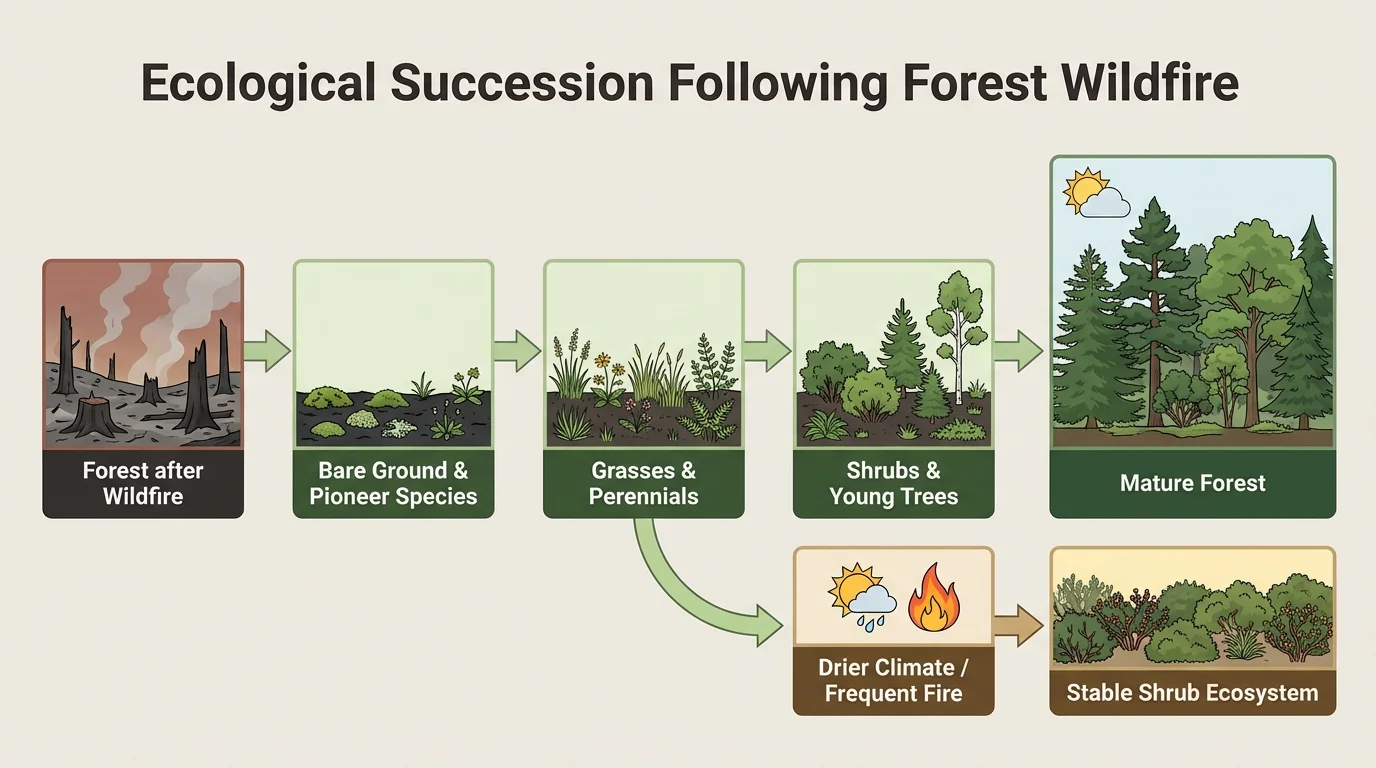
Ecosystems can change gradually or suddenly. Under altered conditions, the interactions that once maintained relative consistency may no longer operate in the same way. A severe disturbance, long-term climate shift, introduction of an invasive species, major nutrient pollution event, or persistent drought can push the system past a threshold. That transition to a different stable pattern is why scientists say changing conditions may result in a new ecosystem rather than a simple return to the old one.
After a wildfire, for example, a forest may recover through succession, the gradual change in community composition over time. If rainfall, soil, and seed sources remain similar, grasses and shrubs may be followed by young trees and eventually a forest resembling the previous one. But if the region becomes much hotter and drier, repeated fires may prevent tree recovery. The area may instead become a shrubland that persists for decades.
Coral reefs provide another example. Healthy reefs depend on a close relationship between coral animals and photosynthetic algae living inside them. When ocean temperatures rise too much, corals can expel the algae, leading to bleaching. If stress is brief, reefs may recover. If high temperatures persist and other stresses such as pollution continue, reefs may lose coral cover and become dominated by algae. The new ecosystem supports different species and functions differently.
Arguments about ecosystem change must therefore address time scale. A short disruption is not automatically evidence of permanent transformation. Likewise, a brief recovery does not prove long-term resilience. Good evaluation asks: is this a temporary fluctuation, a stage in recovery, or evidence of a shift to a new stable state?
Some lakes can shift from clear water with abundant submerged plants to murky water dominated by algae after excess nutrients enter the system. Once that shift happens, simply reducing nutrients a little may not immediately restore the original state because feedbacks now support the new condition.
That last point is important because it shows why accepted explanations often include thresholds and feedbacks, not just one direct cause. A lake overloaded with nitrogen and phosphorus may experience algal blooms. When algae die, decomposers use oxygen while breaking them down. Dissolved oxygen can drop so far that fish die. A simple measure of change in dissolved oxygen is
\[\Delta O = O_f - O_i\]
where \(O_i\) is initial oxygen and \(O_f\) is final oxygen. If \(O_i = 9 \textrm{ mg/L}\) and \(O_f = 3 \textrm{ mg/L}\), then \(\Delta O = 3 - 9 = -6 \textrm{ mg/L}\). That large decrease supports a claim that conditions for many aquatic organisms worsened dramatically.
[Figure 3] Not all evidence is equally strong. Evidence quality depends on how data are collected, over what time span, and whether the methods are appropriate for the question when comparing limited and long-term data sets. A claim about ecosystem stability based on two months of observations is much weaker than a claim based on twenty years of repeated sampling.
Important questions include: How large was the sample? Were the measurements repeated? Were the same methods used each time? Were there control or comparison sites? Could there be bias in where or when observations were made? Did researchers measure directly, or rely on indirect estimates? Ecological systems naturally vary, so replication matters.
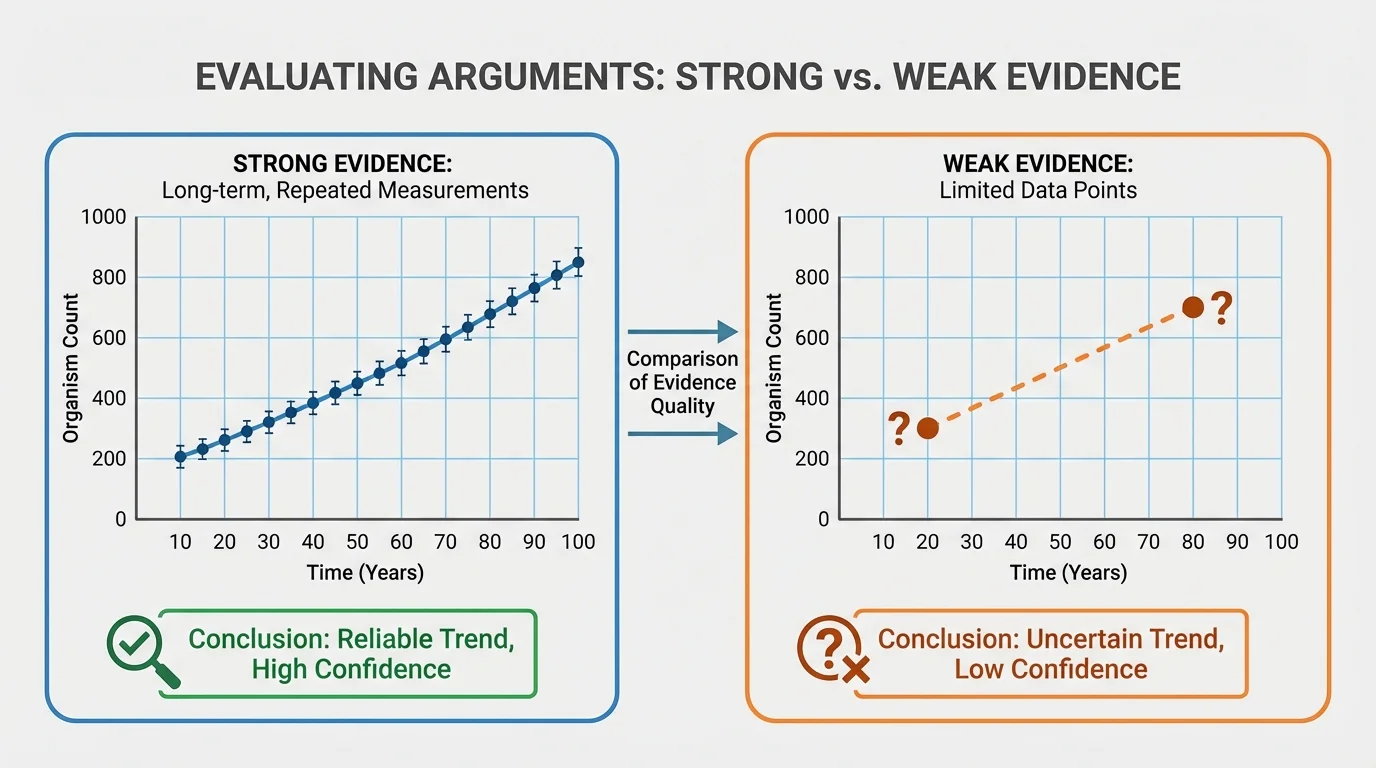
Suppose one group studies insect populations in only one small field during a single summer and concludes that pesticides have no ecosystem effect. Another group samples ten fields over eight years, compares treated and untreated areas, and measures insects, birds, and soil chemistry. The second argument is usually stronger because it uses broader evidence and better controls for random variation.
Students should also watch for correlation being mistaken for causation. If two changes happen at the same time, that does not automatically mean one caused the other. For example, if bird populations decline during a period of warming climate, warming may be involved, but habitat loss, disease, pollution, or food shortages might also contribute. Strong arguments consider alternatives and test them.
| Feature of evidence | Stronger evidence | Weaker evidence |
|---|---|---|
| Time span | Long-term data across seasons or years | Very short-term snapshot |
| Sample size | Many observations or sites | Few observations or one site |
| Methods | Consistent, clearly described methods | Unclear or changing methods |
| Comparison | Includes controls or reference sites | No comparison group |
| Explanations | Considers alternatives | Ignores alternatives |
Table 1. Comparison of common features of stronger and weaker ecological evidence.
Even strong evidence can be used in weak reasoning. To evaluate reasoning, ask whether the conclusion follows logically from the evidence and accepted scientific principles. If an argument says, "Species numbers changed after a storm, so the ecosystem has permanently collapsed," the reasoning may be faulty. A storm can cause a disturbance without eliminating long-term resilience.
Good reasoning names a mechanism. For example: "Drought reduced soil moisture, which lowered plant growth. Herbivores then had less food, reducing survival and reproduction. As a result, herbivore numbers declined." This chain is much stronger than saying, "The drought happened, and then animals disappeared, so drought caused everything." The first explanation connects processes. The second jumps too quickly.
Case study: evaluating an argument about wolves and elk
Claim: Reintroducing wolves helped restore parts of the Yellowstone ecosystem.
Step 1: Identify the evidence.
Researchers recorded wolf numbers, elk behavior and abundance, and changes in vegetation such as willow and aspen over multiple years.
Step 2: Examine the reasoning.
The reasoning is that wolves reduced elk numbers and changed where elk spent time feeding, which allowed young plants in some areas to survive and grow.
Step 3: Check for alternative explanations.
Climate variation, human land use, and other predators may also have influenced vegetation, so a careful argument should discuss those factors rather than credit wolves alone.
Step 4: Judge the merit of the argument.
The argument has merit if it uses long-term, multiple lines of evidence and acknowledges that ecosystem recovery likely had several causes interacting together.
This example shows that evaluating merit is not the same as choosing "true" or "false" instantly. Many ecological arguments are partly supported, but too simple. A strong evaluator can say, "The claim is mostly supported, but the reasoning overstates one factor and underestimates others."
Consider three kinds of claims. First, "A stable forest maintains relatively consistent numbers and types of organisms because of species interactions and resource limits." This claim is often supported by long-term surveys showing recurring population ranges, nutrient cycling, and food web structure. Its merit increases if data cover multiple seasons and if the argument explains mechanisms such as competition, predation, and decomposition.
Second, "Nutrient pollution transformed this lake into a new ecosystem." This claim has merit when evidence includes increasing nitrogen or phosphorus levels, repeated algal blooms, oxygen decline, fish death, and failure to return quickly to the prior clear-water condition. The reasoning is stronger if it includes feedbacks, such as murky water blocking plant growth and reducing stabilization of sediments.
Third, "An invasive species caused ecosystem change." Such a claim requires care. If an invasive mussel appears in a river and native species decline, the invasive species may be a major factor. But the argument improves if researchers also test water quality, temperature, and habitat disturbance. Ecosystems rarely respond to only one influence.
When comparing these cases, remember [Figure 3]: the number of data points and the duration of observation strongly affect how much confidence we should place in a conclusion. Ecological explanations gain power when they are supported by converging evidence from counts, experiments, remote sensing, and chemical measurements.
These skills matter far beyond biology class. Governments decide fishing limits based on arguments about how many individuals can be harvested without collapsing the population. Land managers decide whether prescribed fire will maintain grassland biodiversity or risk driving the system toward a different state. Coastal planners evaluate claims about mangrove restoration, storm protection, and carbon storage. Conservation groups must justify why protecting one species may help preserve an entire food web.
Medical and agricultural issues connect to ecology too. Mosquito populations respond to rainfall, standing water, predators, and temperature. Evaluating claims about disease risk means examining ecosystem evidence, not just counting mosquitoes once. Crop yields also depend on pollinators, soil organisms, and water availability. An argument that ignores ecological interactions may lead to poor decisions.
"The environment is not a backdrop for life; it is a network of relationships that life continuously shapes and depends on."
Scientific evaluation is therefore a practical tool. It helps communities distinguish between evidence-based environmental policy and claims that sound convincing but rest on weak support.
One common mistake is cherry-picking, selecting only the evidence that supports a preferred conclusion. Another is assuming that because an explanation is widely accepted, it no longer needs examination. Accepted explanations in science are powerful precisely because they continue to be tested. A third mistake is using a single dramatic event as proof of long-term change without enough evidence.
Another error is oversimplification. Ecosystems are not machines with only one moving part. If a population changes, multiple causes may interact. Temperature, food, predation, habitat, disease, and human impacts may all matter. Strong reasoning does not ignore complexity; it organizes it with evidence.
Finally, avoid confusing relative consistency with perfection. Stable ecosystems can still show seasonal dieback, migration, storms, outbreaks, and recovery. And when conditions change enough, the old equilibrium may not return. The best arguments recognize both truths: ecosystems can be resilient, and they can also be transformed.
