A surprising thing about algebra is that it often solves everyday questions faster than guessing ever could. Whether you are finding the width of a rectangle, the cost of one ticket, or the amount in each container, the hard part is usually not the arithmetic. The hard part is turning words into a mathematical statement. Once that happens, the path becomes clear.
In many grade 7 problems, the equation you need has one of two common forms:
\(px + q = r\)
or
\[p(x + q) = r\]
Here, \(x\) is the unknown quantity, and \(p\), \(q\), and \(r\) are specific rational numbers. A rational number is any number that can be written as a fraction, including integers, fractions, and terminating or repeating decimals.
These equations appear in real situations because many quantities are built from steps. You might multiply first and then add, or add first and then multiply. Understanding that sequence is the key to solving the problem correctly.
When you solve a word problem, begin by deciding what the unknown represents. A variable is a letter used to stand for a number you do not yet know. Then identify what operations connect that unknown to the known total.
Equation means a statement that two expressions are equal. In word problems, an equation models the relationship between the quantities in the situation.
Coefficient means the number multiplied by a variable, such as the \(p\) in \(px\).
Inverse operations are operations that undo each other, such as adding and subtracting, or multiplying and dividing.
A useful habit is to ask, "What happened to the unknown?" If the unknown was multiplied by a number and then another number was added, the equation will likely look like \(px + q = r\). If the unknown had a number added to it first, and then the whole quantity was multiplied, the equation will likely look like \(p(x + q) = r\).
For example, if three identical notebooks cost $16 after a $2 coupon is applied, the equation is \(3x - 2 = 16\). An equivalent equation is \(3x = 18\), but that comes from solving the original equation, not from a different wording of the same situation. The words matter, so read carefully.
Remember the order of operations: parentheses first, then multiplication and division, then addition and subtraction. Solving equations uses inverse operations in the reverse order of how the expression was built.
If an expression is built as "multiply by \(p\), then add \(q\)," you solve by subtracting \(q\) first and then dividing by \(p\). If an expression is built as "add \(q\) inside parentheses, then multiply by \(p\)," you divide by \(p\) first and then subtract \(q\).
These two forms may look similar, but they are not solved in the same order. The comparison in [Figure 1] shows why the sequence of inverse operations depends on the structure of the equation, especially whether the addition happens inside parentheses or outside after multiplication.
For \(px + q = r\), the operations applied to \(x\) are: first multiply by \(p\), then add \(q\). To undo that, subtract \(q\) from both sides, then divide both sides by \(p\).
For \(p(x + q) = r\), the operations applied to \(x\) are: first add \(q\), then multiply by \(p\). To undo that, divide both sides by \(p\), then subtract \(q\).
In general:
\[px + q = r \quad \Rightarrow \quad px = r - q \quad \Rightarrow \quad x = \frac{r-q}{p}\]
and
\[p(x + q) = r \quad \Rightarrow \quad x + q = \frac{r}{p} \quad \Rightarrow \quad x = \frac{r}{p} - q\]
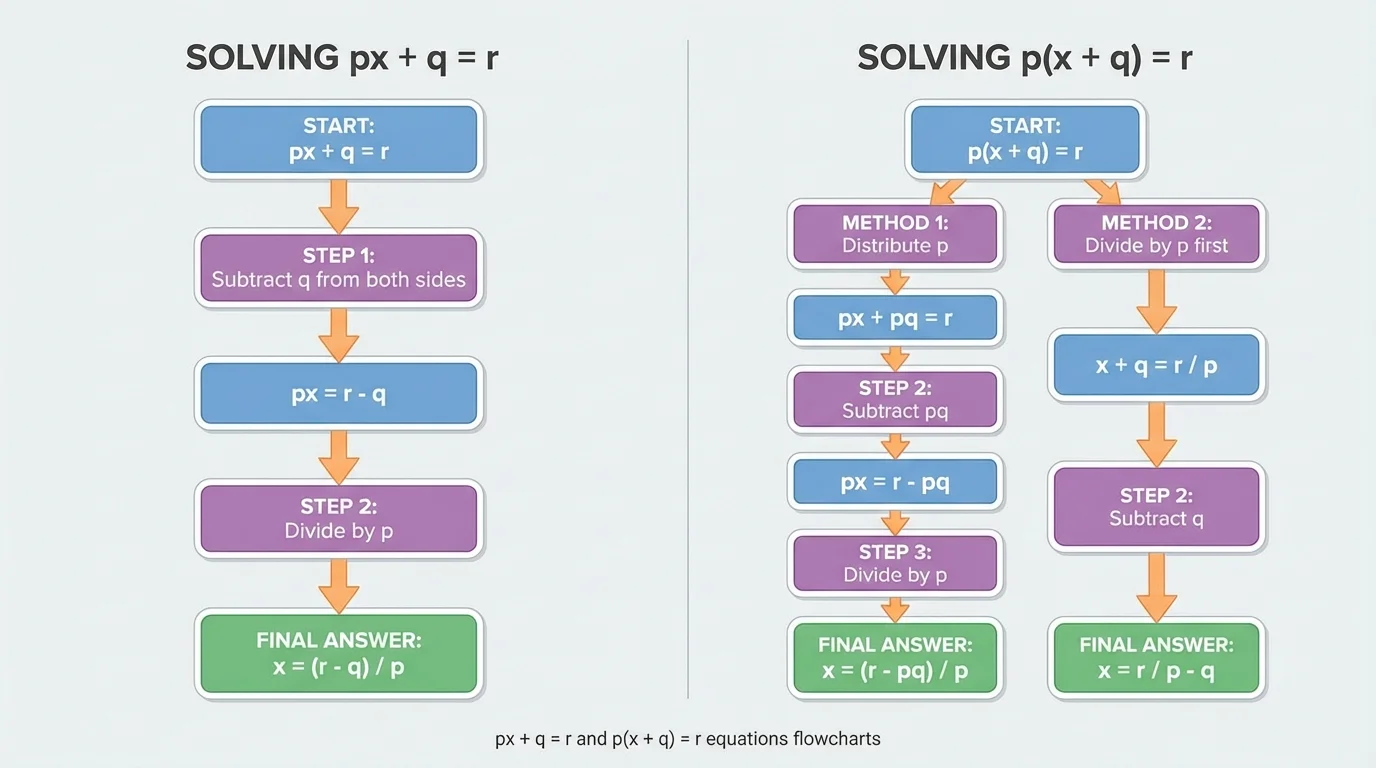
Notice that the parentheses change everything. In \(px + q = r\), the multiplication affects only \(x\). In \(p(x + q) = r\), the multiplication affects the entire quantity \(x + q\).
This is why careful reading matters in word problems. "Three times a number plus \(5\)" means \(3x + 5\). But "three times the sum of a number and \(5\)" means \(3(x + 5)\). Those are different expressions and usually have different answers.
Geometry gives a great example of equation solving. In a rectangle, the perimeter is the sum of all four sides, and [Figure 2] shows that the two lengths match each other and the two widths match each other. That structure helps us write an equation instead of guessing.
Suppose the perimeter of a rectangle is \(54 \textrm{ cm}\), and its length is \(6 \textrm{ cm}\). What is its width?
Worked example 1
Find the width of a rectangle with perimeter \(54 \textrm{ cm}\) and length \(6 \textrm{ cm}\).
Step 1: Choose a variable.
Let \(w\) represent the width in centimeters.
Step 2: Write the perimeter equation.
A rectangle has two lengths and two widths, so \(2l + 2w = P\).
Substitute \(l = 6\) and \(P = 54\): \(2(6) + 2w = 54\).
Step 3: Simplify and solve.
\(12 + 2w = 54\)
Subtract \(12\) from both sides: \(2w = 42\).
Divide both sides by \(2\): \(w = 21\).
Step 4: State the answer with units.
The width is \(21 \textrm{ cm}\).
Final answer: \[w = 21 \textrm{ cm}\]
The equation \(12 + 2w = 54\) is of the form \(px + q = r\), with \(p = 2\), \(x = w\), \(q = 12\), and \(r = 54\).
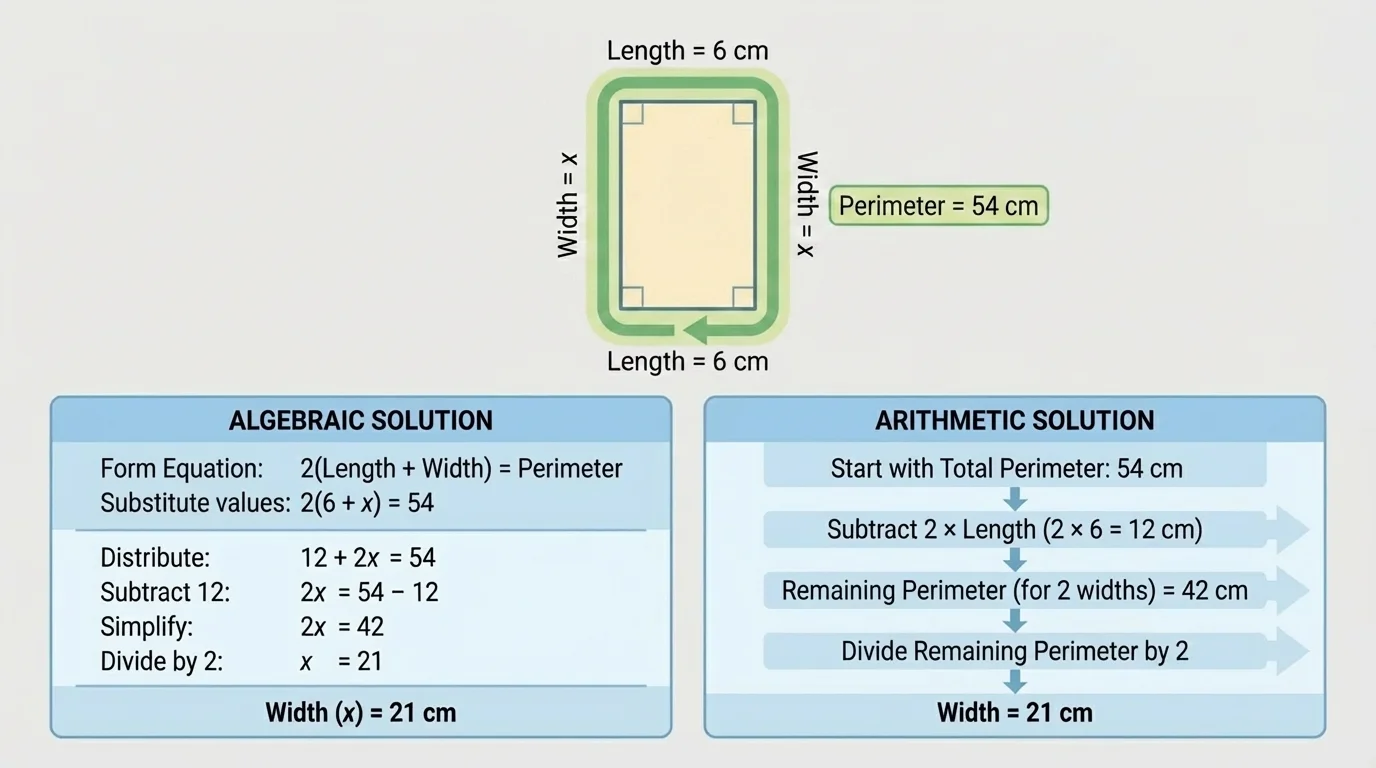
This problem can also be solved arithmetically without writing a variable at first. Since the total perimeter is \(54\), the two lengths together use \(2 \times 6 = 12\) centimeters. That leaves \(54 - 12 = 42\) centimeters for the two widths. Then each width is \(42 \div 2 = 21\) centimeters.
The arithmetic method works by following the structure of the rectangle directly. The algebraic method works by expressing that same structure in an equation. Later, when problems become more complicated, algebra is usually more reliable, but both methods should agree. We will compare these methods more carefully in a later section, and [Figure 2] stays useful because it makes the perimeter structure visible.
Not every word problem uses whole numbers. Rational numbers such as fractions and decimals often appear in measurement, shopping, and science. The solving process is the same: write the equation, undo the operations in reverse order, and check the result.
Suppose a ride-share company charges a base fee of $2.50 plus $1.75 per mile. If the total fare is $11.25, how many miles were traveled?
Worked example 2
A fare is $11.25, with base fee $2.50 and cost $1.75 per mile. Find the number of miles.
Step 1: Define the variable.
Let \(m\) be the number of miles.
Step 2: Write the equation.
The total cost is the base fee plus the per-mile charge: \(1.75m + 2.50 = 11.25\).
Step 3: Undo addition first.
Subtract \(2.50\) from both sides: \(1.75m = 8.75\).
Step 4: Undo multiplication.
Divide both sides by \(1.75\): \(m = 5\).
Final answer: \(m = 5\)
This equation is also in the form \(px + q = r\). Here, \(p = 1.75\), \(q = 2.50\), and \(r = 11.25\).
Fractions work in exactly the same way. Suppose one-third of a number plus \(\dfrac{5}{2}\) equals \(\dfrac{17}{6}\). Then the equation is \(\dfrac{1}{3}x + \dfrac{5}{2} = \dfrac{17}{6}\). Subtract \(\dfrac{5}{2}\) first, then divide by \(\dfrac{1}{3}\).
Worked example 3
Solve \(\dfrac{1}{3}x + \dfrac{5}{2} = \dfrac{17}{6}\).
Step 1: Subtract \(\dfrac{5}{2}\) from both sides.
\(\dfrac{1}{3}x = \dfrac{17}{6} - \dfrac{5}{2}\)
Use a common denominator of \(6\): \(\dfrac{5}{2} = \dfrac{15}{6}\).
So \(\dfrac{1}{3}x = \dfrac{17}{6} - \dfrac{15}{6} = \dfrac{2}{6} = \dfrac{1}{3}\).
Step 2: Divide by \(\dfrac{1}{3}\).
\(x = \dfrac{1}{3} \div \dfrac{1}{3} = 1\).
Final answer: \(x = 1\)
When solving fractional equations, stay organized. Work one inverse operation at a time, and simplify carefully after each step.
Now consider the second common form, \(p(x + q) = r\). These problems often describe equal groups where each group includes an unknown amount plus a known amount. The parentheses tell you the addition happens before the multiplication.
Suppose \(4\) identical boxes each contain \(x\) pencils and \(3\) bonus pencils. Altogether there are \(36\) pencils. How many pencils are in each box before the bonus pencils are added?
Worked example 4
There are \(4\) boxes, each with \(x + 3\) pencils, for a total of \(36\).
Step 1: Write the equation.
\(4(x + 3) = 36\)
Step 2: Undo multiplication first.
Divide both sides by \(4\): \(x + 3 = 9\).
Step 3: Undo addition.
Subtract \(3\): \(x = 6\).
Final answer: \(x = 6\)
Notice the order. Because the entire quantity \(x + 3\) is multiplied by \(4\), you divide first. If you subtracted \(3\) before dividing, you would not be undoing the operations in the correct order.
The flow of steps matches the structure shown earlier in [Figure 1]. Parentheses act like a package, so you must remove the outside multiplication before changing the inside expression.
Here is another example with rational numbers: three jars each contain \(x + \dfrac{1}{2}\) liters of juice, and the total is \(9\) liters. The equation is \(3(x + \dfrac{1}{2}) = 9\). Divide by \(3\) to get \(x + \dfrac{1}{2} = 3\), then subtract \(\dfrac{1}{2}\) to get \(x = \dfrac{5}{2}\).
Many students think parentheses always make a problem harder. In fact, parentheses often make the structure clearer because they show exactly which quantities belong together as one group.
Sometimes you may be tempted to distribute first: \(4(x + 3) = 36\) becomes \(4x + 12 = 36\). That is correct, and then you can solve by subtracting \(12\) and dividing by \(4\). Both methods give the same answer. However, dividing first is often faster when the equation is already in the form \(p(x + q) = r\).
Solving is not the end. You should always check your answer in the original equation or in the original situation. A solution is a value that makes the equation true.
Why checking matters
Word problems involve real quantities such as length, time, weight, and cost. A number might satisfy your calculations only if you made an earlier mistake, or it might be unreasonable in the situation. Checking by substitution helps catch errors and confirms that the answer makes sense.
For the rectangle problem, if \(w = 21\), then the perimeter is \(2(6) + 2(21) = 12 + 42 = 54\). The value works.
For the fare problem, if \(m = 5\), then \(1.75(5) + 2.50 = 8.75 + 2.50 = 11.25\). The value works.
For the boxed pencils problem, if \(x = 6\), then \(4(6 + 3) = 4 \times 9 = 36\). The value works.
Also think about whether the answer is reasonable. A width of \(21 \textrm{ cm}\) is possible for a rectangle with length \(6 \textrm{ cm}\) and perimeter \(54 \textrm{ cm}\). But a negative width would not make sense in that context, even if it appeared from an error in calculation.
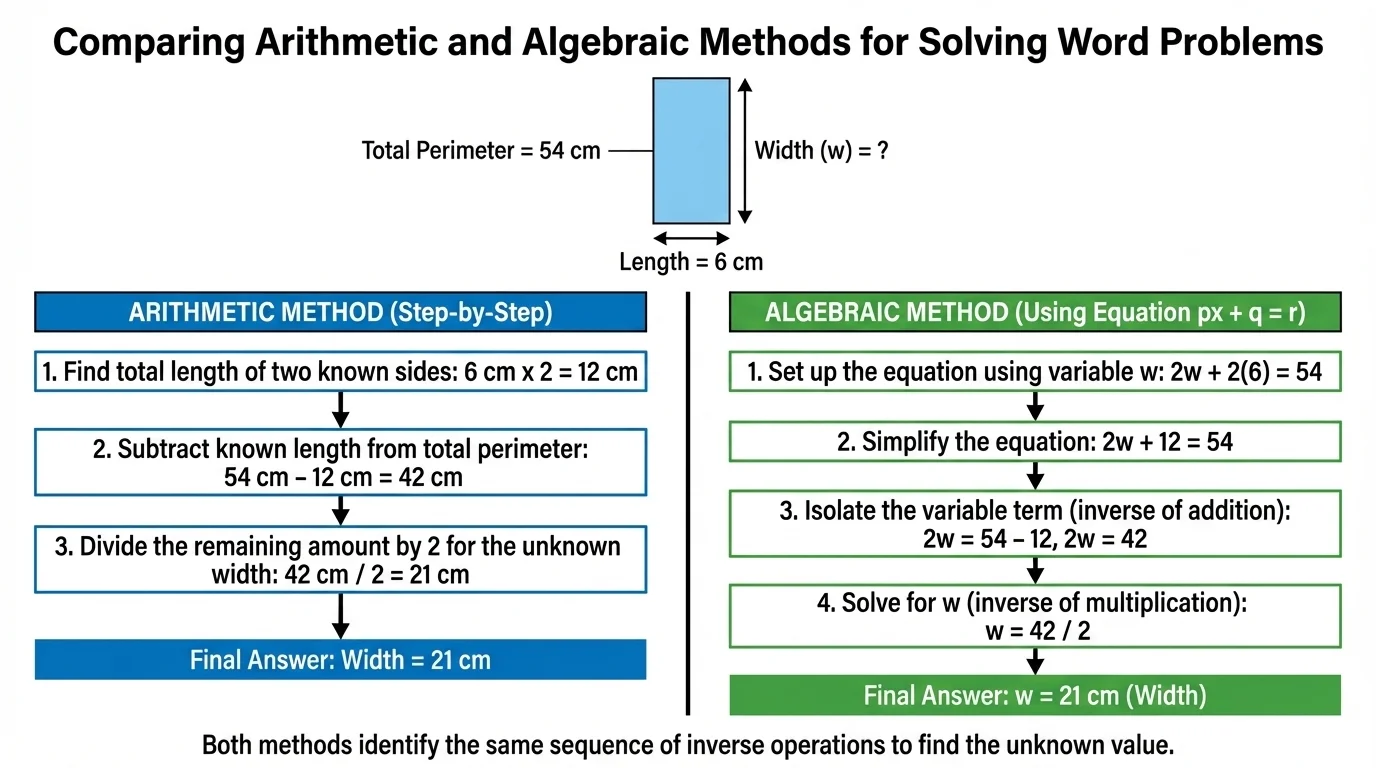
Sometimes a problem can be solved either by writing an equation or by reasoning directly with numbers. Both approaches use the same relationships, but they organize the thinking differently.
[Figure 3] An algebraic solution uses a variable and an equation. An arithmetic solution uses numerical reasoning without formally writing the variable equation first.
For the rectangle problem:
| Method | Sequence of thinking |
|---|---|
| Algebraic | Let width be \(w\). Write \(2(6) + 2w = 54\). Simplify to \(12 + 2w = 54\). Subtract \(12\). Divide by \(2\). |
| Arithmetic | Two lengths total \(12\). Subtract from perimeter: \(54 - 12 = 42\). Split the remaining amount equally between two widths: \(42 \div 2 = 21\). |
Both methods undo the same structure. The algebraic method records the relationship in a general way, which is especially useful when the numbers are not as friendly or when the problem is more complicated. The arithmetic method can feel faster in simple cases because you reason straight from the situation.
Here is another comparison. Suppose \(3x + 4 = 19\).
Algebraic solution: subtract \(4\) to get \(3x = 15\), then divide by \(3\) to get \(x = 5\).
Arithmetic solution: if \(4\) was added to the total \(19\), remove it first to get \(15\). Then split \(15\) into \(3\) equal parts, so each part is \(5\).
The sequence of operations matters in both approaches. In the original expression \(3x + 4\), multiplication happens before addition. To reverse that, you subtract before dividing. Likewise, for \(3(x + 4) = 21\), the original operations are add \(4\), then multiply by \(3\). So to reverse them, divide first and then subtract. This is the same idea shown earlier in [Figure 3], where each method follows the structure of the expression rather than random steps.
"Good algebra is organized thinking."
— A useful classroom principle
When you compare arithmetic and algebraic solutions, ask yourself two questions: What happened to the unknown? And in what order did it happen? Those two questions reveal the correct inverse operations.
One common mistake is solving \(p(x + q) = r\) as if it were \(px + q = r\). For example, from \(4(x + 3) = 36\), subtracting \(3\) first is incorrect because the \(3\) is inside the grouped expression.
Another mistake is forgetting what the variable means. If \(x\) stands for the width, your final answer must describe the width, not some other quantity.
Students also sometimes make sign errors. In \(2w + 12 = 54\), subtract \(12\) from both sides to get \(2w = 42\), not \(2w = 66\).
With fractions and decimals, line up your work carefully. For fractions, use common denominators when subtracting or adding. For decimals, keep place value organized.
Quick error check example
Solve \(2(x + \dfrac{1}{4}) = \dfrac{5}{2}\).
Correct step 1: Divide by \(2\).
\(x + \dfrac{1}{4} = \dfrac{5}{4}\)
Correct step 2: Subtract \(\dfrac{1}{4}\).
\(x = \dfrac{5}{4} - \dfrac{1}{4} = 1\)
Because the addition is inside parentheses, dividing first is the correct inverse step.
Building the habit of checking will catch most of these mistakes quickly.
These equations appear everywhere. In shopping, a total bill may be a fixed fee plus a cost per item, which leads to equations like \(px + q = r\). In packaging, a company may prepare equal groups of items with an extra amount in each group, which leads to equations like \(p(x + q) = r\).
In geometry, perimeter and area relationships often create equations with unknown lengths. The rectangle example from [Figure 2] is a good model of how a picture, a formula, and a word description can all represent the same relationship.
In science and engineering, measurements are often adjusted by a fixed amount or repeated across equal groups. Even though the contexts become more advanced, the idea stays the same: represent the unknown with a variable, write an equation that matches the structure, solve using inverse operations, and check the result.
That is why fluency matters. Being fluent does not mean rushing. It means recognizing the form of the equation, choosing the right sequence of steps, and solving accurately and confidently.
