Have you ever wondered why one toy car rolls farther than another, or why one plant grows better by a window? Scientists wonder about things too. Then they make a plan, test their ideas, and look closely at what happens. You can do that same kind of science when you work with your teacher and classmates.
An investigation is a careful way to find out about something. We do not just guess. We ask a question, make a plan, try it out, and look at what happens.
Investigation means trying to find something out by asking a question, observing, and testing. Observe means to look carefully, listen carefully, and notice details.
Sometimes an investigation is about plants, water, shadows, magnets, sound, or moving objects. A good investigation helps us learn from real things we can see, hear, touch, or measure.
Every investigation begins with a question. A science question should be something we can test. For example, "Which paper towel soaks up more water?" is a testable question. "Are rainbows pretty?" is not a science test question because people may have different opinions.
Your teacher helps you turn big wondering ideas into small testable questions. A simple question for young students may be, "Do plants in the sun grow taller than plants in the shade?" Another may be, "Which ball rolls farther on the floor?"
When you compare things, you are looking for what is the same and what is different. That helps you notice patterns.
It is important to change just one main thing at a time when possible. If you test balls, you may change the kind of ball but use the same ramp. If you test plants, you may change where the plant sits but give each plant the same water.
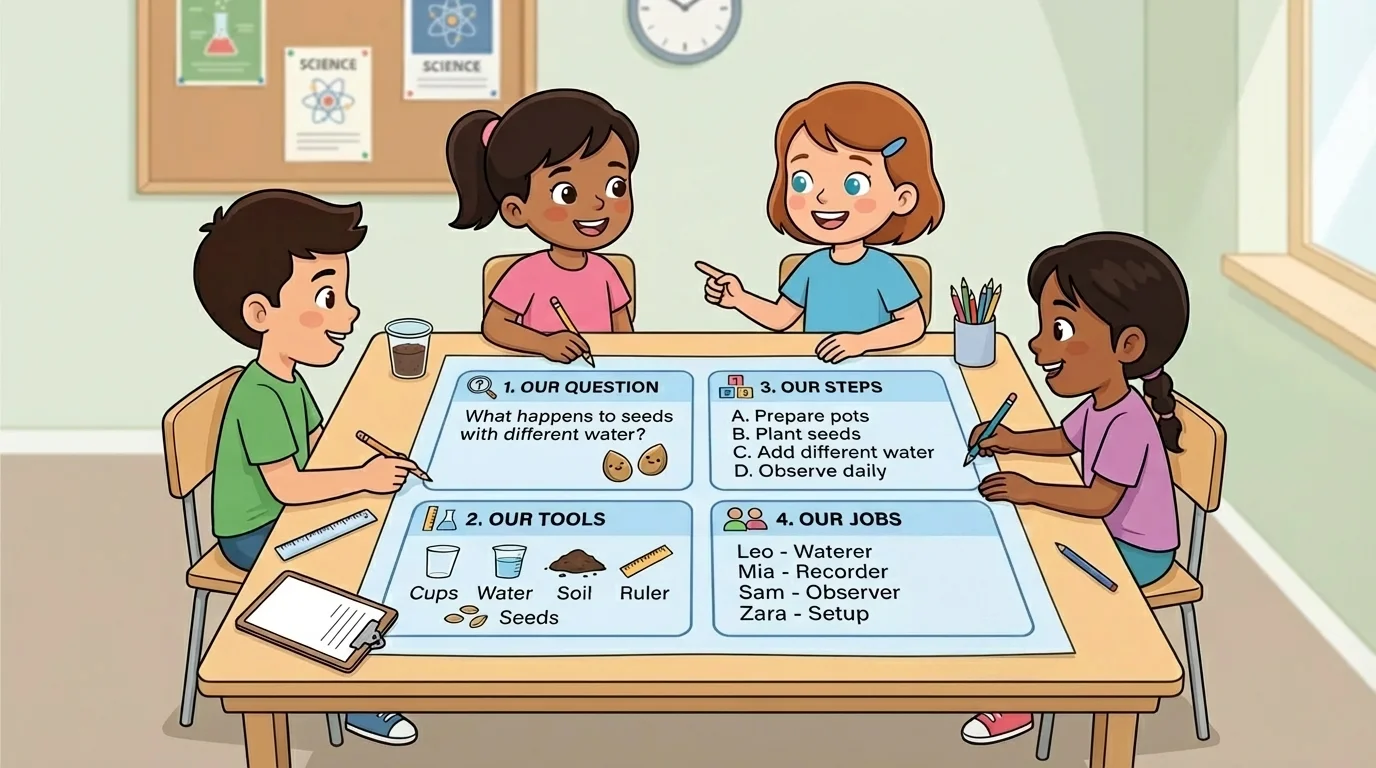
A plan helps everyone know what to do, as [Figure 1] shows. When children investigate together, they decide on the question, the tools, the steps, and who will do each job.
You and your classmates may talk about the materials you need. Materials are the things you use, such as cups, water, toy cars, rulers, paper towels, soil, or crayons for drawing what you see. You also think about the order of the steps. First, next, then, and last help everyone stay organized.
A plan should also be fair. Fair means you are trying to test in the same way each time. If you pour water into cups, use the same amount each time, such as \(1\) small cup. If you roll balls down a ramp, start from the same place each time.
Working with peers means each person can have a job. One child may place the object. One child may watch closely. One child may draw or write what happened. One child may help clean up. Sharing jobs helps the group work smoothly.
Safety is part of planning too. We use tools the right way. We keep water off the floor. We do not taste investigation materials unless the teacher says it is safe. We listen carefully to directions before we begin.
Why planning matters
Planning helps an investigation make sense. When everyone knows the question and the steps, the group can focus on observing instead of feeling confused. A good plan also helps make the test fair and safe.
Sometimes the teacher writes the plan on chart paper. Sometimes students help make a class list. A simple plan can be: question, materials, steps, and what to look for.
When it is time to test, you follow the steps one by one, as [Figure 2] illustrates with children working on a rolling-ball test. Going slowly helps you notice important details.
To observe, use your eyes, ears, and sometimes simple tools. You might watch which ice cube melts first. You might listen to which container makes a louder sound. You might use a ruler to see which plant is taller.
Good investigators take turns and stay on task. If one child is speaking, the others listen. If one child is measuring, the others wait and watch. This helps the group collect information together.
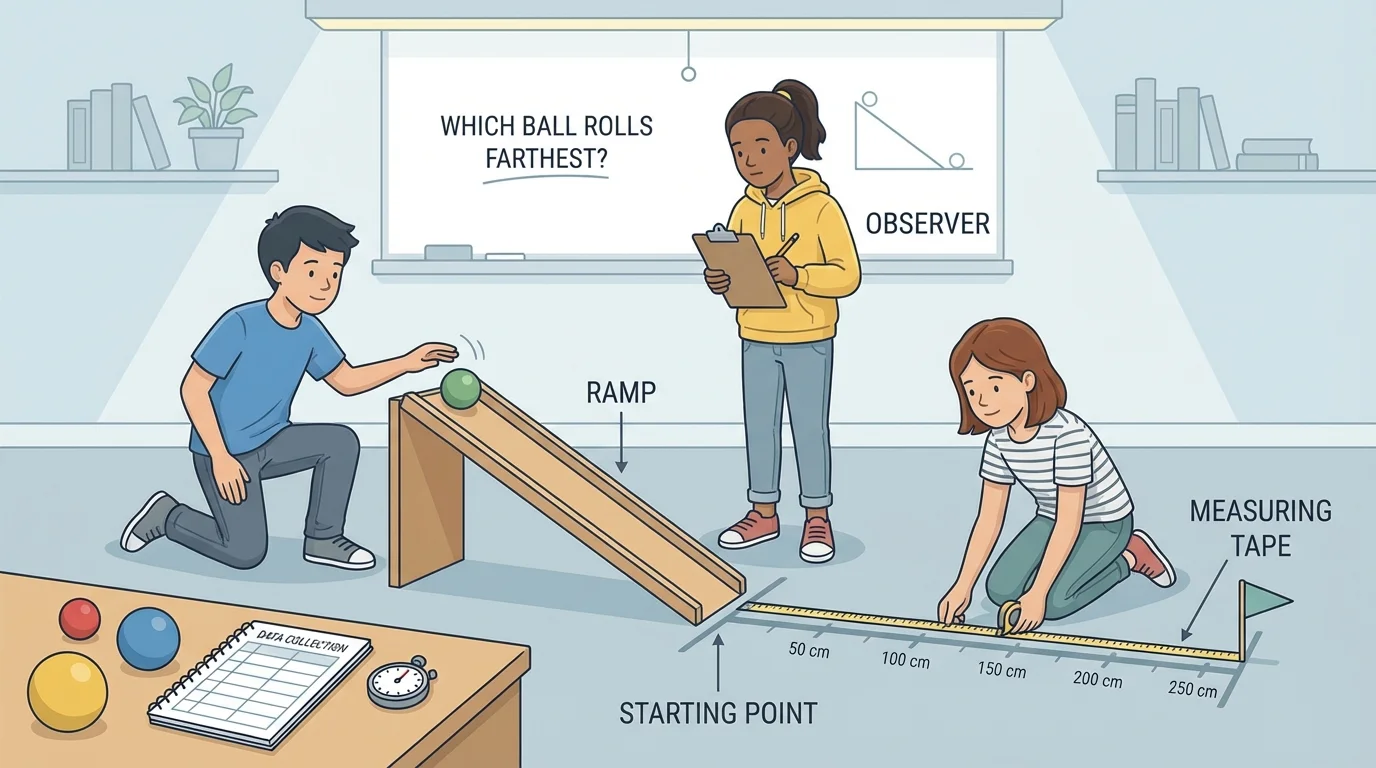
Sometimes the group repeats the test more than once. That means doing it again the same way. Repeating can help us check if the same thing happens again.
Here is an example. A class wants to know which paper towel soaks up more water. They put the same amount of water on each towel, wait the same amount of time, and look at which one holds more. They stay fair by using equal water and equal time.
Example: Testing which ball rolls farther
Step 1: Ask the question.
The group asks, "Which ball rolls farther?"
Step 2: Make the test fair.
They use the same ramp and start each ball from the same place.
Step 3: Observe and record.
One child lets go, one child watches, and one child marks where the ball stops.
Step 4: Repeat.
They roll each ball again to see if the result is similar.
The group learns more because everyone helps and the steps stay the same.
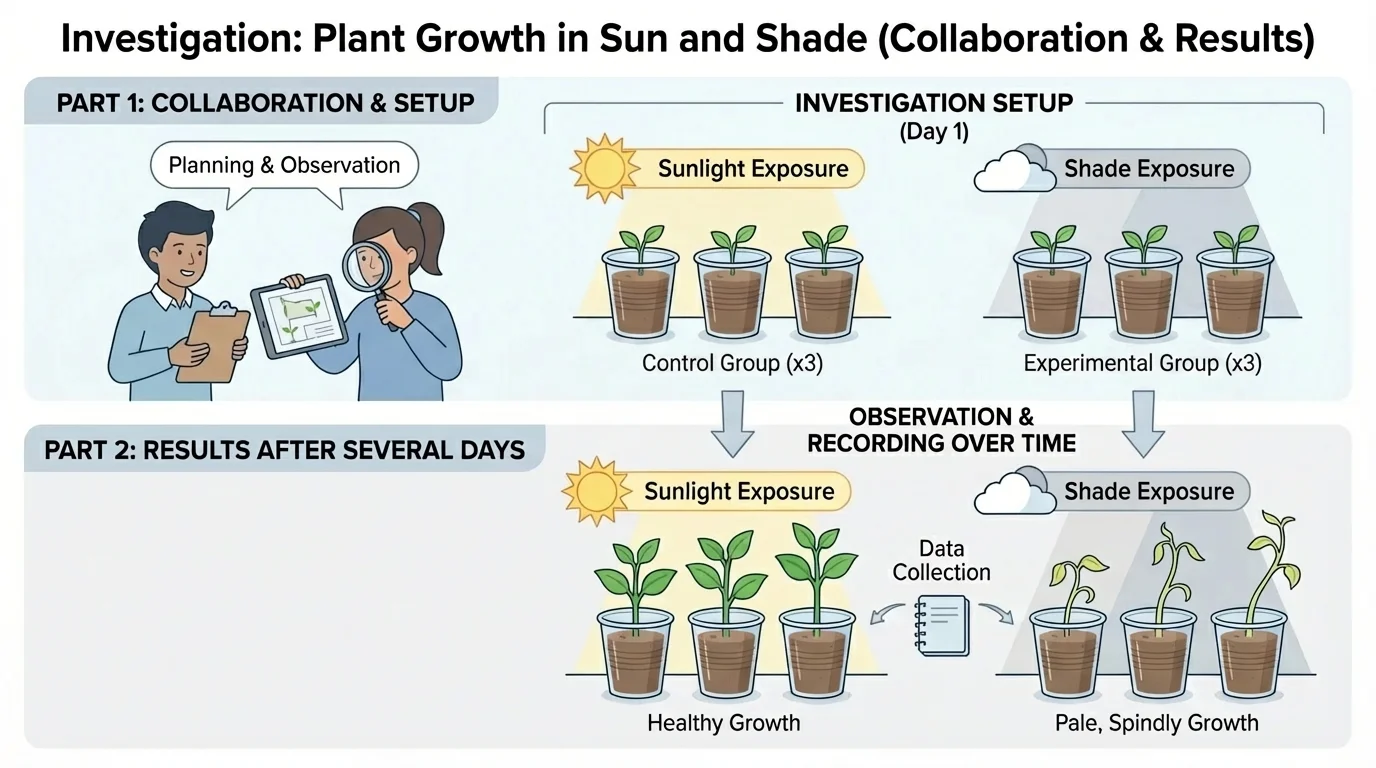
Another example is watching seeds grow. One cup may sit in sunlight and one cup may sit in shade. The class gives both the same water. Then students observe the plants over several days.
After the test, scientists and students look at their results. They ask, "What happened?" and "What did we notice?" Looking for what is the same and different helps children see patterns. A simple class chart can help make those patterns easier to see, as [Figure 3] shows.
You can record results by drawing pictures, using tallies, talking with a partner, or making a simple class chart. Young students might draw a big plant and a small plant, or circle the cup that melted the ice fastest.
Sometimes group members notice different details. That is okay. One child may say, "This ball went fast." Another may say, "This ball went far." Sharing ideas helps the class build a fuller picture of what happened.
With teacher guidance, the class can talk about whether the investigation answered the question. If the question was about which object rolled farther, the results help answer it. If the results are unclear, the class may decide to test again.
Real scientists often work in teams. They share ideas, check each other's work, and learn more by working together.
When you look back at the planning chart from [Figure 1], you can see how a strong plan helps the results make more sense. When you look back at the careful testing in [Figure 2], you can see why following steps matters.
Science is not only about objects and tools. It is also about people working together. A good teammate listens, shares, waits for a turn, and uses kind words.
Sometimes partners do not agree right away. One child may want to test first, and another may want to write first. The teacher can help the group decide fairly. Taking turns and sharing jobs helps everyone join in.
Collaboration means working together. In a group investigation, collaboration can sound like, "I noticed the seed is taller," or "Can you hold the cup while I pour?" These small actions help the whole team succeed.
"Scientists ask, test, observe, and share."
When children explain what they saw, they are practicing science talk. They learn to speak clearly and listen carefully. That is an important part of doing investigations with others.
You can see investigations in many classroom activities. A class may test which surface makes a toy car go slower: carpet or tile. A class may compare what happens to ice in the sun and in the shade. A class may listen to which container makes the softest or loudest sound when tapped gently.
In each case, students need a question, a plan, safe materials, careful observations, and time to share the results. They do not need to know everything before they begin. They need curiosity, guidance, and teamwork.
As the chart in [Figure 3] makes clear, even simple pictures can help young scientists compare results. A drawing, a tally mark, or a spoken sentence can all be useful ways to show what happened.
