A country can have huge oil reserves and still struggle with poverty. Another country can have few natural resources and become one of the richest places in the world. That surprising fact is one reason economics is so important. Across the Eastern Hemisphere, countries have built different systems to answer the same basic problem: people have unlimited wants, but resources are limited. Economists call this problem scarcity.
Every society must decide three basic questions: What should be produced? How should it be produced? For whom should it be produced? An economic system is the way a society organizes the production, distribution, and use of goods and services. Different countries answer these questions differently because they have different histories, resources, beliefs, and experiences.
In some places, customs and family traditions guide economic decisions. In others, the government makes many major choices. In still others, businesses and consumers make most decisions through buying and selling. Most real countries today use a mix of these methods rather than one pure system.
Scarcity means that there are not enough resources to satisfy all wants and needs. Goods are physical products such as food, clothing, and phones. Services are actions people do for others, such as teaching, transportation, or medical care.
Because scarcity is always present, countries must make choices. Choosing one thing usually means giving up another. For example, a government that spends more on railroads may have less money for schools or hospitals. A family that buys a new motorcycle may have less money for food or savings. Economics is really the study of these choices.
There are four main economic systems, and they can be compared by asking who makes the key decisions about production and prices, as shown in [Figure 1]. The four systems are traditional economy, command economy, market economy, and mixed economy.
A traditional economy depends on customs, habits, and beliefs passed down through generations. People may farm, fish, herd animals, or make crafts in ways their families have used for many years. Some rural communities in parts of Africa and Asia still show traditional features, especially where access to technology or transportation is limited.
A command economy is one in which the government controls most major economic decisions. The state may decide how much steel, rice, or electricity to produce. It may also set prices and wages. North Korea is one of the clearest modern examples of a command economy in the Eastern Hemisphere.
A market economy is based mostly on private ownership and voluntary exchange. Businesses decide what to produce, and consumers help shape decisions by what they buy. Prices are influenced by supply and demand. No country is a completely pure market economy, but some countries lean more strongly in that direction.
A mixed economy combines elements of market and command systems. Private businesses operate, but the government also regulates some industries, provides public services, and sets certain rules. Most countries in the Eastern Hemisphere today, including Japan, India, and China, have mixed systems, although the balance between government control and private choice differs greatly.
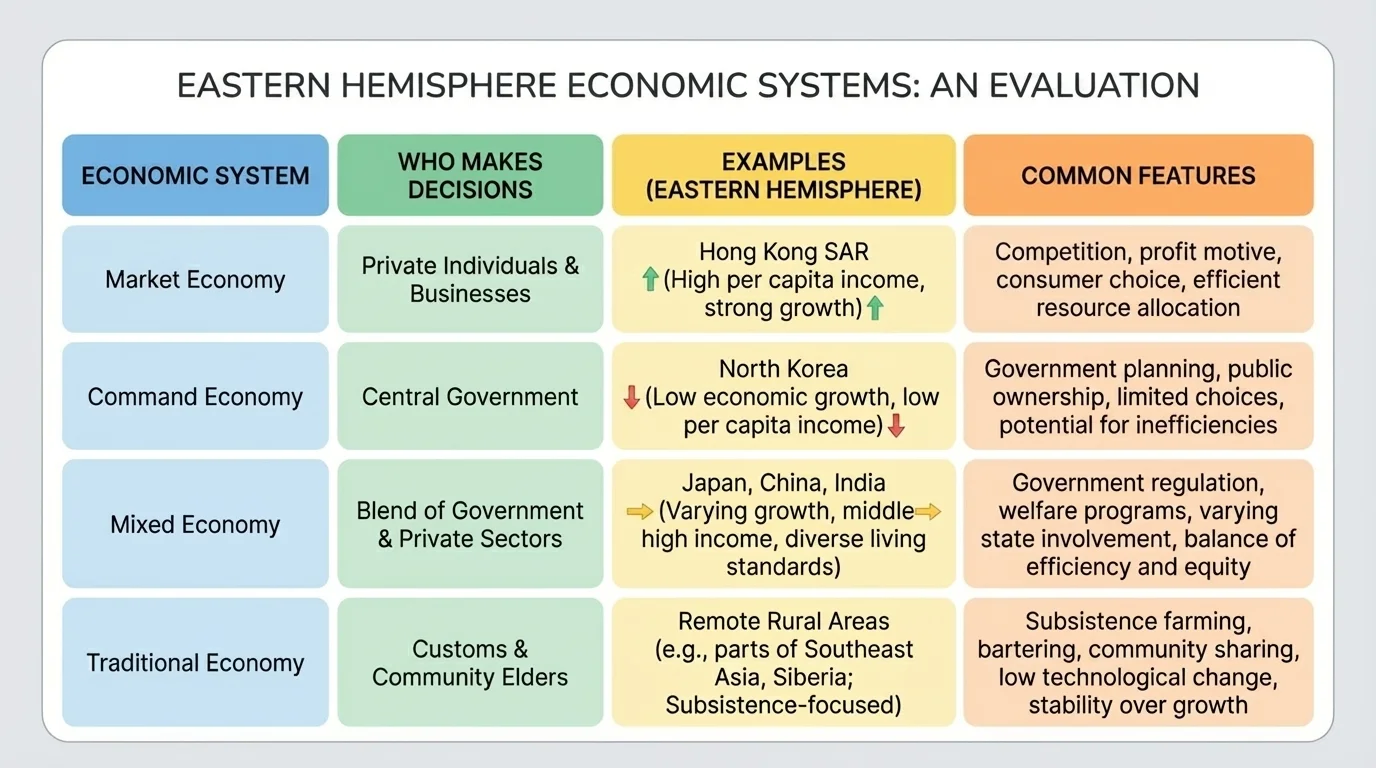
Understanding this spectrum matters. A country does not have to be completely one type. China, for example, has state control in important areas such as banking and energy, but it also allows private businesses and global trade. India has a strong private sector, but the government still plays a major role in planning, services, and regulation. These blended systems are common because governments often try to combine growth with stability.
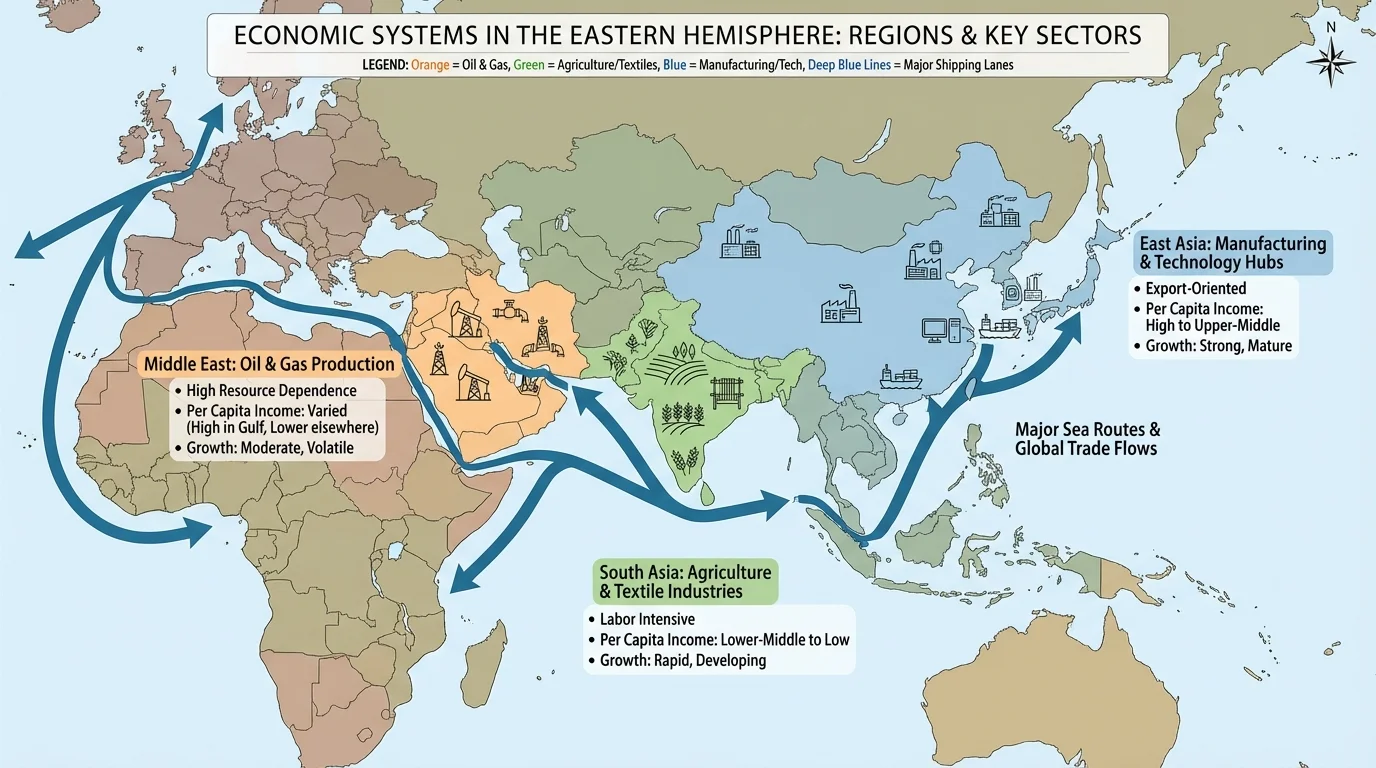
Economic systems do not appear by accident. They develop from a society's access to resources, its beliefs about fairness and power, and its past experiences. The pattern across the Eastern Hemisphere becomes clearer when you look at where oil, farmland, factories, and major sea routes are located, as [Figure 2] shows.
Natural resources strongly affect economic development. In the Middle East, countries such as Saudi Arabia, the United Arab Emirates, and Qatar built much of their wealth on oil and natural gas. In South Asia, fertile river valleys and monsoon rains helped agriculture remain important for millions of people. In East Asia, countries such as Japan and South Korea had fewer raw materials, so they focused on manufacturing, technology, and trade.
Geography also matters. Countries near busy shipping routes can trade more easily. Ports along the Indian Ocean, the South China Sea, and the Mediterranean connect producers and consumers across continents. When transportation is easier, goods move faster and often more cheaply. This can help businesses grow.
Societal values shape economies too. Some societies place strong value on community support and government responsibility. Others emphasize entrepreneurship, competition, and private ownership. These values influence how much people expect the government to provide education, healthcare, or jobs.
Human experiences such as war, colonialism, revolution, and industrialization also leave lasting marks. China experienced revolution and strong communist rule in the twentieth century, which led to a system with large government influence. India experienced British colonial rule and later built a democratic system with both government planning and private enterprise. Japan industrialized rapidly, rebuilt after World War II, and developed a highly productive economy centered on manufacturing and exports.
Japan has very limited natural resources compared with many larger countries, yet it became one of the world's largest economies by investing heavily in education, technology, and efficient industry.
This reminds us that resources matter, but they are not the whole story. Leadership, education, trade connections, and innovation can sometimes matter just as much as oil, minerals, or fertile soil.
To compare economies fairly, we need more than opinions. We need economic growth data, per capita income, and information about standard of living. These measures do not tell us everything, but they help us evaluate how an economy is performing, and [Figure 3] displays how countries can look very different depending on which measure we use.
Economic growth is the increase in a country's output of goods and services over time. It is often measured by changes in gross domestic product, or GDP. If a country's GDP grows quickly, businesses may be producing more, workers may be earning more, and governments may collect more tax revenue.
Per capita income means the average income per person. It is found by dividing total national income by the population. In words, the idea is total income divided by number of people. If a country earns a lot of money but has a huge population, the average income per person may still be moderate or low.
Standard of living refers to people's overall quality of life. It includes income, but also housing, food, healthcare, education, transportation, safety, and access to clean water and electricity. A country can have a rising GDP while some families still struggle with poor housing or limited healthcare.
| Measure | What It Tells Us | Why It Matters | Limitation |
|---|---|---|---|
| Economic growth | Whether the economy is producing more over time | Shows expansion and job potential | Does not show how wealth is shared |
| Per capita income | Average income per person | Helps compare countries with different populations | Averages can hide poverty and inequality |
| Standard of living | Quality of daily life | Shows how people actually live | Harder to measure with one number |
Table 1. Main economic measures used to compare countries and their limits.
Suppose one country has a national income of $500 billion and a population of 100 million people. The average income per person would be found by dividing 500 billion by 100 million. In simplified form, that is $5,000 per person. Another country might earn less total income but have a smaller population, so its per capita income could be higher. This is why economists use averages when comparing countries of different sizes.
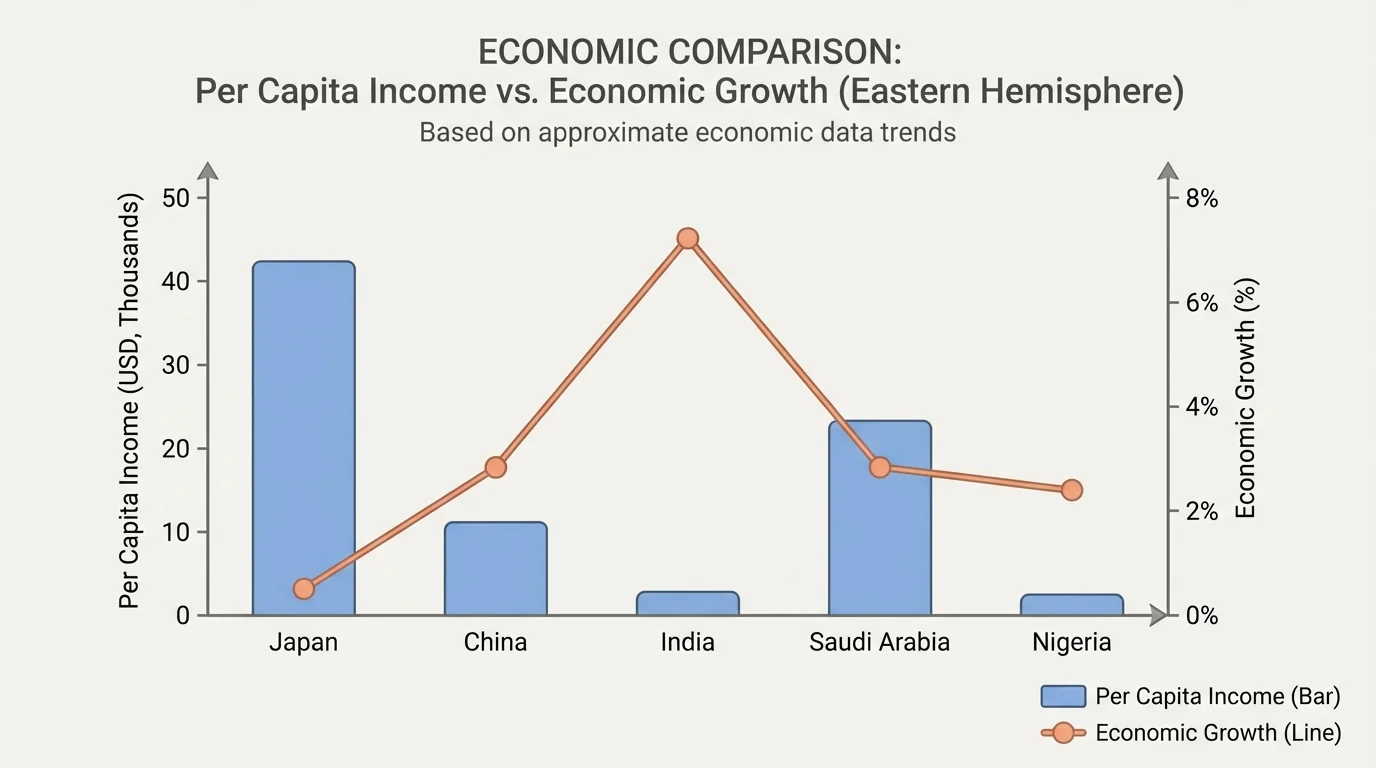
Growth and income are not the same thing. A country with fast growth may still be poor if it started from a low level. A country with high income may have slower growth because it is already highly developed. Japan often has lower growth than India or China, but its average income and living standards remain very high.
Why one number is never enough
If you only look at GDP, you might think the largest economy is always the best place to live. But economists compare several indicators because people care about more than production. They care about wages, education, healthcare, transportation, housing, and opportunity. A careful evaluation uses multiple measures together.
This is similar to evaluating a basketball player. Looking only at points scored would ignore defense, passing, and teamwork. In the same way, looking only at GDP ignores the many parts of daily life that shape well-being.
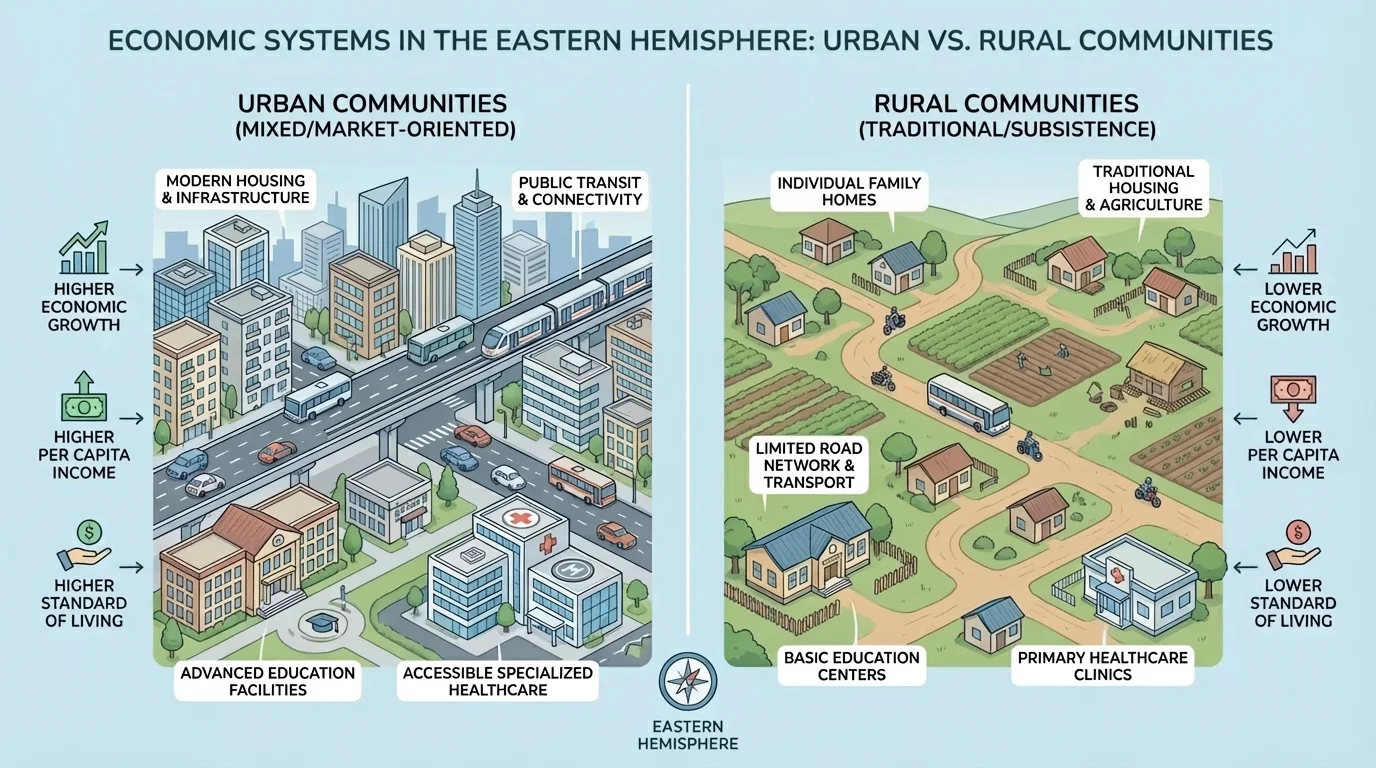
Now we can apply these ideas to several countries. Their differences show why economic systems must be evaluated with both data and context. Standard of living includes visible features of daily life such as housing, transit, schools, and healthcare access, and these contrasts appear clearly in [Figure 4].
China has a mixed economy with strong government influence. Since the late twentieth century, China has expanded manufacturing, trade, and infrastructure at a rapid pace. Its economic growth has been very high for many years, helping lift hundreds of millions of people out of extreme poverty. However, China still has major differences between urban and rural areas, and the government keeps significant control over politics and important industries.
India also has a mixed economy, but it is more democratic and has a very large private sector. India has grown quickly in technology, services, and manufacturing. It has a huge population, so even when the total economy grows, average income per person can remain lower than in richer countries. India shows how a country can have impressive growth and still face challenges in sanitation, inequality, and access to services.
Japan has a mixed economy that leans strongly toward market activity with government guidance. It has one of the highest standards of living in the Eastern Hemisphere. Education levels are high, transportation systems are efficient, and healthcare access is broad. Japan's growth rate may be slower than that of developing countries, but its per capita income and quality of life are high.
Saudi Arabia has built much of its wealth from oil. Its high per capita income has supported modern cities, roads, airports, and public services. At the same time, depending heavily on one main resource can be risky. If oil prices fall, government income can also fall. That is why Saudi Arabia has worked to diversify its economy into tourism, technology, and other industries.
Nigeria, located in Africa, is also rich in oil, yet it has lower average income and larger development challenges than Saudi Arabia. This comparison is important: having natural resources alone does not guarantee a high standard of living. Political stability, infrastructure, education, corruption levels, and how wealth is distributed also matter greatly.
| Country | Economic System | Major Strength | Major Challenge |
|---|---|---|---|
| China | Mixed with strong state control | High industrial growth | Regional inequality and government control |
| India | Mixed with large private sector | Fast growth in services and technology | Lower average income and uneven services |
| Japan | Mixed, market-oriented | High standard of living | Slow growth and aging population |
| Saudi Arabia | Mixed with strong state role | High income from oil | Dependence on one main export |
| Nigeria | Mixed | Natural resource wealth and large market | Poverty, inequality, and infrastructure gaps |
Table 2. Selected Eastern Hemisphere countries compared by economic system, strengths, and challenges.
Looking back at [Figure 3], we can see why these countries should not be ranked by a single measure. A country with rapid growth may still need major improvements in education or sanitation. A country with high income may need to solve slow growth or dependence on imported resources.
Each system has possible benefits. Traditional economies often preserve culture and local cooperation. Command economies can move resources quickly toward national goals, such as building railways or expanding military production. Market economies encourage innovation, competition, and consumer choice. Mixed economies can combine private energy with public services.
Each system also has weaknesses. Traditional economies may have limited technology and fewer opportunities for growth. Command economies may be inefficient because central planners cannot always predict what people need. Market economies can create inequality, where some people become very rich while others remain poor. Mixed economies can face conflict over how much government control is too much or too little.
Case study: evaluating two countries with different data
Suppose Country A grows at a faster rate each year, but Country B has better hospitals, safer roads, and higher average income.
Step 1: Compare growth.
If Country A grows faster, it may be expanding production and jobs more quickly.
Step 2: Compare income and living conditions.
If Country B has higher per capita income and stronger public services, daily life may be easier and healthier there.
Step 3: Make a balanced judgment.
An economist would say Country A has strong momentum, but Country B currently offers a higher standard of living.
This kind of balanced evaluation is more accurate than saying one number decides everything.
That balanced thinking is an important goal in geography and economics. Good evaluation asks not only, How much money is being made? but also, Who benefits, and how do people live?
Economic systems may sound abstract, but they affect everyday life. Government policies influence the price of fuel, the quality of roads, the number of teachers in schools, and whether hospitals are public or private. In a mixed economy, taxes may help pay for transportation, health services, and disaster relief. In a more market-based system, private businesses may provide many services, which can increase choice but also raise costs for some families.
Trade policies matter too. If a country places high taxes on imported goods, local businesses may be protected from competition. But consumers may also pay higher prices. If a country trades freely, people may get cheaper products, but local factories may face tougher competition from abroad.
The role of government is one of the biggest differences among economic systems. Some governments use subsidies, which are payments that help certain industries, such as farming or energy. Others invest heavily in infrastructure like ports, railroads, and power systems. These decisions shape future growth.
From earlier geography study, remember that where people live and how they move goods matter economically. Rivers, ports, climate, and natural barriers often influence trade, farming, and settlement patterns.
For students, these policies may seem far away, but they connect to familiar experiences. The price of bread, the availability of buses, internet access at school, and job opportunities for adults in a family all link back to economic choices made by businesses and governments.
Economic data can be powerful, but averages can hide important details. If a few people in a country are extremely wealthy, the per capita income may look high even if many families are poor. That is why economists also examine inequality, poverty rates, literacy, health, and access to clean water.
Urban and rural differences are especially important. A capital city may have modern hospitals, highways, and high-paying jobs, while villages far away may lack reliable electricity or safe drinking water. As we saw earlier in [Figure 4], two people living in the same country can experience very different standards of living.
We should also think about sustainability. If an economy grows quickly by overusing water, forests, or fossil fuels, it may face serious problems later. A strong economy should meet present needs without damaging the future too severely.
"The true measure of an economy is not only what it produces, but how people live."
This idea helps us evaluate systems more fairly. The best economic system for a country is not simply the one that creates the largest total output. It is the one that helps people meet needs, use resources wisely, and improve quality of life over time.
Across the Eastern Hemisphere, economic systems developed in different ways because countries faced different resources, values, and historical experiences. Oil-rich states in Southwest Asia, manufacturing powers in East Asia, and rapidly growing service economies in South Asia all show different paths. These paths are shaped by both geography and human decisions.
When we evaluate these systems, we should compare growth, income, and standard of living together. A smart evaluation notices strengths, weaknesses, and trade-offs. That approach helps us understand why two countries with similar resources may end up with very different results.
