One tiny symbol can completely change an answer. Compare the expressions \(8 + 4 \times 2\) and \((8 + 4) \times 2\). The first one equals \(16\), but the second one equals \(24\). The numbers are the same, yet the grouping changes what happens first. That is why parentheses, brackets, and braces are so important in math.
Numerical expressions are combinations of numbers and operation symbols such as addition, subtraction, multiplication, and division. Sometimes they also include grouping symbols. These symbols tell us which part of the expression to work on first. Learning to use them correctly helps you read math clearly and solve problems accurately.
When an expression has more than one operation, we need rules so everyone gets the same answer. Grouping symbols are part of those rules. They act like instructions that say, "Do this part first."
Look at these two expressions: \(18 - 6 \div 3\) and \((18 - 6) \div 3\). In the first expression, division comes before subtraction, so \(6 \div 3 = 2\), and then \(18 - 2 = 16\). In the second expression, the parentheses tell us to subtract first: \(18 - 6 = 12\), and then \(12 \div 3 = 4\). Same numbers, different directions, different answers.
A numerical expression is a math phrase made of numbers and operation symbols. It does not have an equal sign.
Grouping symbols include \(( )\), \([ ]\), and \({ }\), which show which part of an expression should be evaluated first.
Evaluate means to find the value of an expression.
Grouping symbols help organize longer expressions, especially when one grouped part is inside another grouped part. They make complex calculations easier to read, almost like punctuation helps us read sentences.
The three main grouping symbols are parentheses \(( )\), brackets \([ ]\), and braces \({ }\). They all have the same job: they group parts of an expression. When several layers are needed, they can be nested, as [Figure 1] shows, so we can tell the inner part from the outer part more easily.
At this level, parentheses appear most often. Brackets and braces are helpful when there is a group inside another group. For example, in \({12 - [3 \times (2 + 1)]}\), the parentheses are the innermost group, the brackets are the next layer, and the braces are the outer layer.
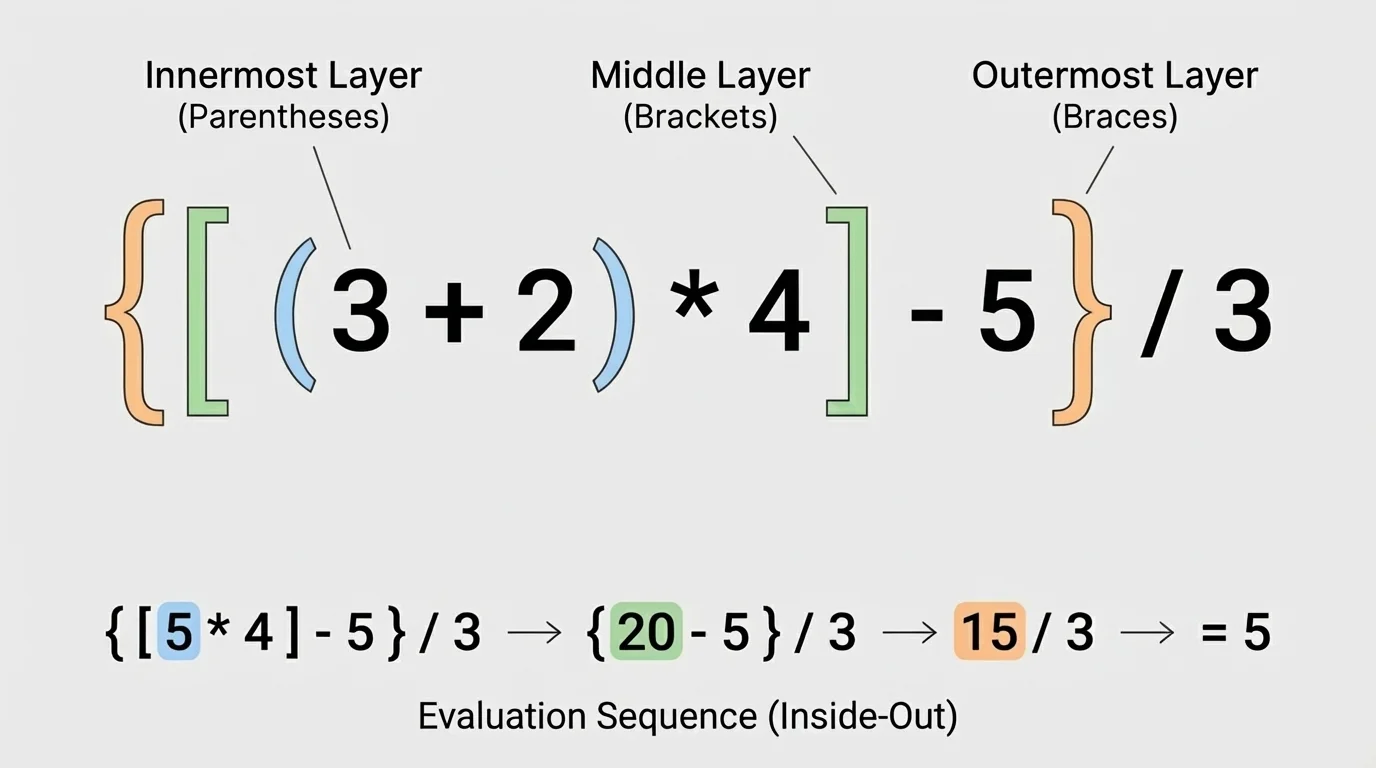
You can think of these layers like boxes inside boxes. First open the smallest box, then move outward. This keeps the steps neat and prevents mistakes.
To evaluate expressions correctly, we follow the order of operations. This order follows a clear path, as [Figure 2] explains: work inside grouping symbols first, then multiplication and division from left to right, and finally addition and subtraction from left to right.
Here is the order to remember:
First: Evaluate inside parentheses, brackets, or braces, starting with the innermost group.
Next: Multiply and divide from left to right.
Last: Add and subtract from left to right.
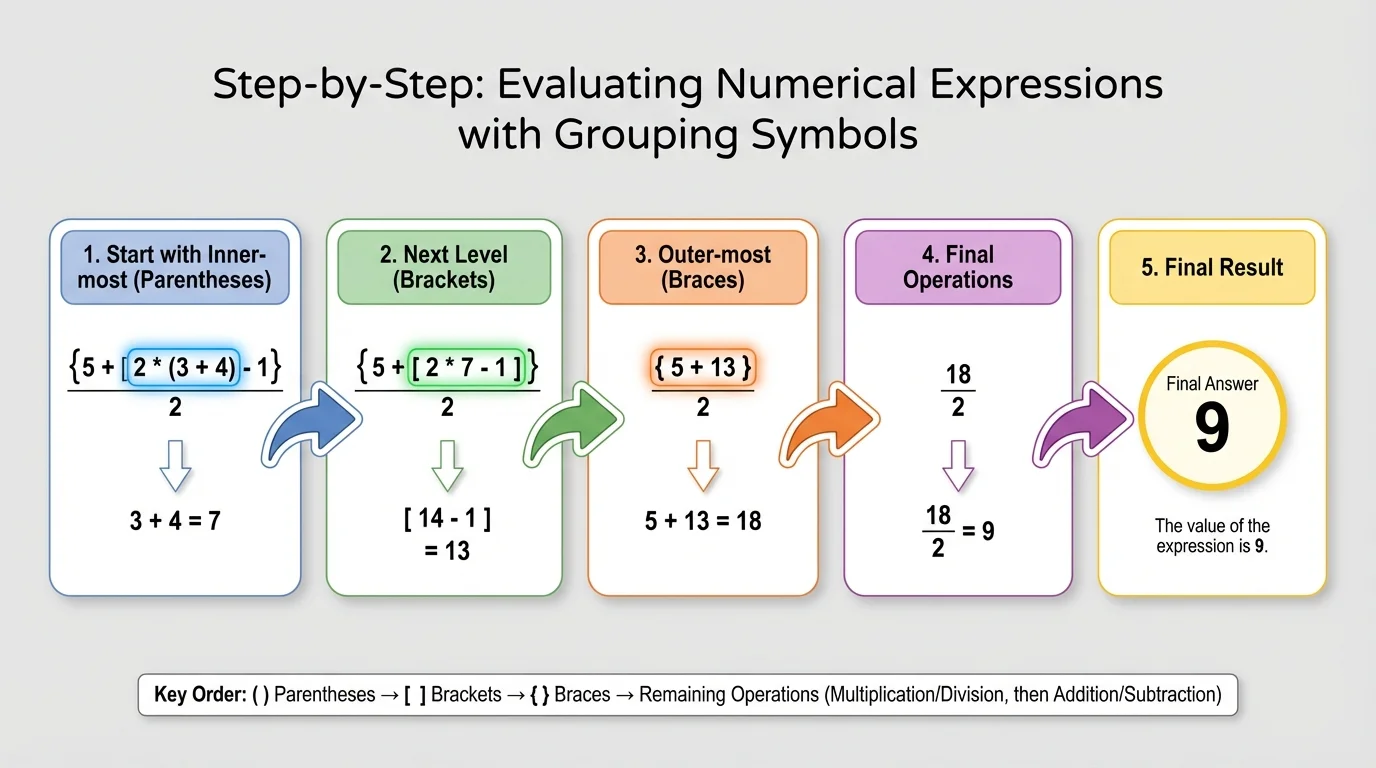
If there are several layers of grouping symbols, do the innermost one first. For example, in \([5 + (9 - 3)]\), you begin with \((9 - 3)\), not with \([5 + \cdots ]\).
Also remember that multiplication does not always come before division, and addition does not always come before subtraction. These pairs are done from left to right after any grouping has been handled.
You already know basic operations: addition, subtraction, multiplication, and division. This lesson builds on that knowledge by showing how to decide which operation comes first when several operations appear in one expression.
As seen earlier in [Figure 1], the symbols themselves are like layers. The order of operations tells you how to move through those layers in a sensible way.
Let us evaluate \((7 + 5) \times 3\).
Worked example
Step 1: Evaluate inside the parentheses.
\(7 + 5 = 12\)
Step 2: Replace the parentheses with the value you found.
The expression becomes \(12 \times 3\).
Step 3: Multiply.
\(12 \times 3 = 36\)
The value of the expression is
\(36\)
The parentheses changed the order. Without them, \(7 + 5 \times 3\) would mean \(5 \times 3 = 15\) first, then \(7 + 15 = 22\). That is very different from \(36\).
Now evaluate \([4 + (10 - 6)] \times 2\).
Worked example
Step 1: Start with the innermost grouping symbol, the parentheses.
\(10 - 6 = 4\)
Step 2: Rewrite the expression.
It becomes \([4 + 4] \times 2\).
Step 3: Evaluate inside the brackets.
\(4 + 4 = 8\)
Step 4: Multiply.
\(8 \times 2 = 16\)
The value of the expression is
\(16\)
This example shows an important pattern: inside first, then outward. Parentheses were inside brackets, so the parentheses had to be done first.
Here is a longer expression: \({20 - [2 \times (3 + 4)]}\).
Worked example
Step 1: Evaluate the parentheses.
\(3 + 4 = 7\)
Step 2: Rewrite the expression.
It becomes \({20 - [2 \times 7]}\).
Step 3: Evaluate inside the brackets.
\(2 \times 7 = 14\)
Step 4: Rewrite and evaluate inside the braces.
The expression becomes \({20 - 14}\), and \(20 - 14 = 6\).
The value of the expression is
\(6\)
This is a perfect example of nested grouping symbols. Each layer waits its turn.
Why inner groups come first
When one grouped expression is inside another, the inner one must be evaluated first because the outer group depends on it. In \({20 - [2 \times (3 + 4)]}\), the brackets cannot be completed until \((3 + 4)\) is known. This is why we always move from the inside outward.
Later, when you see larger expressions, the same idea still works. Whether there is one layer or three layers, the strategy stays the same.
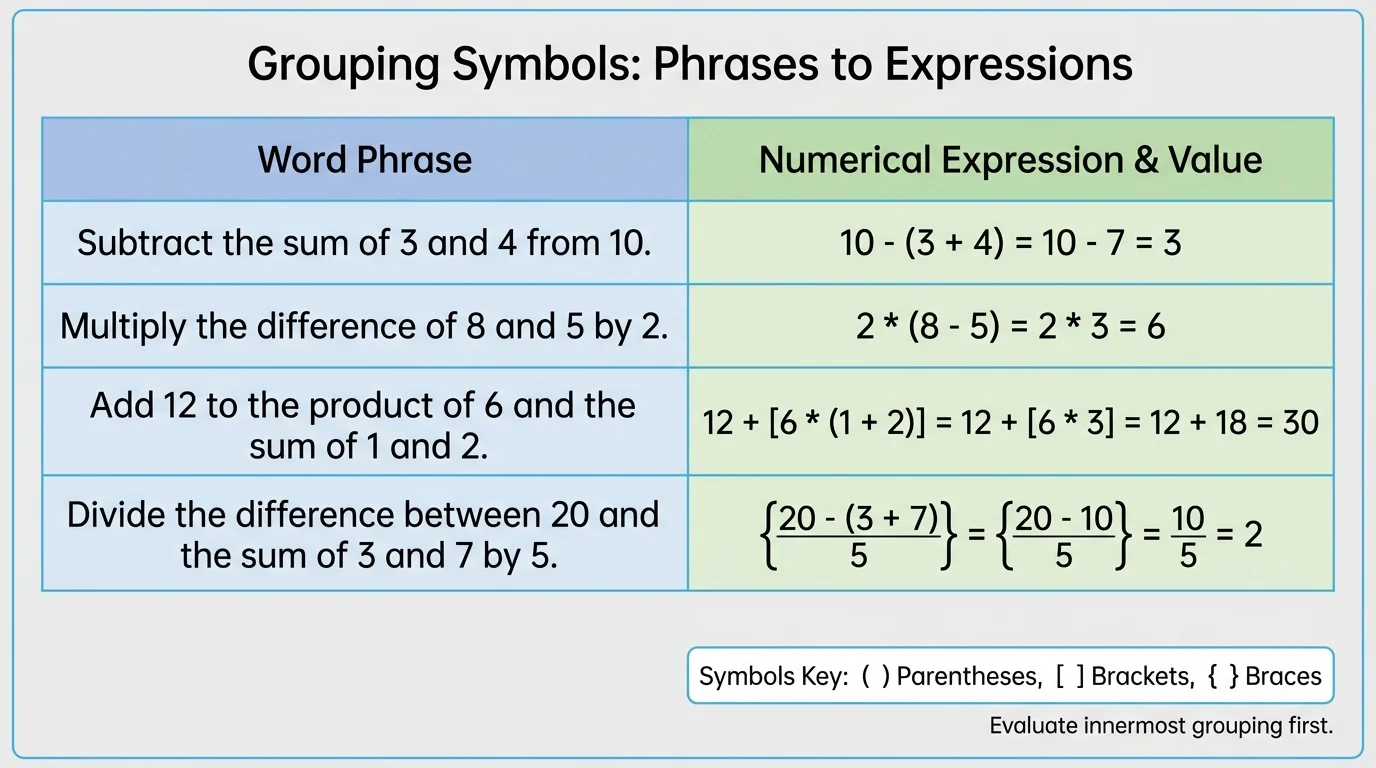
Math is not only about solving expressions. It is also about reading words and writing the correct expression. Word clues help us choose grouping symbols, as [Figure 3] shows, because phrases like "the sum of" or "the difference between" often tell us that a whole part should be grouped together.
For example, "multiply the sum of \(8\) and \(5\) by \(2\)" means add first, then multiply. The expression is \((8 + 5) \times 2\), not \(8 + 5 \times 2\).
Here are some common word clues:
| Word clue | Meaning | Example expression |
|---|---|---|
| sum of | add numbers | \((6 + 3) \times 4\) |
| difference of | subtract numbers | \(2 \times (9 - 1)\) |
| product of | multiply numbers | \([3 \times 5] + 2\) |
| quotient of | divide numbers | \((12 \div 4) + 7\) |
| twice the sum | multiply a sum by \(2\) | \(2 \times (4 + 6)\) |
Table 1. Common word clues and matching numerical expressions with grouping symbols.
Let us translate a sentence into an expression: "Subtract \(9\) from the product of \(4\) and the sum of \(3\) and \(2\)." First, the sum of \(3\) and \(2\) is \((3 + 2)\). Then multiply by \(4\): \(4 \times (3 + 2)\). Finally subtract \(9\): \([4 \times (3 + 2)] - 9\).
As the chart in [Figure 3] makes clear, words such as sum and difference often point to the part that belongs inside grouping symbols.
One common mistake is ignoring the grouping symbols. For example, in \((6 + 2) \times 5\), a student might multiply \(2 \times 5\) first just because multiplication usually comes before addition. But the parentheses change the rule for this expression. The correct first step is \(6 + 2 = 8\).
Another mistake is stopping too early. In \([9 - (4 + 1)] \times 2\), you cannot do \(9 - 4\) first because the entire \((4 + 1)\) must be found before subtracting.
A third mistake happens when translating words into symbols. The phrase "three times the quantity \(7 + 2\)" means \(3 \times (7 + 2)\). It does not mean \(3 \times 7 + 2\).
Computer programs also depend on grouping symbols. In coding, symbols like parentheses help the computer know exactly which calculation to perform first, just as they guide you in math.
A good habit is to circle or mentally notice the innermost group before doing anything else. Then rewrite the expression after each step so your work stays organized.
Grouping symbols appear whenever we need to show a clear sequence of steps. Suppose a family buys \(3\) movie tickets and each ticket costs the sum of a \(\$10\) seat charge and a \(\$2\) service fee. The total cost is \(3 \times (10 + 2)\). First find the cost of one ticket, \(10 + 2 = 12\), then multiply: \(3 \times 12 = 36\). The family pays \(\$36\).
In sports, grouped expressions can describe scoring. If a player makes \(4\) baskets worth \(2\) points each and then adds the sum of \(3\) free throws and \(1\) bonus point, one expression is \((4 \times 2) + (3 + 1)\). Evaluate each part: \(4 \times 2 = 8\) and \(3 + 1 = 4\), so the total is \(8 + 4 = 12\).
In planning equal groups, a teacher might arrange students into teams after combining two small groups. If one group has \(8\) students and another has \(4\), and then the total is divided into \(3\) teams, the expression is \((8 + 4) \div 3\). The grouped sum shows that the two groups are combined before dividing.
After evaluating an expression, it is smart to check whether the answer makes sense. One way is to estimate. For \((19 + 21) \div 4\), the sum is \(40\), and \(40 \div 4 = 10\). If you got something like \(85\), you would know right away that something went wrong.
Another way to check is to reread the expression from the innermost grouping outward. Ask yourself, "Did I finish everything inside the grouping symbols before moving on?" This is the same structure shown in [Figure 2], where each stage leads to the next in order.
Careful rewriting also helps. Instead of trying to do many steps in your head, write the new expression after each step. For example, \({18 - [3 \times (5 - 1)]}\) becomes \({18 - [3 \times 4]}\), then \({18 - 12}\), then \(6\). Clear work prevents hidden mistakes.
"Do the inside first, then work your way out."
— A powerful rule for grouped expressions
As expressions become longer, the symbols are not there to make math harder. They are there to make the intended order clear. Once you trust the order of operations and move from the inside outward, even a long expression becomes manageable.
