Have you ever wondered why one paper towel soaks up spills better than another, or why one toy car rolls farther than the rest? Scientists and engineers wonder about things like this too. They do not just guess. They investigate. A good investigation is like being a careful detective: you ask a question, test it in a fair way, collect information, and use what you find to explain what happened or to make something work better.
When scientists want to learn how something works, they try to change only one thing at a time. This helps them know what caused the result. If too many things change, it becomes hard to tell what really made the difference. For example, if you want to know whether more sunlight helps a plant grow taller, you should not also change the kind of plant, the size of the pot, and the amount of water at the same time.
This kind of careful test is often called a fair test. In a fair test, one part is changed, one part is measured, and the other important parts stay the same. Fair tests help scientists gather evidence they can trust.
Investigation is a planned way to find out about something by observing, measuring, testing, and recording results.
Evidence is the information you collect that helps support an explanation or show whether a design works well.
Fair test is a test in which only one variable is changed while the other important variables are kept the same.
Scientists use investigations to answer questions about nature, such as how plants grow or how shadows change. Engineers also investigate, but they often use tests to improve a product or solve a problem, such as making a stronger bridge from craft sticks or designing a lunch box that keeps food cooler for longer.
Every strong investigation starts with a clear question. A good question can be tested. For example, "Which paper towel absorbs the most water?" is a testable question. "Are paper towels nice?" is not a scientific question because it depends on opinion.
Next comes a prediction. A prediction is what you think might happen. It should be based on what you already know. A student might predict that the thickest paper towel will absorb the most water. A prediction is not the same as evidence. It is just an idea before the test begins.
Then come the materials and steps. Scientists list what they need and what they will do. They also think about safety, careful measuring, and how they will record results. During the test, they make observations with their senses and take measurements with tools such as rulers, timers, thermometers, or measuring cups.
At the end, scientists look at the data and write a conclusion. A conclusion tells what the results show. It should be based on evidence, not just opinion. If the evidence does not match the prediction, that is still useful science. Real science is about what the evidence shows.
You already know that measuring means finding out how much of something there is, such as length, time, mass, or temperature. In investigations, careful measuring helps make results more accurate.
Sometimes scientists repeat an investigation several times. Repeating helps them check whether the results happen again and again. One surprising result may be an accident, but a pattern across several trials is stronger evidence.
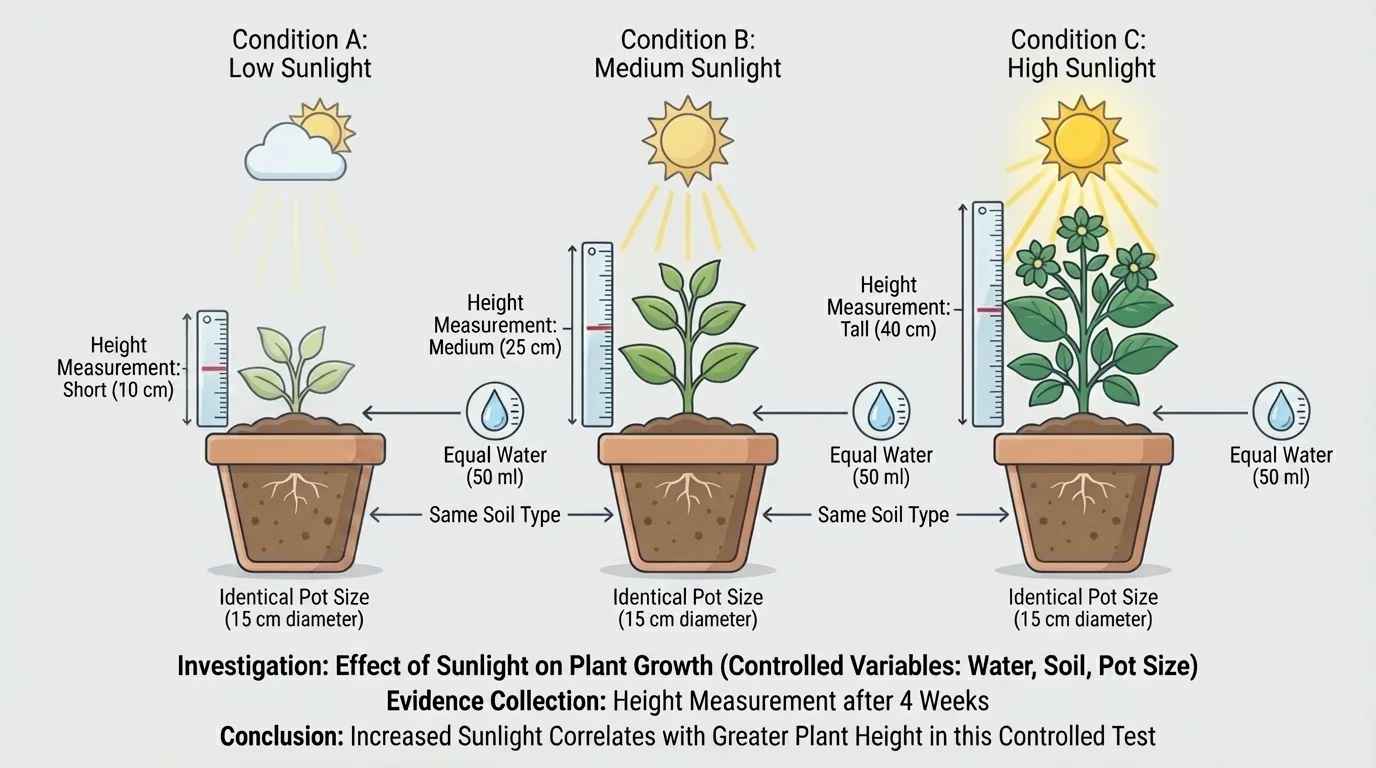
One of the most important ideas in science is the variable. In a test, a variable is something that can change. In a plant investigation, scientists may change the amount of sunlight, measure plant height, and keep the amount of water, soil, and pot size the same. This helps them learn whether sunlight affects growth, as shown in [Figure 1].
There are three main kinds of variables in an elementary investigation. The independent variable is the one thing you choose to change. The dependent variable is what you observe or measure to see the result. The controlled variables are the parts you keep the same so the test stays fair.
Think about a test with toy cars rolling down a ramp. If you want to find out whether ramp height changes how far a car rolls, the independent variable is the ramp height. The dependent variable is the distance the car rolls. Controlled variables might include using the same toy car, the same ramp surface, and the same floor each time.
If controlled variables are not kept the same, the results can become confusing. Suppose one trial uses a small toy car and another uses a heavy toy truck. Then you would not know whether the distance changed because of the ramp height or because the vehicles were different.
Later, when you compare evidence from other investigations, [Figure 1] still helps you remember the basic pattern: one thing changes, one result is measured, and the other important things stay the same.
Why controlling variables matters
Controlling variables makes an investigation more trustworthy. If only one thing changes, you can connect the result to that change more confidently. This is how scientists build explanations and how engineers decide which design works best.
Sometimes students think "keeping things the same" means doing exactly the same trial every time. That is not quite right. In a good investigation, you keep the important conditions the same, but you purposely change one factor so you can test its effect.
Before starting, it helps to make a simple plan. First, write the question. Next, decide what independent variable you will change and what dependent variable you will measure. Then list the controlled variables. After that, gather materials and write steps in order. Clear steps make it easier for someone else to repeat the investigation.
A strong plan also includes how many trials you will do. A trial is one time you perform the test. If you do the same test three times, you have three trials. Multiple trials help you see whether the results are consistent.
Scientists also decide how to record data before they begin. They may use a table, chart, tally marks, drawings, or notes. If you know how you will record the information, you are less likely to forget an important result.
| Part of the plan | What it does |
|---|---|
| Question | Tells what you want to find out |
| Prediction | Tells what you think may happen |
| Independent variable | The one thing you change |
| Dependent variable | What you observe or measure |
| Controlled variables | Things you keep the same |
| Trials | Repeated tests for stronger evidence |
| Data table | Organizes the results |
Safety is part of planning too. If water may spill, work in a safe area. If glass or heat is involved, an adult should help. Good scientists care about safety as much as they care about results.
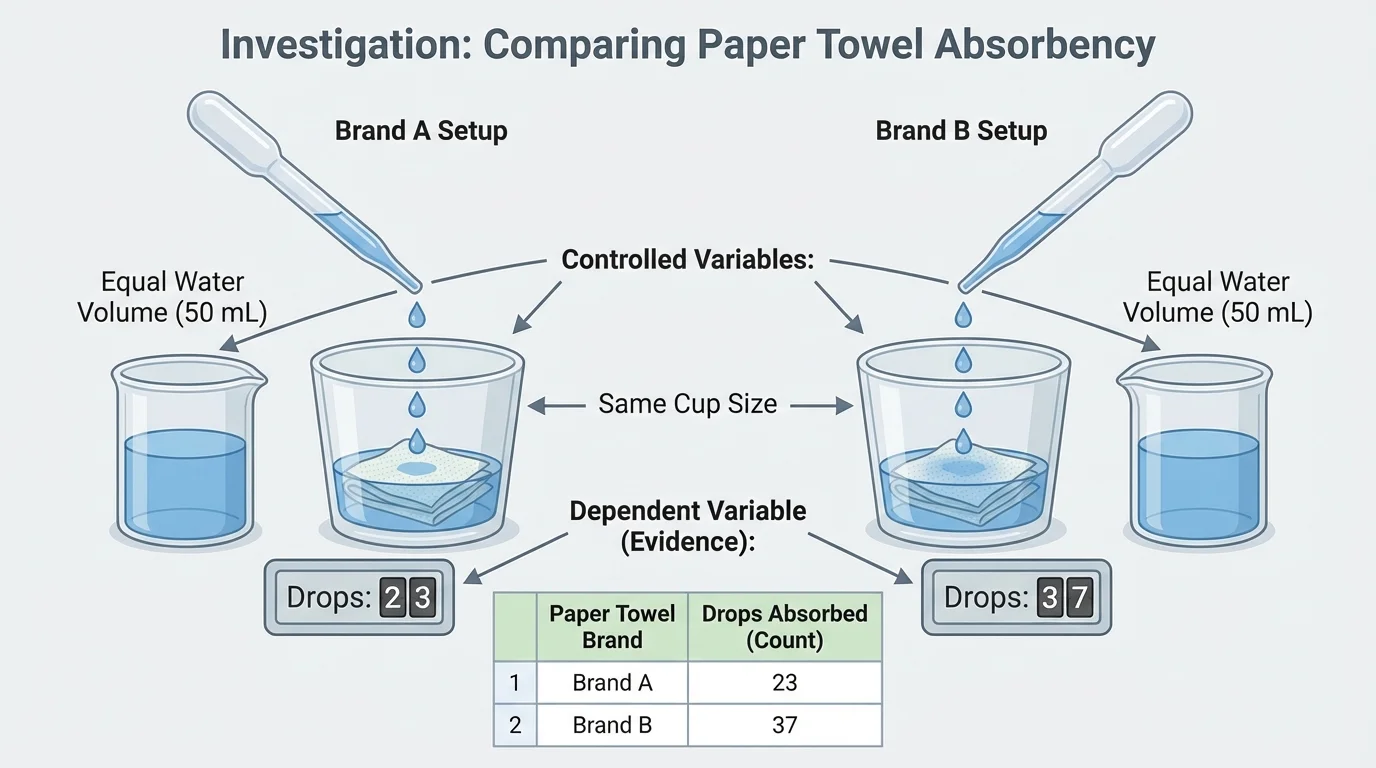
Suppose you want to test which brand of paper towel absorbs the most water. This is a great investigation because it asks a clear question and can be tested fairly. Each towel sample should be the same size, each cup should start with the same amount of water, and each towel should be tested in the same way.
As [Figure 2] illustrates, the independent variable is the brand of paper towel. The dependent variable could be how much water each towel absorbs. The controlled variables should include the size of each paper towel piece, the amount of water available, the time the towel stays in the water, and the container used.
You might test each brand three times. If one towel absorbs about the same amount each time and more than the others, that pattern is stronger evidence than a single test would be.
Planning the paper towel investigation
Step 1: Ask the question
Which paper towel brand absorbs the most water?
Step 2: Make a prediction
You may predict that the thickest paper towel will absorb the most water.
Step 3: Identify the variables
Change the independent variable by using different brands, measure the dependent variable by recording the amount of water absorbed, and keep towel size, water amount, and testing time the same.
Step 4: Repeat trials and record data
Test each brand several times and write each result in a table.
Step 5: Use evidence for a conclusion
If Brand B absorbs the most water in most trials, the evidence supports the conclusion that Brand B is the most absorbent in this test.
This kind of evidence can support an explanation, such as "thicker towels in this set absorbed more water," or a design solution, such as "we should choose Brand B for cleaning up spills."
Much later, if you compare another absorbency test, [Figure 2] still reminds you what a fair setup looks like: equal amounts, equal sizes, and the same method each time.
Engineers who design cleaning products test materials again and again. They need evidence before choosing the best material for a sponge, towel, or absorbent pad.
Even simple classroom investigations connect to real jobs. Product testers, engineers, and scientists all depend on careful planning and controlled variables.
Now think like an engineer. You want to design a ramp so a toy car rolls as far as possible. A test can help you improve the design. You might ask, "How does ramp height affect how far the car rolls?"
If ramp height is the independent variable, then the distance rolled is the dependent variable. Controlled variables could include the same car, the same ramp, the same starting point, and the same floor. If you change both the ramp height and the car, you will not know which change caused the result.
After several trials, you may notice that the car rolls farther from a higher ramp. That evidence can support an explanation about motion, or it can help you design a better ramp for a game or a model road.
Engineers often test many versions of a design. They do not stop after one try. They gather evidence, improve the design, test again, and keep making it better.
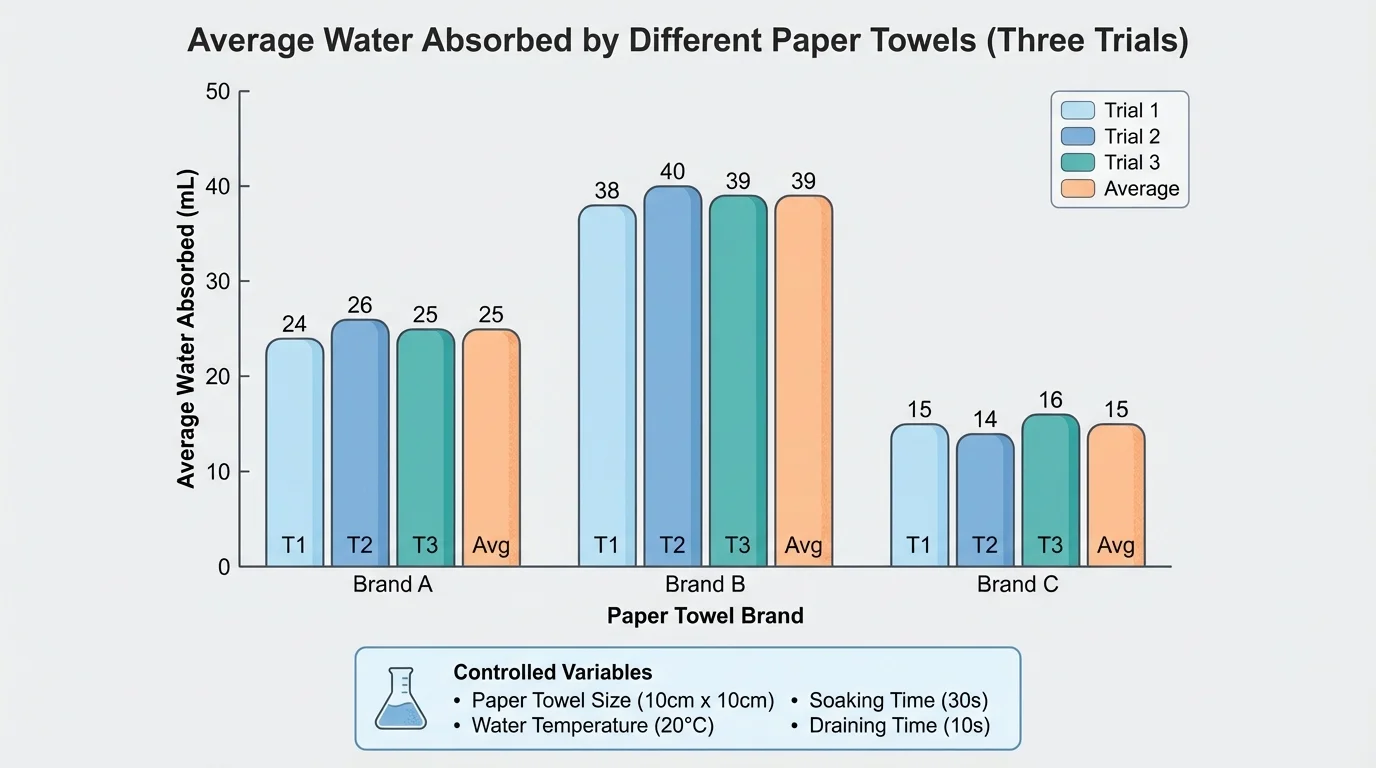
Data are the recorded results of an investigation. Scientists look for patterns in the data, and a chart can make those patterns easier to see. A table may list each trial, while a bar chart can help you compare groups quickly.
If one paper towel absorbed water amounts of \(20\), \(22\), and \(21\) milliliters in three trials, those results are close together. That suggests the tests were fairly consistent. The average is \((20 + 22 + 21) \div 3 = 21\) milliliters. If another towel averaged \(15\) milliliters, the first towel appears to absorb more water, as shown in [Figure 3].
Scientists do not just look for the biggest or smallest number. They think about whether the results repeat and whether the test was fair. That is why several trials matter.
Sometimes a result does not fit the pattern. Maybe one towel tore, or one cup had a little extra water. Scientists notice those unusual results and think carefully about what may have happened.
When you explain your conclusion, use evidence words such as because, based on the data, and in most trials. These words show that your idea comes from evidence, not just a guess. Later, when you compare bars or totals, [Figure 3] helps you see why organized data are easier to understand than a pile of scattered notes.
Using data to make a conclusion
A student tests three paper towel brands and finds these averages: Brand A \(= 14\) milliliters, Brand B \(= 21\) milliliters, and Brand C \(= 18\) milliliters.
Step 1: Compare the averages
Brand B has the greatest average, \(21\) milliliters.
Step 2: Connect to the question
The question asks which brand absorbs the most water.
Step 3: Write an evidence-based conclusion
The evidence supports the conclusion that Brand B absorbed the most water in this investigation.
Evidence does not need to be fancy. It just needs to be careful, organized, and connected to the question.
Sometimes an investigation does not work well, and that can still teach us something. One common mistake is changing too many things at once. Another is not measuring carefully. If you use different-sized cups or start your timer late, the results may not be reliable.
A different mistake is forgetting to record data right away. Memory is not always accurate. Scientists write things down as they go. They also label their tables clearly so they know what each number means.
Another problem happens when the question is too unclear. "What is the best toy car?" is hard to test. "Which toy car rolls farthest on the same ramp?" is much better because it is specific and measurable.
"Good science is careful science."
Sometimes students feel disappointed if their prediction is wrong. But in science, being wrong is not a failure. If the test was fair, the evidence still teaches something important.
Investigations happen all around us. Doctors test medicines carefully so they can see whether a treatment really helps. Sports designers test shoe materials to learn which ones grip the ground best. Farmers compare plant growth in different conditions. Builders test materials to find strong and safe choices.
At school and at home, you also use investigation skills. You may compare which kind of soil drains water fastest, which lunch container keeps ice from melting the longest, or which bridge design made from paper holds the most weight. In each case, controlling variables helps make the answer more trustworthy.
Scientists explain the world with evidence. Engineers use evidence to improve solutions. Both need good questions, careful planning, fair tests, repeated trials, and clear conclusions.
