A football team loses yards on one play, gains yards back on the next, and suddenly the total change matters more than any one number. A bank account can rise above zero or drop below zero. A winter temperature can be warmer than yesterday even if both temperatures are below zero. These situations all use numbers that can be positive, negative, fractional, or decimal, and learning how to operate with them lets you solve real problems clearly and correctly.
When you work with positive and negative numbers, the answer is not just about calculation. It also tells a story: whether something increases or decreases, rises or falls, gains or loses. Rational numbers help describe those changes precisely, and the four operations help you combine them.
A rational number is any number that can be written as a fraction of two integers, where the denominator is not zero. That means numbers such as \(\dfrac{3}{4}\), \(-2\), \(0.5\), and \(-1.2\) are all rational numbers. Integers are rational because, for example, \(5 = \dfrac{5}{1}\). Terminating decimals and repeating decimals are also rational.
Rational numbers include positive numbers, negative numbers, zero, fractions, and decimals that can be written as a fraction of two integers.
Absolute value is a number's distance from zero on the number line. For example, \(|-4| = 4\) and \(|4| = 4\).
Rational numbers are useful because real life is full of parts, changes, and opposites. Profit and debt, above sea level and below sea level, and gains and losses in sports all involve rational numbers. To solve these problems well, you need to understand what each operation means.
Rational numbers can appear in several forms: integers such as \(-7\), fractions such as \(\dfrac{5}{8}\), and decimals such as \(-0.25\). Sometimes one form is easier to use than another. For example, \(\dfrac{1}{2}\) and \(0.5\) represent the same value, but depending on the problem, one form may make the arithmetic easier.
You should also know that zero is neither positive nor negative, but it is a rational number because \(0 = \dfrac{0}{1}\). Rational numbers can be compared and ordered on a number line, and this helps make sense of operations.
You already know how to add, subtract, multiply, and divide positive fractions and decimals. The new challenge is extending those ideas to include negative values and using them in realistic situations.
One important habit is to think about the meaning of a number before calculating. A negative number often means the opposite of a positive number in context: a loss instead of a gain, a temperature below zero instead of above zero, or a depth below sea level instead of a height above it.
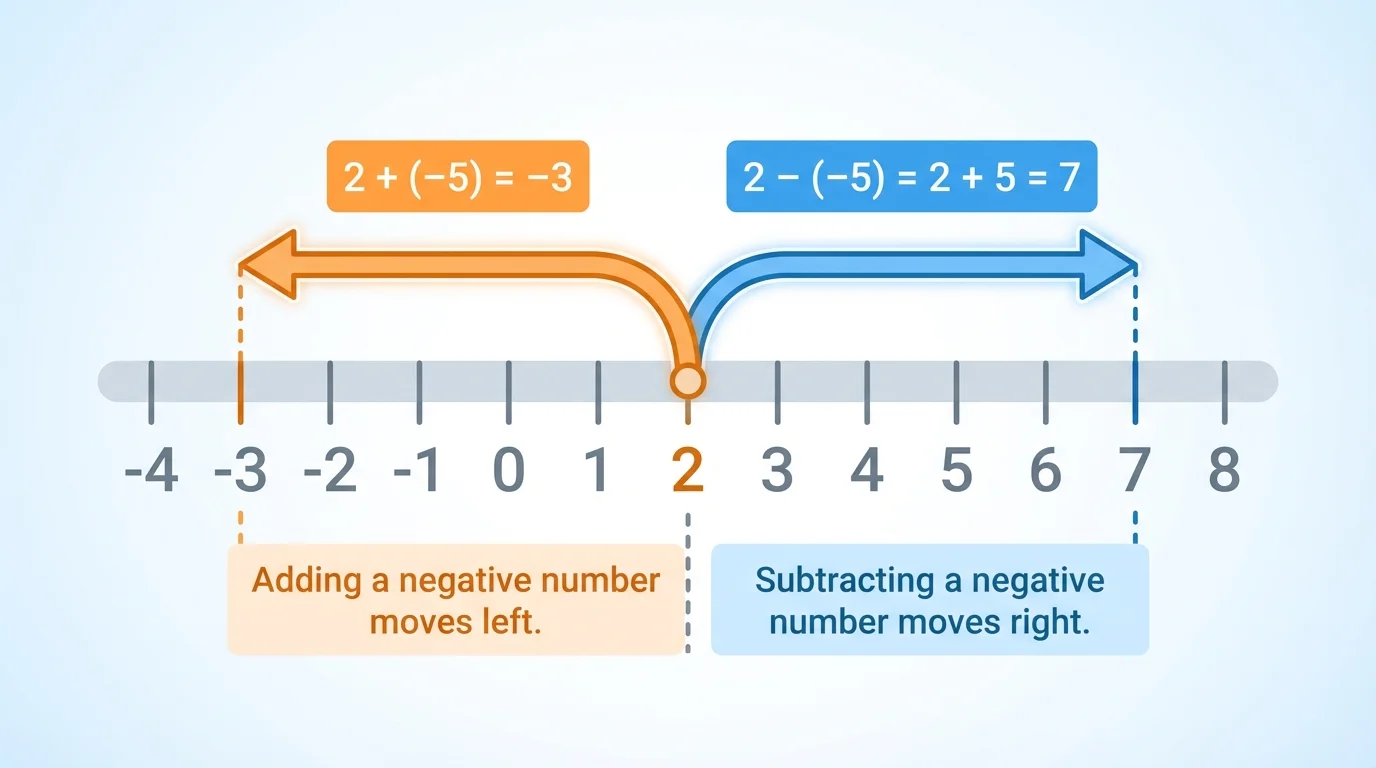
Addition and subtraction with rational numbers can be understood on a number line, as [Figure 1] shows. Adding a positive number moves right, and adding a negative number moves left. Subtracting a number means adding its opposite, which is why subtraction and addition are closely connected.
When two rational numbers have the same sign, add their absolute values and keep that sign. For example, \((-3) + (-4) = -7\). When they have different signs, subtract the smaller absolute value from the larger absolute value and keep the sign of the number with the larger absolute value. For example, \((-8) + 3 = -5\).
Subtraction can be rewritten as addition of the opposite:
\[a - b = a + (-b)\]
So \(5 - (-2)\) becomes \(5 + 2\), which equals \(7\). And \(-3 - 4\) becomes \(-3 + (-4)\), which equals \(-7\).
Solved example 1
Find \(-\dfrac{3}{5} + \dfrac{7}{10}\).
Step 1: Write both fractions with a common denominator.
\(-\dfrac{3}{5} = -\dfrac{6}{10}\)
Step 2: Add the numerators.
\(-\dfrac{6}{10} + \dfrac{7}{10} = \dfrac{1}{10}\)
Step 3: State the result.
\[ -\frac{3}{5} + \frac{7}{10} = \frac{1}{10} \]
The sum is positive because \(\dfrac{7}{10}\) has the larger absolute value.
This same idea works with decimals. For example, \(-2.4 + 5.1 = 2.7\). The positive number has the greater distance from zero, so the answer is positive. Thinking about distance from zero helps explain why the sign rule makes sense.
Later, when you solve complex problems, the number line idea from [Figure 1] still helps: adding a negative is a move left, and subtracting a negative is a move right.
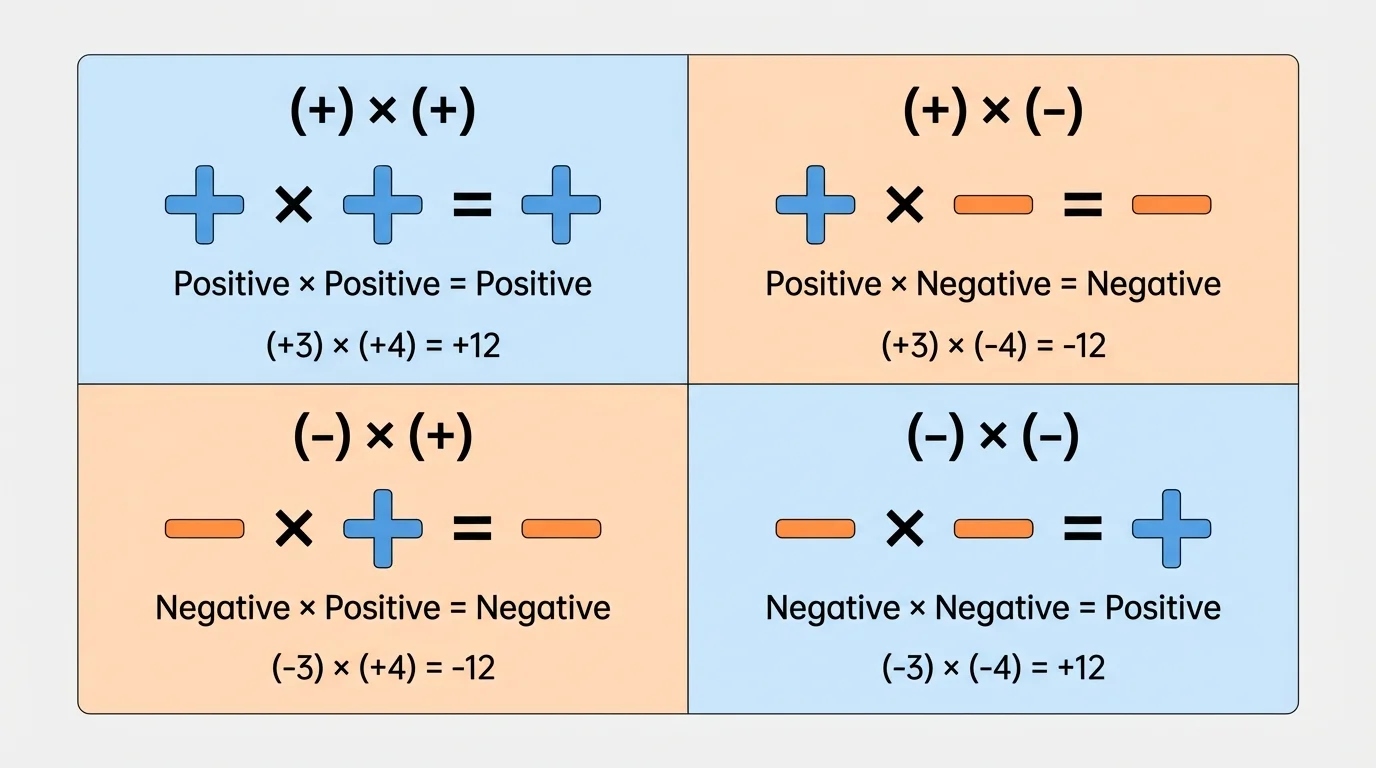
Multiplication with rational numbers follows a powerful sign pattern, and [Figure 2] displays that pattern clearly. First multiply the absolute values. Then decide the sign: same signs give a positive product, and different signs give a negative product.
These are the sign rules:
| Expression | Sign of Product | Example |
|---|---|---|
| \((+)\cdot(+)\) | Positive | \(3\cdot2 = 6\) |
| \((+)\cdot(-)\) | Negative | \(3\cdot(-2) = -6\) |
| \((- )\cdot(+)\) | Negative | \((-3)\cdot2 = -6\) |
| \((- )\cdot(-)\) | Positive | \((-3)\cdot(-2) = 6\) |
Table 1. Sign rules for multiplying rational numbers.
For fractions, multiply numerators and multiply denominators. Then simplify if possible. For decimals, multiply as usual and then apply the sign rule.
Why a negative times a negative is positive
One way to think about this is through patterns. If \(3\cdot(-2) = -6\), \(2\cdot(-2) = -4\), and \(1\cdot(-2) = -2\), then continuing the pattern gives \(0\cdot(-2) = 0\), and one more step gives \((-1)\cdot(-2) = 2\). The pattern increases by \(2\) each time, so the product must be positive.
Multiplication often represents repeated groups or scaling. When a number is negative, it can represent movement in the opposite direction or a change below zero. This is why sign matters so much in real-world interpretations.
Solved example 2
Find \(-\dfrac{4}{9} \cdot \dfrac{3}{5}\).
Step 1: Multiply the numerators.
\(-4 \cdot 3 = -12\)
Step 2: Multiply the denominators.
\(9 \cdot 5 = 45\)
Step 3: Simplify.
\(-\dfrac{12}{45} = -\dfrac{4}{15}\)
\[ -\frac{4}{9} \cdot \frac{3}{5} = -\frac{4}{15} \]
As shown by the sign pattern in [Figure 2], one negative factor and one positive factor produce a negative answer.
To divide by a nonzero rational number, multiply by its reciprocal. The reciprocal of \(\dfrac{a}{b}\) is \(\dfrac{b}{a}\), as long as \(a \ne 0\).
The division rule is:
\[\frac{a}{b} \div \frac{c}{d} = \frac{a}{b} \cdot \frac{d}{c}, \quad c \ne 0, d \ne 0\]
The same sign rules used in multiplication also apply after you rewrite division as multiplication. For example, \((-12) \div 3 = -4\), and \((-12) \div (-3) = 4\).
Solved example 3
Find \(-\dfrac{2}{3} \div \dfrac{5}{6}\).
Step 1: Rewrite division as multiplication by the reciprocal.
\(-\dfrac{2}{3} \div \dfrac{5}{6} = -\dfrac{2}{3} \cdot \dfrac{6}{5}\)
Step 2: Multiply.
\(-\dfrac{2\cdot6}{3\cdot5} = -\dfrac{12}{15}\)
Step 3: Simplify.
\(-\dfrac{12}{15} = -\dfrac{4}{5}\)
\[ -\frac{2}{3} \div \frac{5}{6} = -\frac{4}{5} \]
Division by zero is never defined. Because no number multiplied by \(0\) gives a nonzero dividend, expressions such as \(5 \div 0\) do not have a value.
Real problems often require more than one operation. When that happens, use the order of operations: parentheses first, then exponents if any, then multiplication and division from left to right, then addition and subtraction from left to right.
Consider the expression \(-3 + 4\left(-\dfrac{1}{2}\right)\). Multiply first: \(4\left(-\dfrac{1}{2}\right) = -2\). Then add: \(-3 + (-2) = -5\).
Solved example 4
Evaluate \(-2.5 + 3\left(1.2 - 2\right)\).
Step 1: Work inside the parentheses.
\(1.2 - 2 = -0.8\)
Step 2: Multiply.
\(3\cdot(-0.8) = -2.4\)
Step 3: Add.
\(-2.5 + (-2.4) = -4.9\)
\[ -2.5 + 3(1.2 - 2) = -4.9 \]
In multi-step work, be careful with signs. A misplaced negative sign can change the entire answer. Writing each step clearly helps prevent mistakes.
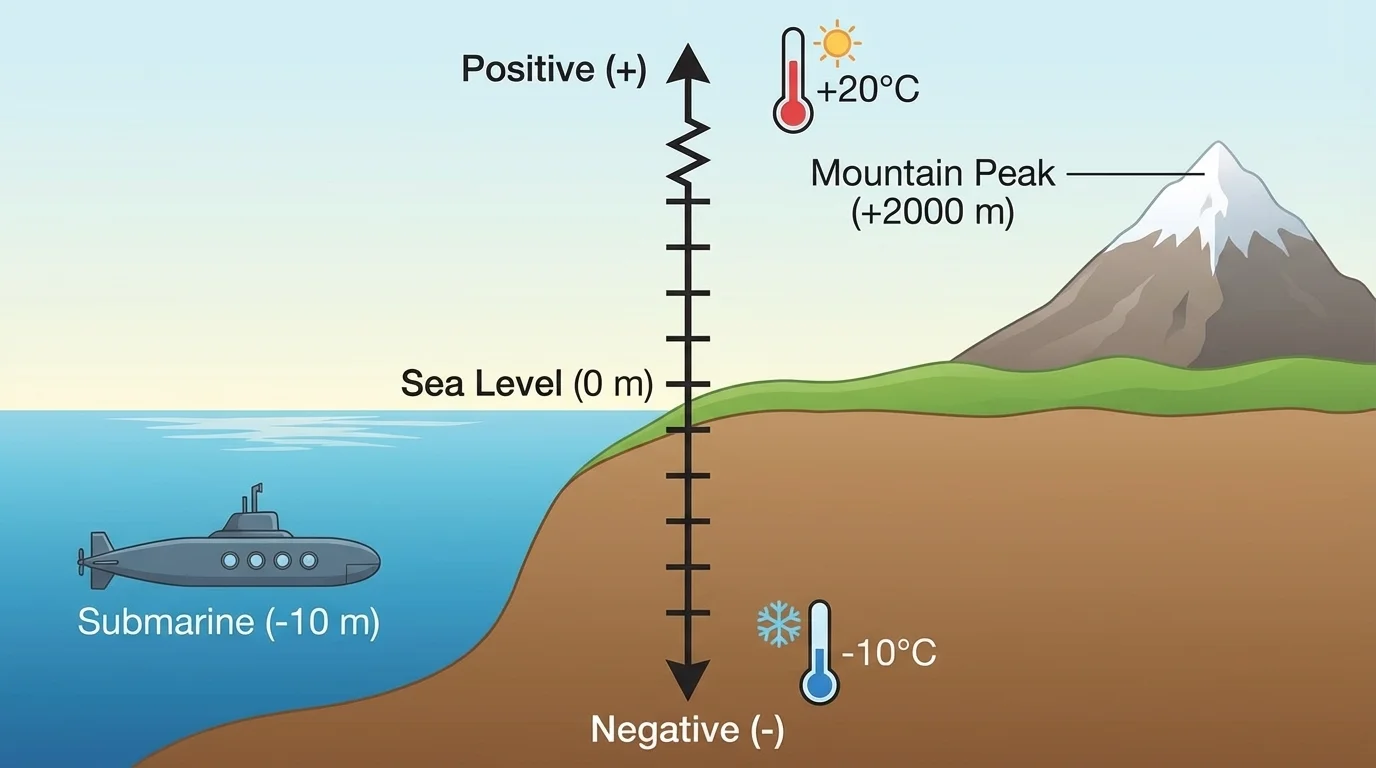
Rational numbers appear in temperature, elevation, finances, and rates, as [Figure 3] illustrates through values above and below zero. In these settings, the sign tells direction or type of change, while the number itself tells size.
If a scuba diver starts at sea level and descends \(18.5\) meters, the diver's elevation is \(-18.5\) meters. If the diver then rises \(7.25\) meters, the new elevation is \(-18.5 + 7.25 = -11.25\) meters.
Suppose the temperature in the morning is \(-6.5^\circ\textrm{C}\) and by afternoon it rises \(9.25^\circ\textrm{C}\). The afternoon temperature is \(-6.5 + 9.25 = 2.75^\circ\textrm{C}\). Even though the day started below zero, the increase pushes the temperature above zero.
Solved example 5
A student has \(\$15\) in a lunch account but spends \(\$18.50\). Then the student deposits \(\$7.25\). What is the final balance?
Step 1: Find the balance after the purchase.
\(15 - 18.50 = -3.50\)
Step 2: Add the deposit.
\(-3.50 + 7.25 = 3.75\)
The final balance is \(\$3.75\).
Sports also use rational-number thinking. If a quarterback loses \(8\) yards on one play and gains \(13.5\) yards on the next, the net change is \(-8 + 13.5 = 5.5\) yards. The team is ahead by \(5.5\) yards overall.
The vertical model in [Figure 3] helps connect these ideas: above zero and below zero are not just symbols, but positions relative to a reference point such as sea level, zero degrees, or zero dollars.
Air temperatures in some places on Earth can stay below \(0^\circ\textrm{C}\) for long periods, yet a small change such as \(3^\circ\textrm{C}\) or \(4^\circ\textrm{C}\) can still be very important. Rational-number operations help meteorologists describe those changes precisely.
Some real-world problems also involve multiplication or division. For example, if a stock changes by \(-1.5\) points each day for \(4\) days, the total change is \(4\cdot(-1.5) = -6\) points. If a debt of \(\$12\) is shared equally across \(3\) days, the daily change is \(-12 \div 3 = -4\) dollars per day.
Sometimes fractions are easier because they show exact values, especially in multiplication and division. For instance, \(\dfrac{2}{3} \div \dfrac{4}{9}\) is often simpler in fraction form than as decimals. Other times decimals fit the context better, such as money or measurements like \(2.75\) meters.
A smart problem solver chooses the form that keeps the work accurate and understandable. You can also convert between forms when helpful. For example, \(0.25 = \dfrac{1}{4}\), and \(1.75 = \dfrac{7}{4}\).
One common mistake is forgetting that subtracting a negative becomes addition. For example, \(4 - (-3)\) is not \(1\); it is \(7\). Another common mistake is applying sign rules from multiplication to addition. In addition, the sign depends on absolute values, not just whether the signs match.
Another helpful strategy is estimation. If you calculate \(-4.2 + 10.1\), you should expect a positive answer near \(6\). If your result is negative, something is wrong. If you compute \(-\dfrac{3}{4}\cdot8\), estimate first: three-fourths of \(8\) is about \(6\), and because one factor is negative, the answer should be about \(-6\).
"A correct answer should make sense before it is even written down."
Checking reasonableness does not replace exact work, but it does catch many errors. Ask yourself: should the answer be positive or negative? Should it be greater or less than the starting amount? Should it be large or small?
