An improper fraction has a top number larger than (or equal to) the bottom number.
Example:
 Where 3 is greater than 2
 Where 100 is greater than 5
A fraction such as  has two numbers - Numerator and Denominator. For example, in
  7 is the numerator and 4 is the denominator. This means:
Improper Fractions or Mixed Fractions
We can use either an improper fraction or a mixed fraction to show the same amount.
For example, 1 =
=  as shown here
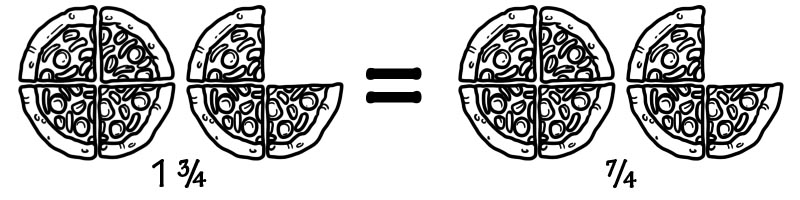
Converting improper fractions to mixed fractions
To convert an improper fraction to a mixed fraction, follow these steps:
Example: Convert  to a mixed fraction
 i.e. Quotient
Convert mixed fractions to improper fractions
To convert a mixed fraction to an improper fraction, follow these steps:
Example: Convert 3 to an improper fraction

Adding and subtracting improper fractions
The rules for adding and subtracting improper fractions are the same as working with proper fractions.
Adding and subtracting improper fractions with common denominators
Step 1 – Keep the denominator the same.
Step 2 – Add or subtract the numerators.
Step 3 – If the answer is an improper form, reduce the fraction into a mixed number.
For example,  +
+  =
= 
Thus, we have 2 
Adding and subtracting improper fractions with different denominators
Example: Subtract the fraction  -
- 
 , we get the LCM (24) as the new denominator:
  =
= 
 =
= 
 -
-  =
=  of a whole.