Have you ever tried to convince someone of something? Maybe you said, "We should play outside because the weather is sunny," or "We need a pencil because we are doing our work." When you say because, you are giving a reason. Authors do the same thing in informational texts. They make a point, and then they give reasons to help readers understand why that point makes sense.
An informational text teaches about a topic. It might teach about animals, weather, schools, healthy food, or how things work. In these texts, an author often wants readers to learn an important idea. That important idea may be a fact, a claim, or a statement the author wants readers to remember.
Authors do not just drop in an important idea and walk away. Good authors support their ideas. They add details, examples, and reasons. When readers notice how the parts fit together, the text becomes easier to understand.
Point is an important idea the author is making.
Reason is why the author's point makes sense.
Support means to hold up or help prove something.
When we read, we ask, "What is the author saying?" That helps us find the point. Then we ask, "Why does the author say that?" That helps us find the reasons.
A point is like the big message the author wants you to notice. As [Figure 1] shows, a point is the main idea the author is making in one part of the text, and the smaller parts around it are the reasons that hold it up. For example, if an author writes, "Recycling is important," that is a point.
A reason tells why the point is true or important. If the author says, "Recycling keeps some trash out of landfills," that is a reason. If the author adds, "Recycling can turn old things into new things," that is another reason. These reasons support the point that recycling is important.
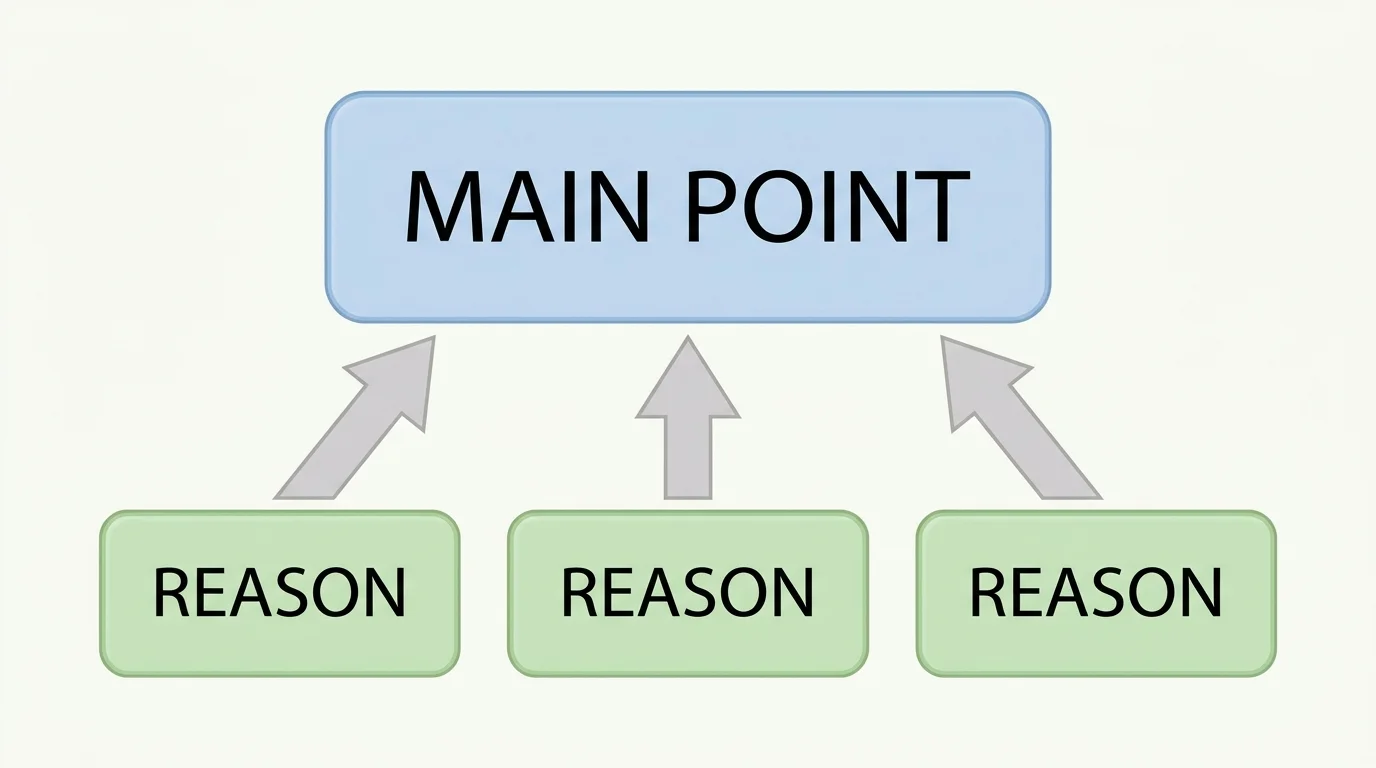
You can think of a point as a stool seat and the reasons as the legs. The seat needs the legs to stay up. In the same way, the point needs reasons to stand strong in the text.
Sometimes an author gives one reason. Sometimes the author gives several reasons. More than one reason can make a point clearer and stronger.
A reason supports a point when it matches the point and helps explain it. The reason must connect to the same idea. If the author says, "Drinking water is healthy," then a matching reason might be, "Water helps your body stay hydrated." That reason fits because it explains why water is healthy.
But not every sentence in a text is a reason. Some sentences may tell extra facts, describe something, or give examples. Readers need to think carefully: "Is this sentence helping prove the point?" If the answer is yes, it is probably a reason.
How the parts fit together
When readers understand support, they see the text like connected pieces. The point is the idea the author wants to make. The reasons are the pieces that explain, prove, or back up that idea. If the pieces fit, the text makes sense. If the pieces do not fit, the reason does not really support the point.
Here is a simple example. Point: "Trees are important." Reason 1: "Trees give shade on hot days." Reason 2: "Trees are homes for birds and insects." Both reasons support the point because both tell why trees matter.
Sometimes the point is easy to find. It may come at the beginning of a paragraph. It may be repeated more than once. It may sound like the author's big message.
Look for sentences that tell what the author most wants you to know. Ask yourself these questions:
Suppose a text says, "Bees help plants grow. Bees move pollen from flower to flower. Many fruits and vegetables can grow because of this." The point is that bees help plants grow. The other sentences give reasons and details that support that point.
Readers should be careful not to pick a tiny detail as the point. A detail is a small piece of information. A point is larger and more important.
Authors often leave clues that help readers find reasons. As [Figure 2] shows, clue words in a paragraph can point right to supporting ideas. Look for words and phrases like because, since, one reason, another reason, so, this helps, and for example.
These clue words do not appear every time, but they are helpful. If a sentence says, "We wear helmets because they protect our heads," the word because introduces the reason. The point is that we wear helmets. The reason is that they protect our heads.
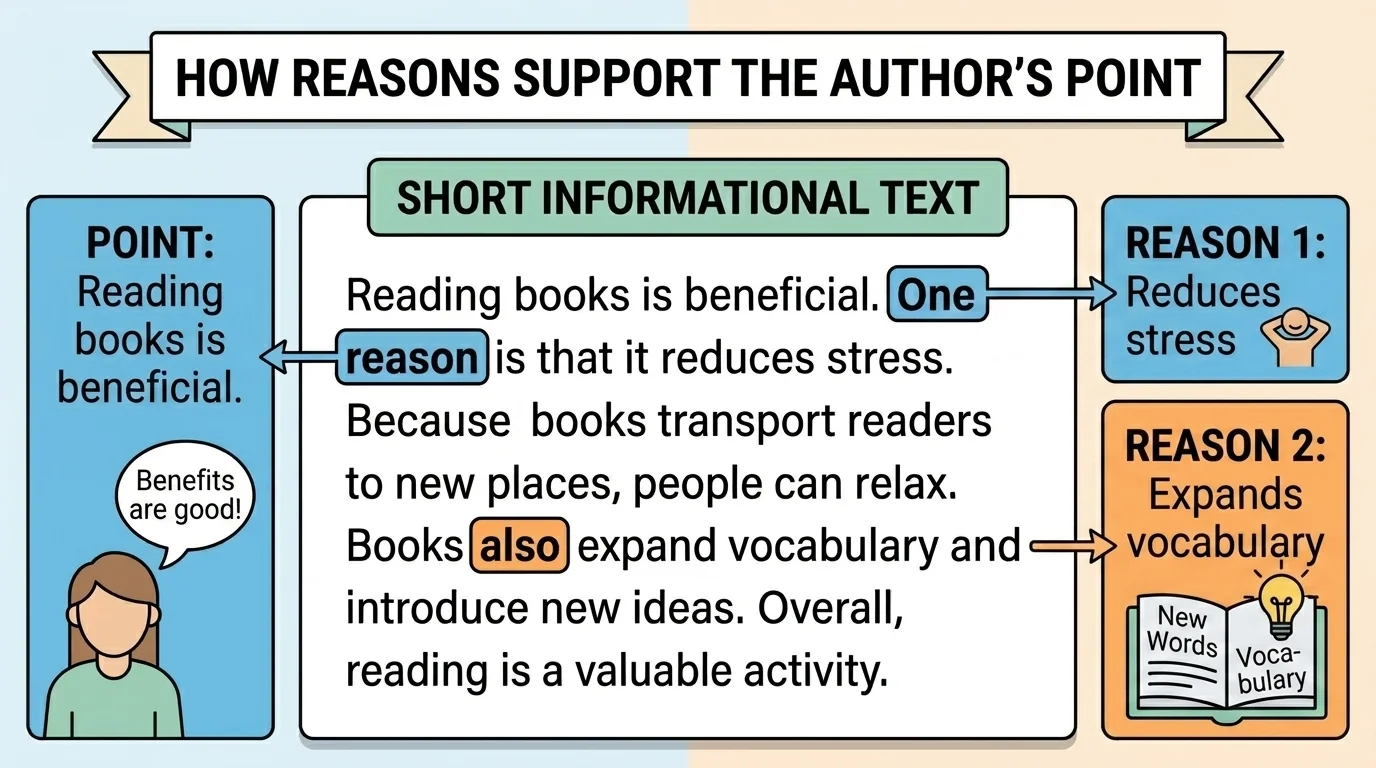
Sometimes the reasons come in a list. An author might write, "School gardens are useful. They help students learn about plants. They give students a chance to work together. They can grow vegetables." Each new sentence gives another reason.
Later, when you read a new text, remember the clue words in [Figure 2]. They help you spot places where the author is supporting a point.
Remember that a main topic tells what the whole text is about, such as frogs, weather, or farms. A point is more specific. It tells what the author says about that topic.
For example, a whole passage may be about frogs. One point in the passage could be, "Frogs need water to live." The reasons then explain why that point is true.
Not every reason is a good match. A reason that supports the point must stay close to it, and [Figure 3] compares reasons that fit well with reasons that do not. Readers should ask, "Does this reason really help explain the point?"
Look at this point: "Our playground should have more trees." A strong matching reason is, "Trees give shade when children play outside." That fits the point. A weak matching reason is, "My favorite color is green." That sentence mentions a color, but it does not explain why the playground should have more trees.
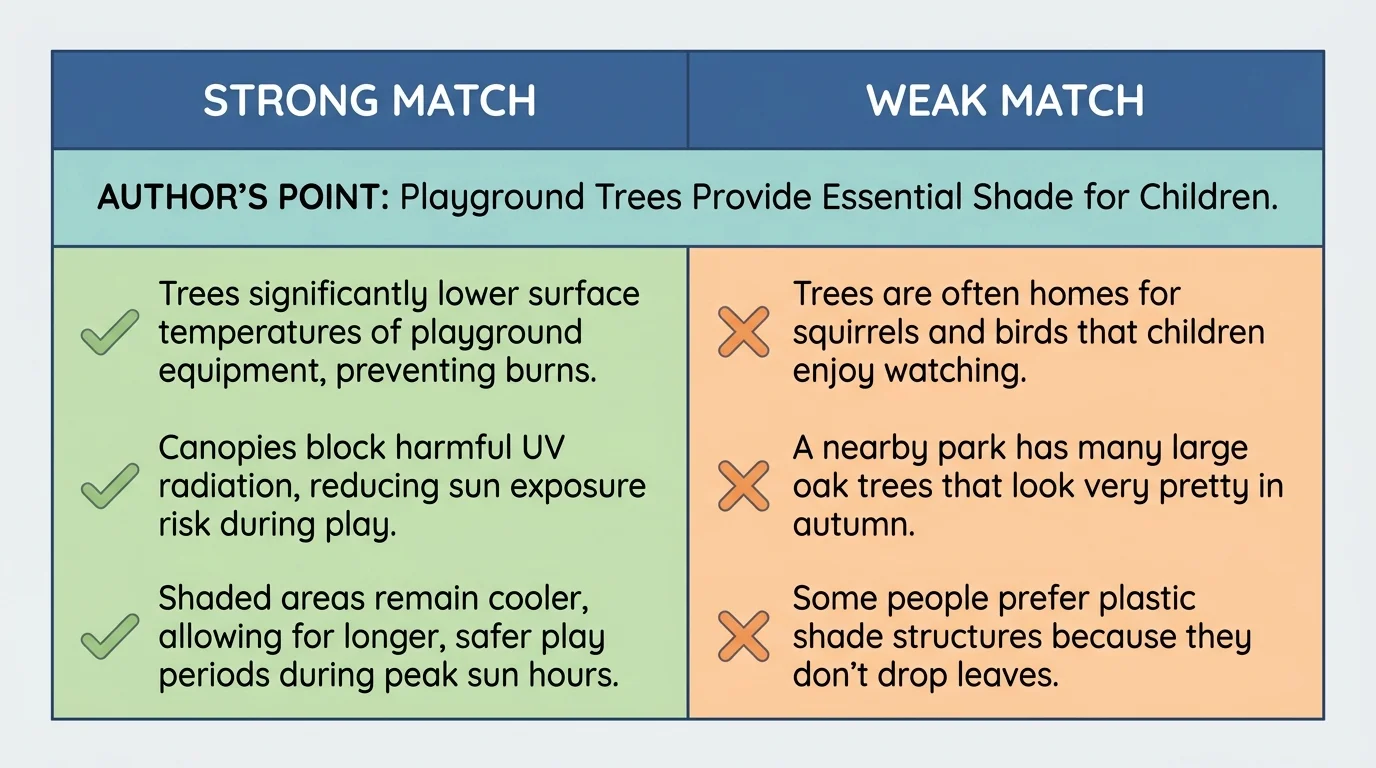
Here is another example. Point: "Reading every day helps children learn." Strong reason: "Daily reading helps children practice new words." Weak reason: "Books can come in many colors." The strong reason explains learning. The weak reason does not.
When a reason is strong, it stays on the same subject and helps the point make sense. When a reason is weak, it may be off-topic or only partly related.
Let's look at some short passages and find the points and reasons inside them.
Example 1
Passage: "Washing your hands is important. Clean hands can stop some germs from spreading. Washing with soap also helps keep people healthy."
Step 1: Find the point.
The point is "Washing your hands is important."
Step 2: Find the reasons.
Reason 1: "Clean hands can stop some germs from spreading." Reason 2: "Washing with soap also helps keep people healthy."
Step 3: Explain the support.
Both reasons tell why handwashing matters, so both support the point.
Notice that each reason answers the question, "Why is washing your hands important?" That is a great question to ask while reading.
Here is another passage. "Owls are good hunters at night. Their large eyes help them see in low light. Their hearing helps them find small animals in the dark." The point is that owls are good hunters at night. The reasons are about their eyes and hearing. These reasons match the point very well.
Example 2
Passage: "Libraries are helpful places. People can borrow books there. Libraries also offer quiet spaces for reading and learning."
Step 1: Find the point.
The point is "Libraries are helpful places."
Step 2: Find the reasons.
Reason 1: "People can borrow books there." Reason 2: "Libraries also offer quiet spaces for reading and learning."
Step 3: Explain the support.
Borrowing books and having quiet places are both reasons that show why libraries are helpful.
Now think about the match between point and reason, just like the comparison in [Figure 3]. If a sentence tells why the point matters, it supports the point. If it wanders away from the idea, it does not support the point well.
One more example: "Rainforests are important habitats. Many animals live there. Many plants grow there too." The point is that rainforests are important habitats. The reasons are that many animals and plants live there. These reasons support the point because they explain why rainforests are important places to live.
Some nonfiction books use headings, captions, and sidebars to add more reasons and details. Readers can use those text features to find support for the author's points too.
Even when a passage is short, it can still have a clear point and clear reasons. Strong readers listen for the big idea and then gather the details that hold it up.
When you explain your thinking, use clear words. You can say, "The author's point is ___." Then say, "One reason is ___." After that, explain, "This supports the point because ___."
Here are some helpful sentence frames:
Using these sentence frames helps you speak and write like a careful reader. You are not just naming a sentence from the text. You are explaining how the text works.
Good readers are a little like detectives. They look for clues, check connections, and make sure ideas fit together. When you read an informational text, stop and think: "What point is the author making?" Then ask, "What reasons support it?"
If a reason does not seem to fit, read again. Maybe the point is different from what you first thought. Maybe the sentence is only a detail. Maybe the author is giving an example instead of a reason. Careful readers reread and check.
The point-and-reason chart in [Figure 1] reminds us that texts are built from connected parts. The clue words in [Figure 2] help us notice those parts, and the comparison in [Figure 3] helps us judge whether the support is strong or weak.
When you understand how reasons support specific points, informational texts become clearer. You can tell what matters most, how the author builds the idea, and why the author chose certain details.
