Have you ever looked at two texts about the same animal and noticed that they do not look exactly alike?
One text may have more pictures, and another may have more words. Both books can teach you about the same topic. Good readers learn to look closely and notice what is the same and what is different.
When we compare two texts, we look at both of them and think carefully. We ask, "What do both texts tell me?" and "What is different in each text?" A text can be a page, a book, or another piece of reading that gives information.
Sometimes two texts are about the same topic, such as frogs, weather, or planting seeds. Even when the topic is the same, the texts may teach it in different ways. One text might have a large photo. Another might have a drawing. One may tell many facts. Another may tell only a few facts.
Similarity means something that is the same in both texts. Difference means something that is not the same. When readers compare, they look for both similarities and differences.
You do not have to find every tiny detail. Start with the big ideas. Ask yourself: Are both texts about the same thing? Do both show the same kind of picture? Do both tell the same facts? Do both give the same steps?
There are many parts of a text we can compare. Three important parts are illustrations, descriptions, and procedures.
Illustrations are the pictures. They may be drawings, paintings, or photos. Descriptions are the words that tell about the topic. Procedures are directions that explain how to do something step by step.
| Part of the text | What to look for |
|---|---|
| Illustrations | What the picture shows |
| Descriptions | Facts and details in the words |
| Procedures | Steps and order |
Table 1. Parts of two texts that readers can compare.
When you compare, you can use sentence starters like these: "Both texts show..." "This text tells..." "That text tells..." "One difference is..." "One similarity is..."
Pictures can help readers understand a topic, and two texts may use pictures in different ways, as [Figure 1] shows with pages about butterflies. One illustration may zoom in close. Another may show the animal in its home. Both pictures help, but they do not always teach the same details.
Look for what the picture includes. Does it show color? Size? Body parts? Where the animal lives? Does one picture have labels while the other does not? These are clues you can compare.
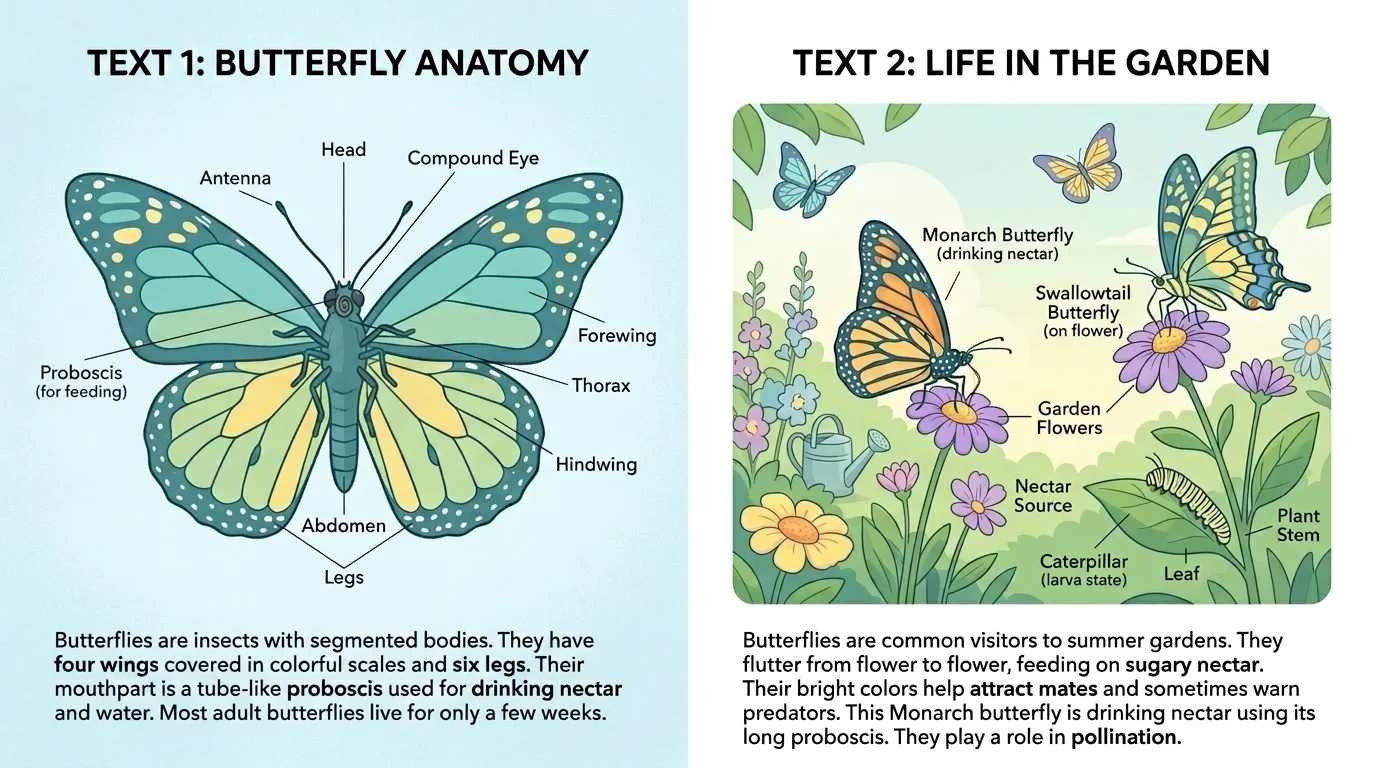
For example, two texts about birds may both show wings and beaks. That is a similarity. But one text may show a nest in a tree, while the other shows a bird standing in water. That is a difference.
Sometimes a picture gives information that the words do not say. Later, when you compare a full example, you can remember from [Figure 1] that illustrations can match in topic but differ in what details they show.
Some informational books teach a lot through pictures alone. A labeled drawing can help a reader learn parts of an animal or plant even before reading every word.
That is why good readers do not skip the pictures. They study them and ask what each one adds.
The words in a text tell facts and details. When you compare descriptions, listen for what both texts say and what only one text says. If two texts are about rain, both may say that rain is water from clouds. That is a similarity.
But one text may say rain helps flowers grow, while the other may say people use umbrellas in the rain. Those are differences. The topic stays the same, but the details change.
Big idea: Two descriptions can both be true, even when they are different. One text may give more details, use different words, or focus on a different part of the same topic.
Here is another example. Text A says, "Frogs live near water." Text B says, "Frogs can jump and swim." Both texts are about frogs. Both give true facts. The similarity is the topic: frogs. The difference is the detail each text chooses to tell.
Sometimes one text is shorter and another is longer. A longer text may have more details, but both texts may still teach the same main topic.
A [Figure 2] helps us notice that procedures may have the same goal but not the exact same steps. Two texts might both explain how to plant a seed. Both procedures may tell you to use a seed, soil, and water. That is a similarity.
But one procedure may say to plant the seed in a cup indoors, and another may say to plant the seed outside in a garden. One may tell you to water first, while another says to water last. These changes make differences in the procedure.
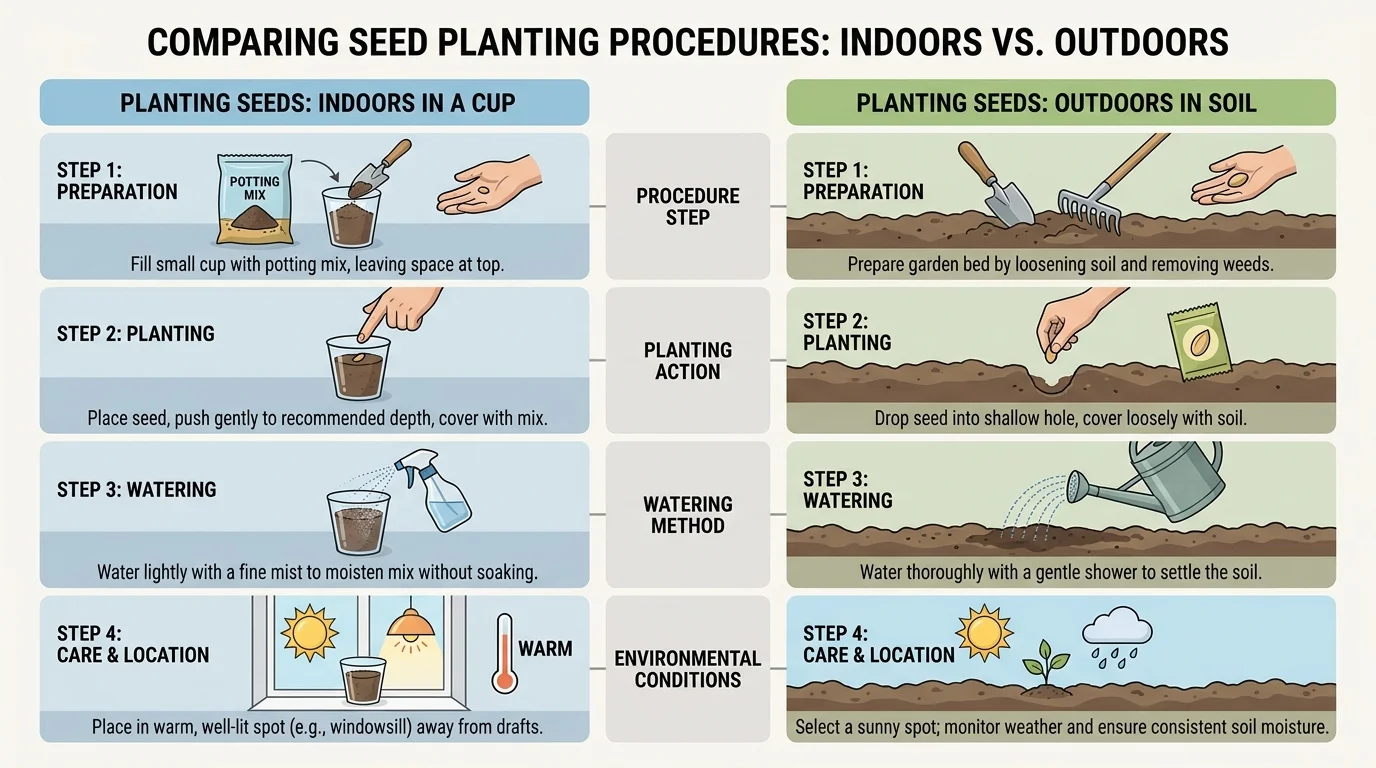
When you compare procedures, look carefully at the order. Ask: What happens first? What happens next? Are the steps the same number? Do both texts use the same tools?
This kind of thinking helps in real life too. A sandwich recipe at home and a sandwich recipe at school may both show how to make lunch, but the bread, fillings, or order may differ. Just like the seed steps in [Figure 2], procedures can be alike and different at the same time.
Good readers ask simple questions while they read. They may think, "Are these texts about the same topic?" "What is one thing that matches?" "What is one thing that is different?" These questions help you stay focused.
You can also compare by parts. First, look at the pictures. Next, read the facts. Then, check for steps or directions. Going one part at a time makes comparing easier.
When you read informational text, the words and pictures work together. Use both. The picture is not extra; it is part of the information.
It is helpful to use clear words when you answer. You might say, "Both texts are about bees." Then you can add, "One text shows a hive, but the other text shows a bee on a flower." That answer gives both a similarity and a difference.
Let's compare two short texts about seeds, and [Figure 3] organizes the important parts side by side. Text A says, "Put soil in a cup. Place the seed in the soil. Pour in water. Put the cup by a sunny window." Text B says, "Dig a small hole in the garden. Drop in the seed. Cover it with dirt. Water the seed."
These texts have the same topic: planting seeds. They also have a similarity in the procedure. In both texts, a seed goes into soil or dirt, and both texts tell the reader to water the seed.
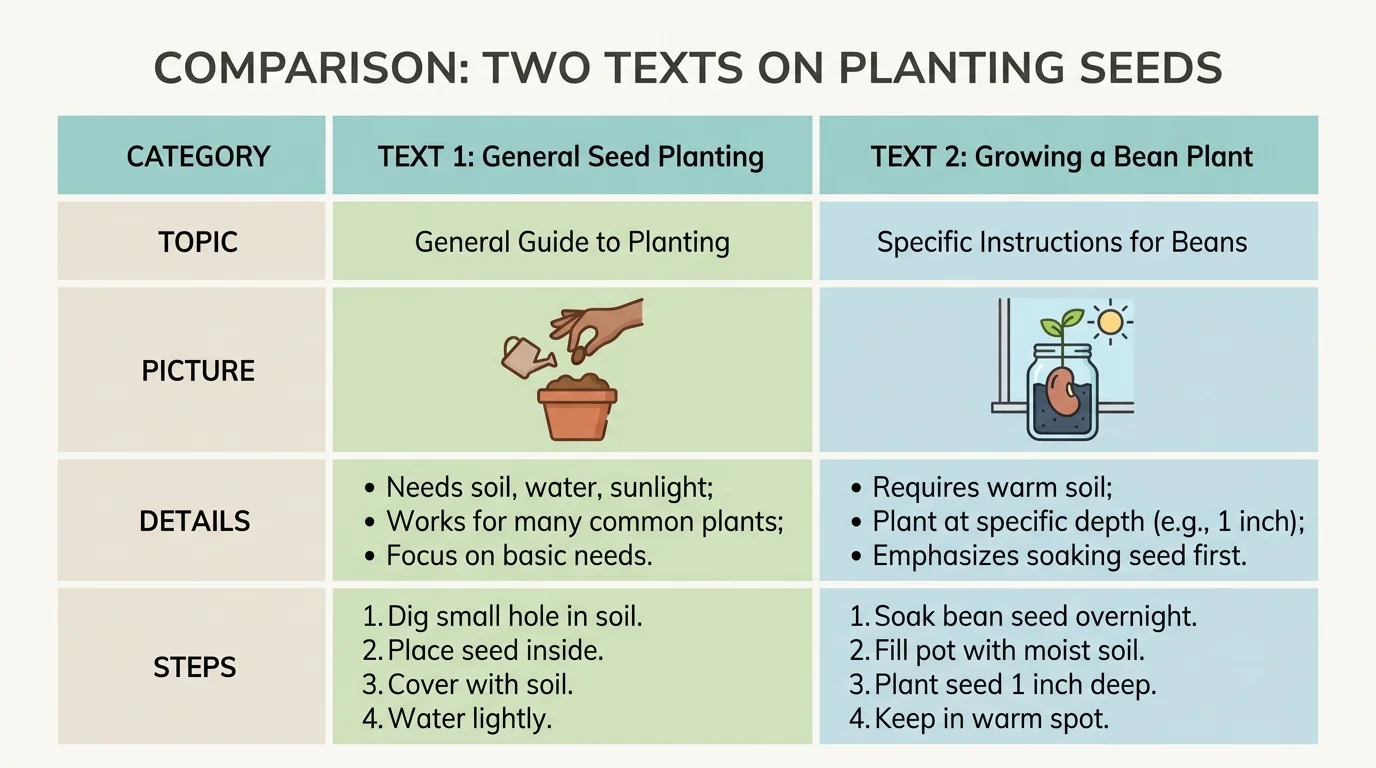
Comparing the two seed texts
Step 1: Find the topic.
Both texts are about planting a seed.
Step 2: Find a similarity.
Both texts use a seed, soil or dirt, and water.
Step 3: Find a difference.
Text A uses a cup indoors. Text B uses a garden outside.
Step 4: Check the steps.
Both have steps, but the place and some details are different.
A strong answer is: Both texts tell how to plant a seed, but one text tells how to plant indoors and the other tells how to plant outdoors.
Now think about pictures too. If Text A has a picture of a cup on a window ledge and Text B has a picture of a garden bed, the illustrations are also different. Yet both pictures still match the same topic. This follows the same comparison pattern shown in [Figure 3].
Sometimes one text is easier to follow because it has shorter steps or a clearer picture. That does not change the topic. It simply changes how the information is shared.
Comparing texts helps you become a stronger reader. You can learn more because you notice extra facts. One text may teach one detail, and another text may teach another detail. Together, they help you understand the topic better.
This skill also helps when reading science books, directions, and classroom articles. If you read two texts about weather, animals, or growing plants, you can tell what matches and what changes. That makes your thinking careful and clear.
When you compare, remember: same topic, then same parts, then different parts. Look at illustrations, descriptions, and procedures. Say what both texts share, and say what makes each one special.
