A forest is more than trees, and an ocean is more than water. Every meal, every breath, and much of modern medicine depend on a living network that most people barely notice until it starts to break down. When pollinators decline, crops suffer. When wetlands are drained, floods worsen. When coral reefs die, fisheries and coastlines become less secure. Biodiversity is not just a list of species; it is the living foundation that helps keep Earth habitable for humans and countless other organisms.
Biodiversity refers to the variety of life at different levels: genes, species, and ecosystems. It includes obvious organisms such as trees, birds, fish, and humans, but also fungi, bacteria, and microscopic plankton. This living variety matters because organisms interact constantly with one another and with their physical environment, creating systems that cycle matter, transfer energy, and support life.
Biodiversity is the variety of living things and the ecological systems they form. It includes genetic diversity within species, species diversity among organisms, and ecosystem diversity across habitats such as forests, grasslands, rivers, and reefs.
Humans depend on biodiversity in direct and indirect ways. Directly, living things provide food, wood, fibers, medicines, and raw materials. For example, many antibiotics and cancer drugs were first discovered in organisms such as fungi, bacteria, or plants. Indirectly, biodiversity supports ecosystem services, which are natural processes that benefit people. These include pollination, water purification, decomposition, soil formation, flood control, and climate regulation.
Think about agriculture. A single crop field may look productive, but its success often depends on a much wider web of life: pollinating insects, earthworms that help build soil structure, microbes that recycle nutrients, and predators that keep pests under control. If too many parts of that web are weakened, the system becomes less stable and more dependent on expensive human inputs such as pesticides or fertilizers.
Many major food crops depend at least partly on animal pollinators. Almonds, apples, blueberries, and many vegetables are tied to the health of bees and other pollinating insects.
Biodiversity also has value that is not purely economic. Mountains, forests, coasts, and grasslands provide places for recreation, tourism, spiritual practices, artistic inspiration, and scientific discovery. A healthy landscape can shape a community's identity just as much as it shapes its local climate or water supply.
Life's variety exists at several levels, as [Figure 1] shows, and each level contributes to the survival of populations and the functioning of ecosystems. Genetic diversity means variation in DNA within a species. Some individuals may be more resistant to disease, drought, or temperature change than others. Without enough genetic variation, a population can become vulnerable to a single environmental stress.
Species diversity refers to the number of species and their relative abundance in an area. Ecosystem diversity refers to the variety of habitats and ecological communities across a region. Together, these levels help determine how well ecosystems function. A more diverse ecosystem often has greater resilience, meaning it can resist damage or recover after disturbance.
Ecosystem functioning includes processes such as primary production, nutrient cycling, decomposition, and population regulation. If many species fill similar roles, one species may partly compensate when another declines. That does not mean species are interchangeable, but it does mean diversity can act like a safety net. In contrast, ecosystems with fewer species may be more easily disrupted.
Productivity is also linked to biodiversity. In a grassland, for example, some plants grow best in wet conditions, while others perform better during dry periods. Across changing seasons, this variety can stabilize total plant growth. The same principle matters in forests, wetlands, and marine environments. Later, this becomes important when we examine climate change and habitat disturbance.
Diversity and stability
A diverse ecosystem is not automatically invincible, but it often has more ways to keep functioning when conditions change. Different species use resources differently, respond differently to stress, and interact in ways that can reduce the chance of total system collapse.
The value of genetic diversity is especially clear in crops and livestock. Farmers often prefer certain traits, but relying on very few genetic lines can be risky. If a disease spreads that targets one common variety, the damage can be severe. Maintaining diverse seed stocks and wild relatives helps preserve options for future breeding and food security.
Organisms do not live in isolation. Each species occupies a particular niche, or role in its environment, and interacts with others through competition, predation, cooperation, and symbiosis. These interactions form food webs, and the coastal food web in [Figure 2] illustrates how energy and matter move through an ecosystem rather than along a single simple chain.
Some species have effects that are much larger than their abundance would suggest. A keystone species can strongly shape community structure. Sea otters are a classic example. They eat sea urchins, which graze on kelp. If otters disappear, urchin populations can explode, kelp forests can collapse, and many fish and invertebrate species lose habitat. This kind of chain reaction is called a trophic cascade.
These interactions help explain why biodiversity loss is not just about one species at a time. Removing one population may affect pollination, seed dispersal, soil microbes, predators, and prey. Ecosystems are networks, so damage often spreads through connections.
Decomposers such as fungi and bacteria are also essential. They break down dead material and waste, returning nutrients to the soil and water. Without decomposers, nutrients would remain locked in dead organic matter, and ecosystems would lose productivity. This is one reason biodiversity includes many organisms that people rarely notice but cannot live without.
The same systems that support other species also support humans. Fisheries depend on healthy marine food webs. Forest regeneration depends on pollinators, seed-dispersing animals, and soil organisms. Clean water depends on living communities in wetlands and streams. As we saw with the food web in [Figure 2], even a species that seems unimportant at first can have wide effects through an ecosystem.
Human influence on biodiversity is now global. The six major drivers of biodiversity loss, summarized in [Figure 3], are human population growth, overexploitation, habitat destruction, pollution, introduction of invasive species, and climate change. These factors often interact, so their effects can add up or reinforce one another.
Human population growth increases demand for food, water, land, energy, and materials. A larger human population does not automatically cause environmental damage, but when consumption rises and land use expands, pressure on ecosystems usually grows. More roads, farms, cities, dams, and mines fragment habitats and increase resource extraction.
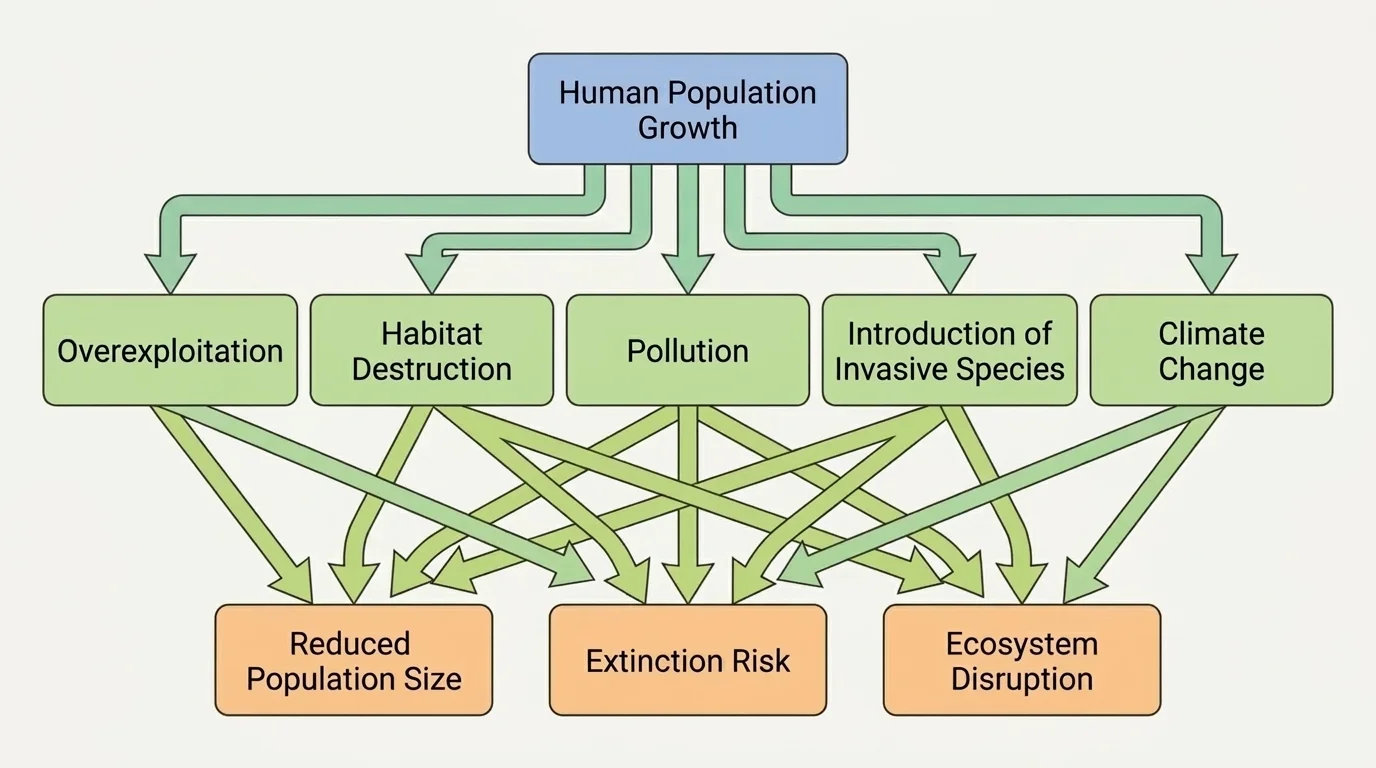
Overexploitation happens when organisms are removed from nature faster than populations can recover. Examples include overfishing, unsustainable logging, illegal wildlife trade, and excessive hunting. If a fish population produces fewer offspring than the number removed each year, the population declines. A simplified population idea is that if annual births are about 10% of a population but harvesting removes 25%, the trend is downward.
Habitat destruction is one of the most powerful causes of biodiversity loss. Forests are cleared for agriculture and development. Wetlands are drained. Rivers are dammed. Grasslands are converted to cropland or paved over. Even when habitat is not fully destroyed, fragmentation can isolate populations into smaller patches, reducing gene flow and making extinction more likely.
Pollution damages organisms and ecosystems in many forms. Nutrient runoff from fertilizers can cause algal blooms in lakes and coastal waters. When algae die and decompose, oxygen levels can drop, creating dead zones where many aquatic organisms cannot survive. Air pollutants and acid rain can harm forests and freshwater systems. Plastics can injure marine animals directly and also break into microplastics that spread through food webs.
Invasive species are organisms introduced to an area where they are not native and where they spread in ways that harm local ecosystems, economies, or health. They may outcompete native species, prey on them, bring new diseases, or alter habitats. Islands are especially vulnerable because native species there often evolved without certain predators or competitors.
Climate change shifts temperature, rainfall patterns, fire frequency, sea level, and ocean chemistry. Some species can move or adapt, but others cannot keep pace. Ocean warming contributes to coral bleaching, and rising atmospheric \(\textrm{CO}_2\) also dissolves into seawater, contributing to ocean acidification. These changes affect survival, reproduction, migration, and ecological timing.
Real-world application: nutrient pollution and oxygen loss
Excess fertilizer from farms can wash into rivers and coasts, adding nitrogen and phosphorus that stimulate rapid algal growth.
Step 1: Nutrients enter water.
Rain carries dissolved compounds into streams, lakes, or coastal zones.
Step 2: Algae bloom.
The extra nutrients act like fertilizer for aquatic algae and cyanobacteria.
Step 3: Decomposition uses oxygen.
When the algae die, decomposers break them down and consume dissolved oxygen.
Step 4: Aquatic animals suffer.
If oxygen drops below the level needed by fish or shellfish, many species die or leave the area.
This chain shows how one human action can alter biodiversity through ecosystem processes, not just by directly killing organisms.
These six drivers are not separate boxes. Climate change can make habitats less suitable, which increases stress on already fragmented populations. Pollution can weaken organisms, making them easier for invasive species or disease to affect. Overexploitation can remove predators, causing food-web imbalances. Biodiversity loss is often the result of multiple pressures acting at once.
Some of the clearest examples of biodiversity loss come from ecosystems people know well or rely on directly. Coral reefs, shown in contrast in [Figure 4], are among the most biodiverse marine environments on Earth and support fisheries, tourism, and coastal protection.
Corals live in partnership with photosynthetic algae. When water becomes too warm, corals may expel these algae, leading to bleaching. Bleached corals are not always dead at first, but if stressful conditions continue, many die. Reef structure then begins to break down, and the number of fish and invertebrate species often declines as shelter and food resources disappear.
Pollinators provide another important case. Bees, butterflies, moths, bats, and birds help reproduce many wild plants and crops. Habitat loss, pesticide exposure, disease, and climate shifts have reduced some pollinator populations. The effects are ecological and economic: fewer pollinators can mean lower seed production in wild plants and lower yields in some farms.
Freshwater systems also show how human actions ripple through biodiversity. Dams can block fish migration. Pollution can eliminate sensitive insect larvae that fish depend on. Invasive mussels can alter water clarity and nutrient cycles. Because rivers connect landscapes, local damage can spread downstream.
On islands, invasive predators have caused dramatic losses. Rats, cats, and snakes introduced by humans have wiped out many native birds, reptiles, and small mammals. Native species on islands often evolved without strong defenses against these newcomers. This is one reason invasive species policy is a major part of conservation planning.
The reef comparison in [Figure 4] also reminds us that biodiversity loss is often visible as a change in structure, not just species count. A degraded reef, forest, or wetland may still exist physically, but it may no longer perform the same ecological functions or support the same community of life.
Protecting biodiversity requires more than saving a few rare species. It means sustaining the conditions that allow ecosystems to function over time. Effective conservation works across landscapes, as [Figure 5] shows, connecting protected areas with wildlife corridors, restored habitats, sustainable farmland, and healthier urban spaces.
Protected areas such as national parks, marine reserves, and wildlife refuges can reduce habitat destruction and overexploitation. However, a protected area is most effective when it is large enough, well-managed, and connected to other habitats. Small isolated patches may not support wide-ranging animals or allow migration under climate change.
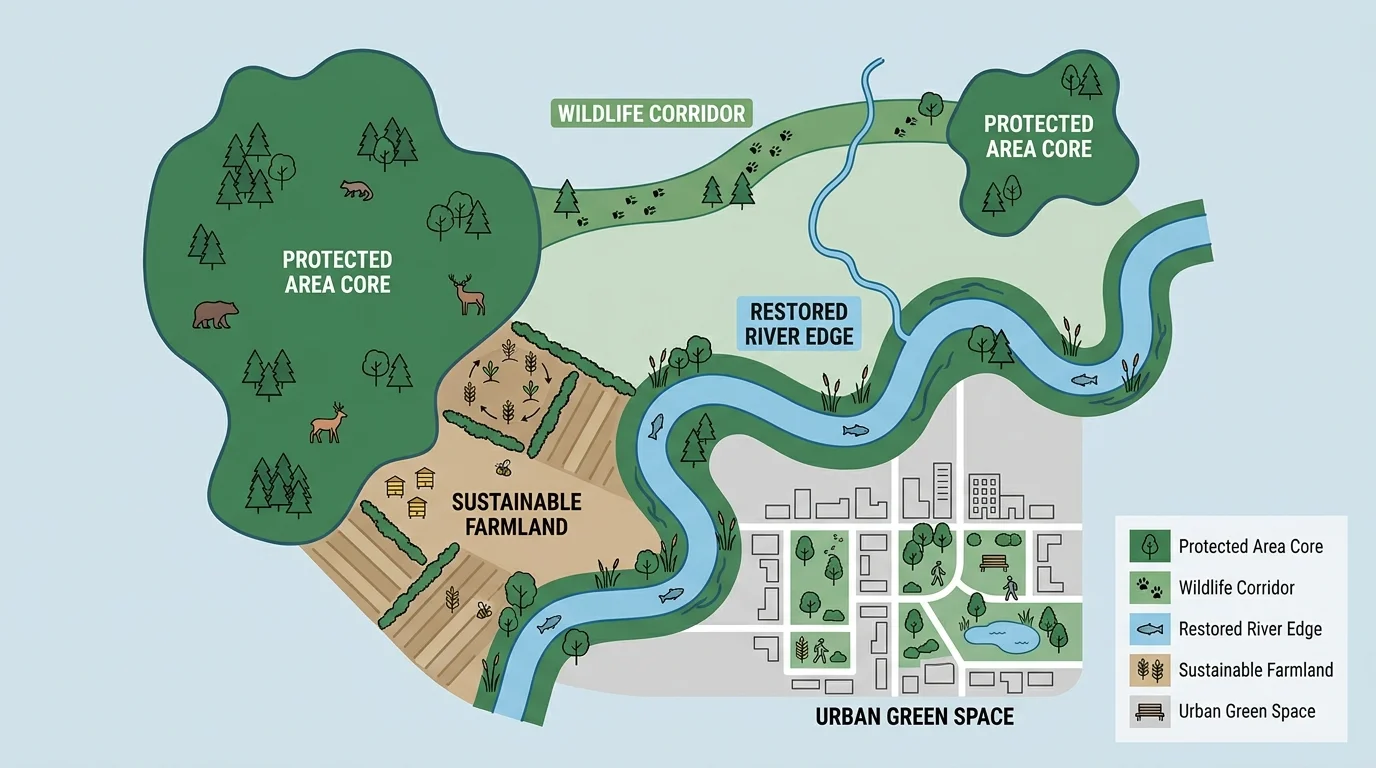
Habitat restoration rebuilds damaged ecosystems. This can include replanting native vegetation, restoring wetlands, removing obsolete dams, rebuilding oyster reefs, or reintroducing species that once shaped an ecosystem. Restoration does not always recreate the exact original state, but it can recover important ecological functions.
Sustainable harvesting aims to use living resources at rates that populations can replace. In fisheries, this may involve catch limits, seasonal closures, size restrictions, and protected nursery habitats. In forests, it may involve selective cutting, long regrowth periods, and protection of soil and water systems.
Pollution reduction can improve biodiversity quickly in some systems. Better wastewater treatment, careful fertilizer use, reduced plastic waste, and cleaner energy sources all lower stress on ecosystems. In many places, cleaner rivers and lakes have shown measurable biological recovery after regulations were strengthened.
Climate action is increasingly necessary for conservation. Reducing greenhouse gas emissions, protecting carbon-rich ecosystems such as forests and mangroves, and planning wildlife corridors for species movement are all part of sustaining biodiversity in a changing world.
Conservation is about systems, not just species
Saving one endangered organism matters, but long-term success usually depends on protecting habitat, ecological interactions, genetic variation, and environmental conditions. Biodiversity conservation works best when it preserves relationships as well as organisms.
Human communities are part of this process. Indigenous knowledge, local land management, scientific monitoring, and public policy can all contribute. In many regions, conservation succeeds best when local people benefit from healthy ecosystems through tourism, sustainable harvests, reduced flood risk, or secure water supplies.
Healthy ecosystems support economies, but they also support mental health, culture, and identity. People hike in forests, fish in rivers, dive on reefs, and find meaning in landscapes that hold family, historical, or spiritual importance. Biodiversity gives these places their character. A forest with birdsong, layered plant life, fungi, and streams is different from a degraded stand of a few stressed trees.
This cultural value is not separate from biology. Recreational and inspirational landscapes depend on functioning ecosystems. National parks, coastlines, alpine meadows, and wetlands attract visitors because living communities create beauty, motion, sound, seasonal change, and ecological richness. Artists, scientists, and communities alike draw inspiration from biological variety.
"In every walk with nature one receives far more than he seeks."
— John Muir
Medical and technological advances also rely on biodiversity. Natural compounds from plants, fungi, and microbes have led to medicines. Studying biological systems has inspired engineering designs, from adhesives to water-repellent surfaces. Losing species may mean losing solutions before humans even discover them.
Scientists track biodiversity in several ways. One simple measure is species richness, the number of species present in an area. Another is relative abundance, which looks at how evenly individuals are distributed among species. Two communities can have the same species richness but very different structures if one is dominated by a single species.
Suppose one meadow contains four plant species with counts of \(25\), \(25\), \(25\), and \(25\). Another meadow also has four species, but the counts are \(97\), \(1\), \(1\), and \(1\). Both meadows have species richness of \(4\), but the first has much greater evenness. In practical terms, that often means the first meadow has a more balanced community and may be less vulnerable if one species declines.
Numeric example: comparing relative abundance
Consider two ponds, each with \(100\) individual organisms distributed among four species.
Step 1: Pond A counts are \(40\), \(30\), \(20\), and \(10\).
No single species completely dominates, so biodiversity is relatively balanced.
Step 2: Pond B counts are \(88\), \(6\), \(4\), and \(2\).
One species dominates most of the community.
Step 3: Compare the meaning.
Both ponds have species richness \(= 4\), but Pond A has higher evenness. If a disease targets the dominant species in Pond B, a large part of the community is affected immediately.
This is why scientists often measure more than just the number of species when assessing ecosystem health.
Decision-making about biodiversity often involves trade-offs, but those trade-offs are real only if long-term ecosystem value is counted. Destroying a wetland may create short-term building space, yet increase flood costs, water treatment expenses, and species loss later. Conserving biodiversity is not about freezing nature in place; it is about maintaining the biological systems that make long-term life and productivity possible.
As we saw earlier in [Figure 1], biodiversity operates from genes to ecosystems. As shown by the food-web relationships in [Figure 2] and the human pressure pathways in [Figure 3], changes at one point in a system can spread widely. Sustaining biodiversity means protecting both the variety of life and the interactions that allow life on Earth to continue in productive, resilient forms.
